
Beginner tarot spreads
When you start with tarot, it is tempting to go straight to the Celtic Cross. That means reading ten cards and four axes at once, which is too much for a beginner. Tarot spreads for beginners use one to five cards. They give you enough structure to let the symbols speak without overwhelming you. Here are the spreads that help you get a feel for the cards fastest in your first weeks, from the daily one-card draw to the classic past-present-future. Each comes with a free, step-by-step interpretation.
Contents

Video · 30 seconds
Tarot for Beginners
Many beginners jump straight into huge, complex spreads. But the best way to start is much simpler: one card a day. This lets you get to know the images without feeling overwhelmed.
Read along
Want to read tarot cards? Don't start with a ten-card spread. When you start cooking, you don't begin with a huge, complex meal. Start with one card each day. Let the image speak to you. Once that feels easy, move to three cards. For past, present, and future. The cards are an invitation to check in with yourself. They aren't telling your fortune. Find simple spreads to get you started at theastroacademy.com.
Where to start as a beginner
Start with the daily card: one card in the morning and one question, "what theme is at the center today?". That way you practice reading card by card, and a big spread can't overwhelm you yet.
After two to three weeks you know about 20 cards well. Then the three-card spread (past-present-future) or the situation-action-outcome variant for concrete questions is next.
If you prefer a step-by-step structure, the 30-day tarot path fits. It takes five minutes a day, and by the end you can read all 78 cards for the main areas of life.
Getting started in four stages
Start small and only add cards once the small spreads feel easy:
- Week 1: one card a day. You get to know the images without keeping positions in your head.
- Week 2: the daily spread with three cards for thinking, feeling and doing, laid out as three positions in a simple row.
- Week 3: past, present, future or situation, action, outcome for a specific question.
- After that: bigger spreads with five or more cards. When a card won’t click, look it up in the card meanings.
| Spread | Cards | Positions | Question |
|---|---|---|---|
| Single Card | 1 | Your Answer | — |
| Daily Reading | 3 | Thinking · Feeling · Doing | How is my day going? |
| 3 Card Reading | 3 | — | |
| Past, Present, Future | 3 | Past · Present · Future | — |
| Situation, Action, Outcome | 3 | Situation · Action · Outcome | — |
You can look up every card you draw in the meanings of all 78 tarot cards, upright and reversed. For everyday use the card of the day is often enough; for a big life question there is the ten-card Celtic Cross. Every topic is in the overview of all tarot spreads, and if you want to read the cards yourself: understand tarot in 5 minutes a day.
How many outcomes does each beginner spread have?
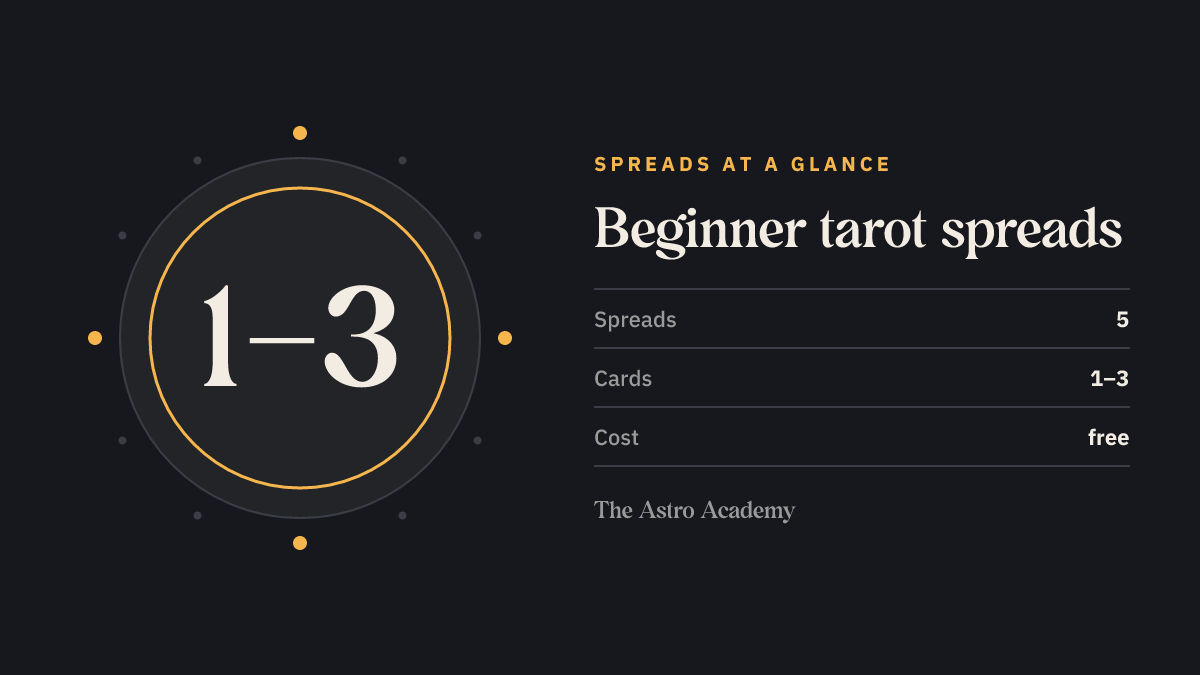
The 5 spreads on this page run from 1 card to 3 cards. "Single Card" has 78 possible outcomes from the full deck, "Daily Reading" already 456,456.
The jump comes from multiplying. Each extra position takes another card from the stack, and every earlier possibility now exists again with each of the cards left. That is why the number grows so fast although only a few cards are added.
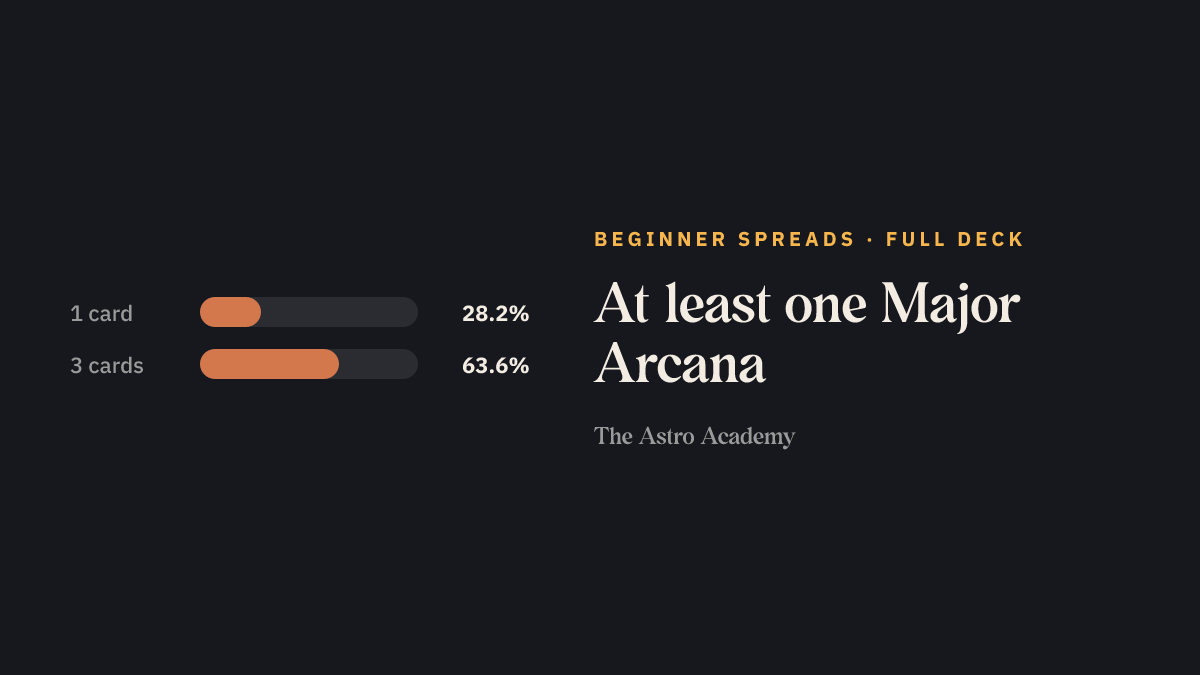
For a given card that means: in 1 card it shows up 1.3% of the time, in 3 cards 3.8%. At least one Major Arcana appears in 28.2% to 63.6% of readings when you draw from the full deck.
| Spread | Possibilities |
|---|---|
| Single Card (1 card) | 78 |
| Daily Reading (3 cards) | 456,456 |
| 3 Card Reading (3 cards) | 456,456 |
| Past, Present, Future (3 cards) | 456,456 |
| Situation, Action, Outcome (3 cards) | 456,456 |
Method: pure combinatorics over our 78-card deck (22 Major, 56 Minor Arcana), the way our reading table deals: without replacement, the 22 Majors by default, reversed cards only on request and then at 30% per card. No usage data.
Other tarot spreads
Common questions
- Which tarot spread is best for beginners?
- Start with the daily card: one card each morning, one question, like "what theme sits at the center of today?" You meet the cards one at a time, and no big spread buries you. After three weeks you'll know about 20 cards well, by day 30 the most important 30–40. Then the three-card or situation-action-outcome spread comes next.
- How many cards does a beginner tarot reading use?
- Between one and three. Lay out more and most beginners lose the thread, then start playing the cards off against each other. A daily card gives you a single card to practice with. The three-card spread adds a simple frame (past, present, future) that still fits in your head. The ten-card Celtic Cross can wait.
- How much does a beginner tarot reading cost?
- Here it costs nothing. Every beginner spread is free to play without signing up, and each card comes with a full interpretation. You don't need a deck of your own either: the browser shuffles and draws for you. If you want to go further after 30 days and work through all 78 cards step by step, the 30-day tarot path comes with your personal astrologer.
- How long does it take to learn tarot?
- Five minutes a day for four weeks is enough to read the most important 30–40 cards. Knowing all 78 in depth takes longer: each card upright and reversed, in love, work and every other area of life. That depth takes 3 to 6 months of regular practice. Our 30-day tarot path takes you through every card in order.
- Do I need my own tarot deck to learn?
- Not necessarily. Every spread here runs in the browser, which shuffles and draws the cards for you. If you'd like a physical deck on the kitchen table, Rider-Waite is the usual first pick. Its cards are full of pictures, it's easy to find, and every tarot book explains it. Marseille and Thoth decks are lovely to look at, but their more abstract images make the start harder.