
Daily spread
Focus on your question and draw all three cards.
3 cards to go.
Tarot online: free reading
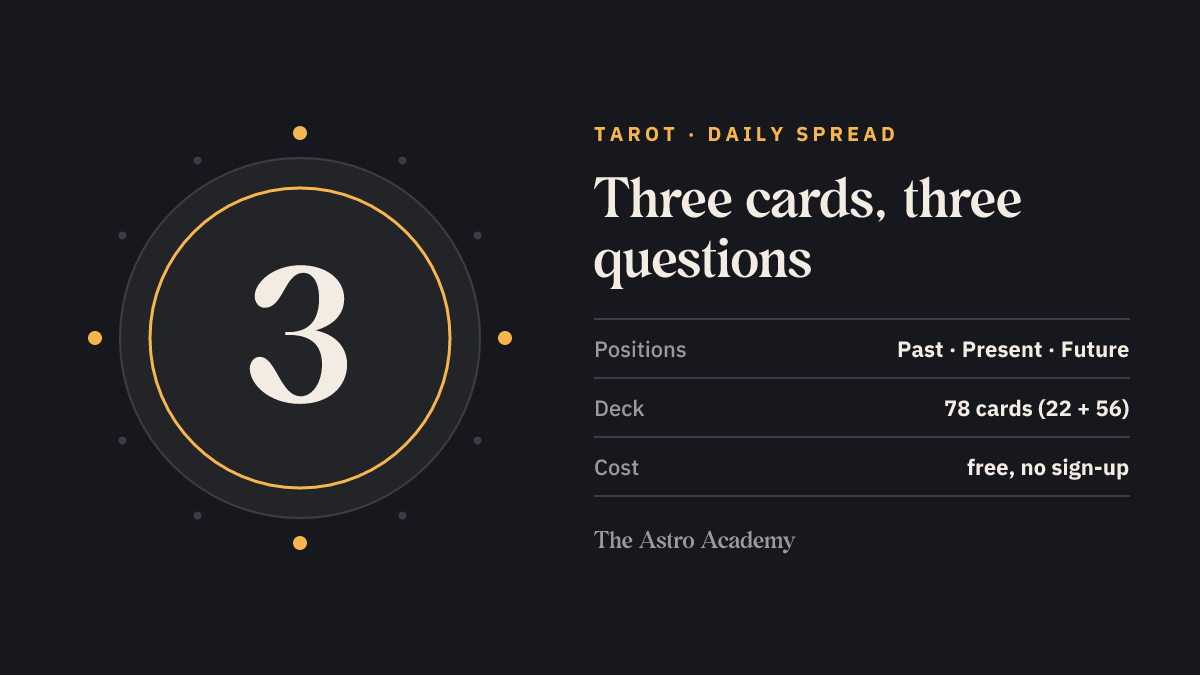
Three cards, three questions to yourself: what lies behind you, what is now, what is taking shape? Draw them above, read each meaning and check for yourself what fits. No sign-up.
How the daily spread works
The spread above is the classic three-card spread: Past, Present, Future. Three cards are enough to see a development and few enough to read in five minutes. You draw them yourself, from all 78 cards or from the 22 Major Arcana only.
- Think of a question that is actually on your mind — tomorrow morning’s conversation, the flat you want to view, the message you haven’t answered yet.
- Draw three cards. The first stands for “Past”, the second for “Present”, the third for “Future”.
- Read each meaning on its own and ask with every card: where do I recognise this, where not?
- Then read the three as one sentence from left to right. The third card is not a prediction but what is taking shape if things carry on as they are.
What the tarot deck is made of
A tarot deck has 78 cards in two groups. The 22 Major Arcana cards carry names and stand for the big themes. The 56 Minor Arcana cards are split into four suits of 14 cards each; every suit belongs to an element and tells of one area of life. If you draw several cards of the same suit, take a second look: three cups in one spread often mean the question is mostly about feelings, three swords more about thoughts going round in circles.
| Group | Cards | Element | Theme |
|---|---|---|---|
| Major Arcana | 22 | — | big life themes, from The Fool to The World |
| Minor Arcana: Wands | 14 | Fire | will, drive, beginnings — starts with the Ace of Wands |
| Minor Arcana: Cups | 14 | Water | feelings, closeness, relationships — starts with the Ace of Cups |
| Minor Arcana: Swords | 14 | Air | thoughts, words, conflict — starts with the Ace of Swords |
| Minor Arcana: Pentacles | 14 | Earth | body, money, everyday life — starts with the Ace of Pentacles |
What a spread can do — and what it can’t
A tarot spread doesn’t tell you what will happen. It gives you three images to check your situation against. If The Tower turns up, you are not headed for a collapse — more often the card asks: what is only still standing out of habit? Every meaning is in the overview of the 78 tarot cards.
For a quick question in the morning, the tarot card of the day is enough. When more is at stake, take the ten-card Celtic Cross or find the right one among the tarot spreads by topic. And if one day you want to read the cards without looking them up: understand tarot in 5 minutes a day.
Popular spreads
For a specific question there is a spread that fits.
Keep exploring
Frequently asked questions
Can I do a tarot reading online for free?
Yes. The spread above is free and needs no sign-up. You draw the cards yourself and get each card’s meaning in plain words.
How does the daily spread work?
Hold a question in mind and draw three cards: the first for what lies behind you, the second for now, the third for what is taking shape. Read them as a prompt to reflect, not as a prediction, and check for yourself what fits your situation.
Major Arcana or all 78 cards?
The 22 Major Arcana cards stand for the big themes and are a good place to start. With all 78 cards, the everyday scenes of the Minor Arcana join in and the reading gets more concrete.
What do reversed cards mean?
A reversed card often shows the same theme, only held back or turned inward. You can switch them on or off with the toggle above.