
Astrology aspects
calculator
Aspects are the angles between two points in your chart. They show which forces in you work together and which rub against each other. Enter your birth data to see every aspect in your chart, sorted by how exact it is.
Your birth data
Your aspects
The date sets the Sun, Moon and every planet.
Your birth date is enough. Add time and place to get the Ascendant and MC aspects too.
Contents
Three steps to your aspects
Enter your birth data
Birth date is enough for the aspects between planets. Add your time and place and the aspects to your Ascendant and MC come in too.
See all your aspects
We compute every major aspect in your chart to the arc-second and sort them by orb, tightest first.
Open an aspect
The most-searched aspects have a full write-up. One click and you can read what it may mean for you.


Video · 34 seconds
Planets as Housemates
Your birth chart is more than a list of planets. The aspects, meaning the angles between them, show how the forces within you interact. Calculate it for free: theastroacademy.com
Read along
Imagine your planets are housemates. Do they always get along? The angles between the planets in your chart are like the relationships in a shared flat. These angles are called aspects. They show which forces in you team up, or create friction. Some planets cook dinner together. Others argue about the washing up. This is an invitation to notice these inner conversations. See for yourself if that feels true. Find out which aspects are in your birth chart, for free at theastroacademy.com.
What is an aspect?
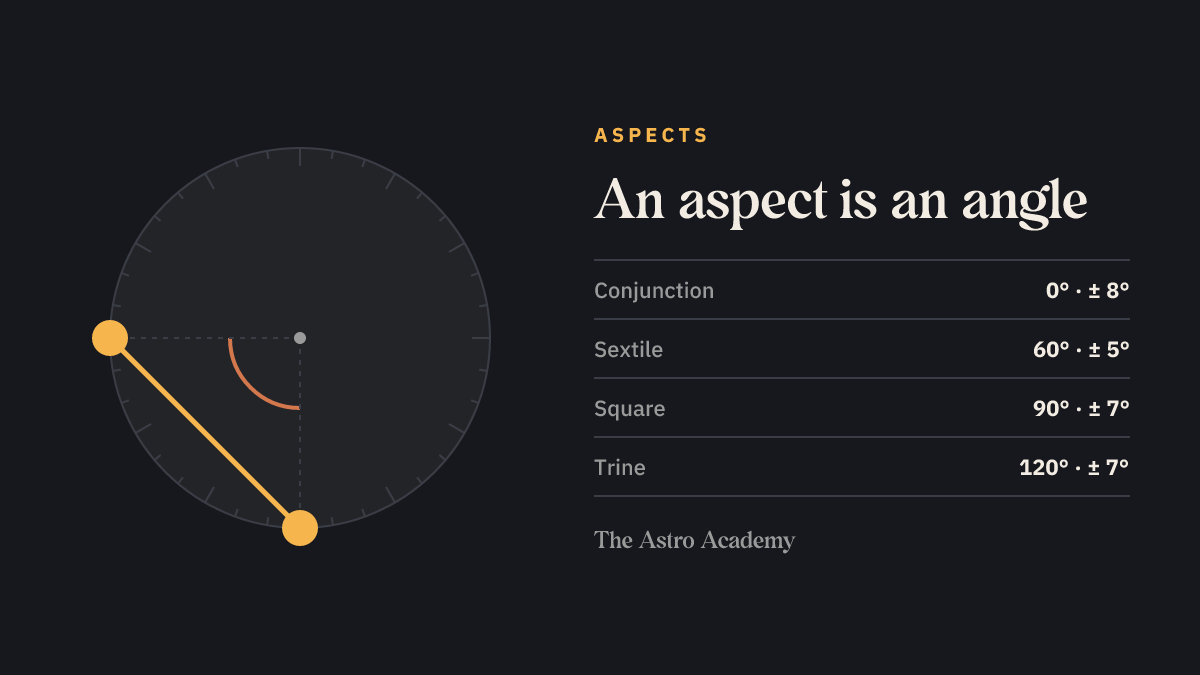
An aspect is the angle between two points in your chart, for example your Sun and your Moon. That angle shows how the two forces in you get along. Some pairs work together or amplify each other, others grind against one another. Without aspects your chart would be a list of separate planets. With them you can see which planets are in conversation.
The five major aspects
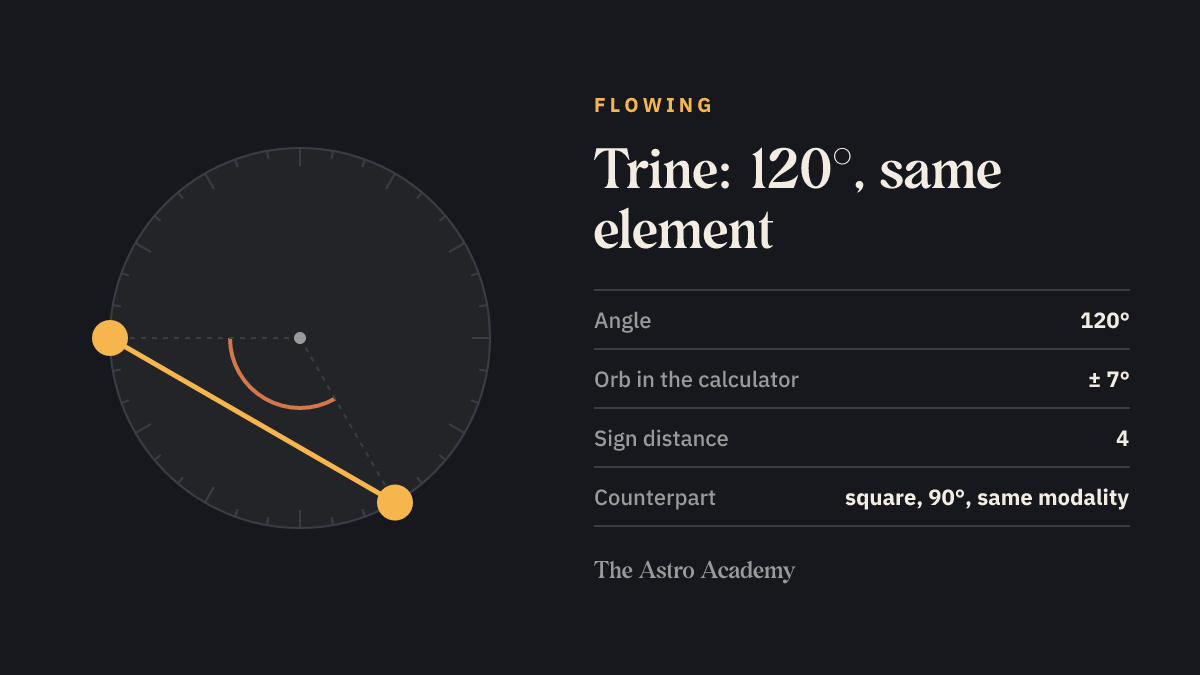
Conjunction (0°): two forces merge and amplify each other. Sextile (60°): an easy opening, a talent you can put to use. Square (90°): tension that chafes, and that friction is often what makes you grow. Trine (120°): energy flows without effort, like an inborn gift. Opposition (180°): a tug-of-war between two poles that asks for balance.
Harmonious, challenging, and the orb
Trines and sextiles are called "harmonious", squares and oppositions "challenging". That does not make the challenging ones bad. The tense aspects are often where you grow the most. How strongly an aspect works depends on the orb, the leeway around the exact angle. The tighter it is, the more clearly you feel the aspect.
Astrology aspects: angle, orb, effect
The calculator checks the five major aspects and allows some leeway around each exact angle, the orb. Conjunction and opposition get 8 degrees, trine and square 7, the sextile 5. If the distance between two points falls within that leeway, the aspect counts; under one degree we call it exact.
| Aspect | Angle | Orb in the calculator | Sign distance | Character |
|---|---|---|---|---|
| Conjunction | 0° | ± 8° | 0 | fusing, depending on the planets |
| Sextile | 60° | ± 5° | 2 | flowing, harmonious |
| Square | 90° | ± 7° | 3 | tense, demanding |
| Trine | 120° | ± 7° | 4 | flowing, harmonious |
| Opposition | 180° | ± 8° | 6 | tense, demanding |
Where to start
- Start with the aspects to your Sun, Moon and Ascendant, since those shape you most.
- Then the tightest: an aspect with a 1° orb is clearer than one with 6°.
- Read every interpretation as a question to yourself and test it on a situation from this week.
Examples to start with: Sun Conjunction Moon, Venus Square Mars, Moon Square Saturn. All five angles between Sun and Moon on one page: Sun–Moon aspects. Which life areas an aspect connects is shown by the house calculator; how today's planets form aspects to your chart, by your personalized daily horoscope.
Which aspect is most common in a birth chart?
Square: on average a birth chart has 7.8 of them, 24.5 % of all major aspects. The rarest is the opposition with 4.6 per chart. In total the calculator finds 31.9 aspects between 15 points on average; half of all charts have between 28 and 35.
That comes from the geometry of the circle. Trine, square and sextile exist twice, once on each side of a planet. The conjunction and opposition exist only once. Then there is the orb: trine and square may be up to 7° off, the sextile only 5°.
Hardly anyone lacks a tight link: 99.6 % of all charts have at least one aspect less than 1° from exact.

| Aspect | Average per chart |
|---|---|
| Conjunction | 5.27 (16.5 %) |
| Opposition | 4.62 (14.5 %) |
| Square | 7.8 (24.5 %) |
| Trine | 7.52 (23.6 %) |
| Sextile | 6.66 (20.9 %) |
| All major aspects | 31.9 |
| At least one aspect under 1° | 99.6 % |
Counted with the Swiss Ephemeris: 25,933 birth charts, one for every day from 1940 to 2010, each day at a different hour, born in Frankfurt am Main. 15 points as in the calculator (ten planets, lunar node, Chiron, Lilith, Ascendant, MC), the tightest aspect per pair.
Aspects: frequently asked questions
- What is an aspect in astrology?
- An aspect is a specific angle between two points in the chart (e.g. 0°, 90°, 120°). It shows how two forces in you interact: in harmony, with tension, or so closely that they merge.
- Do I need my birth time?
- For aspects between planets the birth date is often enough. Aspects to the Ascendant or MC depend on your time and place of birth and cannot be determined without an accurate time.
- What if I do not have an aspect?
- That is completely normal, since nobody has every aspect. The calculator still shows how close you are.
- How accurate is the calculation?
- To the arc-second. We use the Swiss Ephemeris library, the same standard professional astrology software runs on.
Browse every aspect
Grouped by planet, so you can find every aspect a point in your chart can form.
Sun aspects
Moon aspects
Mercury aspects
Venus aspects
Mars aspects
Jupiter aspects
Saturn aspects
Uranus aspects
Neptune aspects
Pluto aspects
Ascendant aspects
MC aspects
North Node aspects
South Node aspects
Lilith aspects
See your whole chart
Instead of going aspect by aspect, build your full birth chart for free, with every aspect, house and planet.
Build my birth chartFree, no sign-up.