
Rauhnacht spreads: your guide for the twelve nights
A Rauhnacht spread uses oracle or tarot cards to reflect on the coming year during the twelve nights between Christmas and Epiphany. Each night traditionally corresponds to a month, so your cards can offer a theme or a point of focus. You can lay out a full twelve-month spread at the beginning or draw one card each evening.
Calculator and rituals
For every day
For any question
The big spread

Video · 39 seconds
Rauhnächte made simple
During the Rauhnächte, each night corresponds to a month of the coming year. This is an invitation to reflect on the themes of 2027 with cards or your chart. Calculate it for free: theastroacademy.com
Read along
Imagine the next year has 12 chapters. And you get a little preview right now. The Rauhnächte are the twelve nights after Christmas. Each night corresponds to a month of 2027. It's like a box with 12 seed packets for your garden. You're just checking what could grow. You can draw one card each night for its month. Or lay out all twelve for the big picture. The cards simply act as a mirror for your thoughts. Check for yourself what feels right for you. See the theme your own chart suggests in the Rauhnächte calendar. Work it out for free at theastroacademy.com.
Contents
Finding the right spread for each evening
The best spread for you depends on how much time and quiet you have each evening. For a big overview, a twelve-month spread laid out on the first night gives you a map for the whole year.
If you prefer to focus on one day at a time, drawing a single card of the night is a simple and meaningful practice. The Rauhnächte, the twelve nights after Christmas, are a quiet time that favors reflection. You can use smaller spreads to explore a specific topic that feels important right now. For example, a letting-go spread can help you close a chapter, while a wish spread supports you in formulating your hopes for the new year.
There is no rule about which spread to use when. You might decide to do the large twelve-month spread on the first night and then draw a single card for each of the following eleven nights. Or you could choose a different small spread each evening based on what feels right.
| Spread | Purpose |
|---|---|
| Twelve-month spread | big overview, map for the whole year |
| Single card of the night | focus on one day, simple and meaningful practice |
| Smaller spreads | explore a specific topic |
| Letting-go spread | help you close a chapter |
| Wish spread | supports you in formulating your hopes |
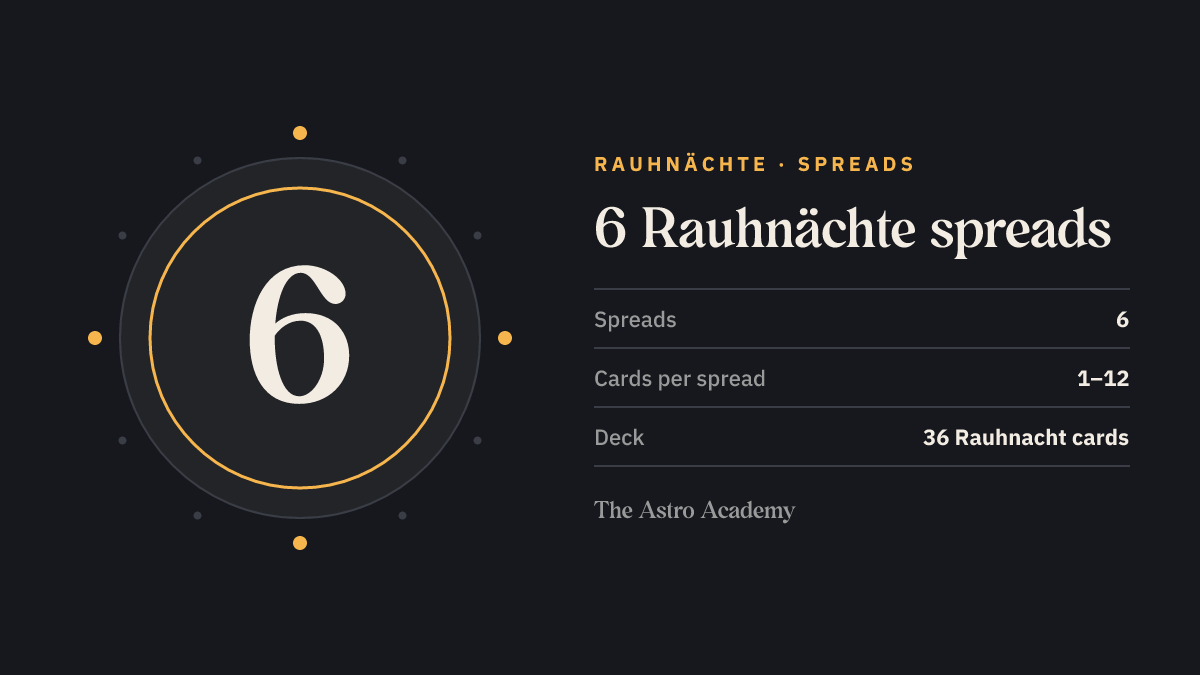
The twelve-month spread month by month
This spread gives you a theme for each month of the coming year. You can lay it out in two ways.
Either you draw all twelve cards at once on the first Rauhnacht, or you draw one card each night, with the card for the first night representing January, the second February, and so on. Laying out all the cards at once provides a complete picture, showing you how the year's themes might connect and develop. Drawing one card per night helps you stay in the moment and focus on one month at a time. Both methods are valuable; choose the one that fits your style of reflection.
If a challenging card appears for a certain month, it does not mean that month will be bad. It might point to a topic that will require more of your attention or a pattern to be aware of. For example, seeing The Long Night for August could suggest a need for rest during a busy time, not a prediction of hardship.
How to prepare for your reading
A few simple steps can help you create a calm atmosphere for your Rauhnacht spread. Find a quiet place where you will not be disturbed.
Many people like to light a candle to mark the moment as special and separate from the everyday. Before you shuffle, take a moment to think about what you want to ask. A clear question helps you connect with the cards. Instead of asking 'Will I be happy?', you could ask 'What can I focus on to create more joy in my life?'. This gives you something concrete to work with.
Shuffle the cards in any way that feels comfortable. When you feel ready, draw your card or cards. Take some time to look at the images before reading the meanings. Afterward, it is very helpful to write down the cards you drew, your question, and your first thoughts in a Rauhnacht journal.
- 1. Set the mood: Find a quiet spot and light a candle.
- 2. Form your question: Ask something open that you can reflect on.
- 3. Shuffle and draw: Mix the cards and choose them when you feel ready.
- 4. Reflect and record: Write down the cards and your thoughts in a journal.
How often to read the cards
During the Rauhnächte, drawing one card each evening is often enough. This practice gives you a single, clear theme to consider for the corresponding month of the coming year.
It allows you to go deep with one idea rather than getting overwhelmed by too much information. Doing a reading every single day is not necessary for it to be meaningful. Some people choose to do a spread only on the first, middle, and last nights. The goal is to create a moment of calm reflection, not to create another obligation during the holidays.
If you draw a card that seems very heavy or complicated, give yourself space to sit with it. You do not have to figure it all out in one evening. Your journal is a good place to return to your thoughts later, and you might find the card's meaning becomes clearer over time.
| Frequency | Benefit |
|---|---|
| One card each evening | single, clear theme for the coming year |
| Not every single day | not necessary for it to be meaningful |
| First, middle, and last nights | create a moment of calm reflection |
| Spread | Cards | Good for |
|---|---|---|
| Card of the night | 1 | What goes with me through this night? |
| Twelve-month Rauhnacht spread | 12 | What do the twelve nights show me about my new year? |
| Look back, look ahead | 4 | What was good, and what do I turn towards? |
| Wish spread | 3 | What does my wish need from me? |
| Letting-go spread | 3 | What is over, and what becomes free? |
| Five-card threshold spread | 5 | Where do I stand between the old and the new year? |
How often does a given card turn up in “three cards”?
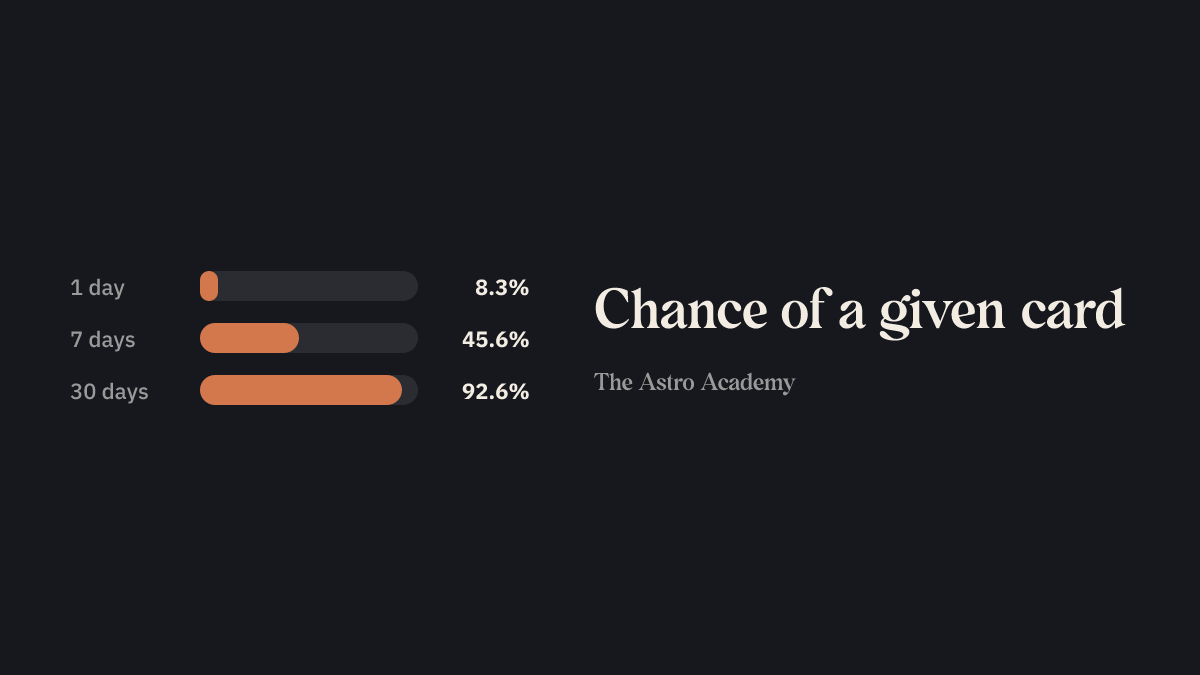
With 3 cards out of 36 Rauhnächte cards, every single card is in your spread with 8.3 %. Lay it every day for a week and a given card shows up at least once with 45.6 %, within a month with 92.6 %.
Until you have seen each of the 36 cards at least once takes 49 days on average. The last missing cards take the longest, because fewer new ones are left each day.
| Case | Value |
|---|---|
| Cards in the deck | 36 |
| Cards in the spread | 3 |
| Chance per card and spread | 8.3 % |
| At least once in 7 days | 45.6 % |
| At least once in 30 days | 92.6 % |
| Two given cards on consecutive places | 0.32 % |
| Days until every card was laid once (mean) | 49 |
Pure probability: every card equally likely, every spread freshly shuffled, no card twice in one spread. The mean until every card was laid is computed exactly over all intermediate states.
Frequently asked questions
- Can I do a twelve nights tarot spread with a regular tarot deck?
- Yes, absolutely. Any tarot or oracle deck can be used for a Rauhnacht spread. The principle of drawing a card for each of the twelve nights to represent the coming months works with any deck you feel connected to.
- What happens if I miss a night during the Rauhnächte?
- If you miss a night, you can simply draw the card the next day. The tradition is a framework for reflection, not a strict rule. You could also draw two cards on the following evening to catch up.
- Which Rauhnacht stands for which month?
- The first Rauhnacht, from December 25 to 26, represents January. The second night stands for February, and so on, until the twelfth night from January 5 to 6, which corresponds to December of the new year.
- How do I interpret a 'bad' card in my Rauhnacht spread?
- Cards that seem difficult often point to areas needing attention, not to a fixed negative outcome. For example, drawing The Ash might suggest a need for closure or letting go in that month. Ask yourself what this theme could mean for you and what resources you have to handle it.
- What is a good question for a Rauhnacht card reading?
- Good questions are open and focused on your own actions and perspectives. Instead of a yes or no question, try something like, 'What energy would serve me best in the coming year?' or 'What should I be mindful of during the month of March?'