
Lenormand spreads: finding the right one
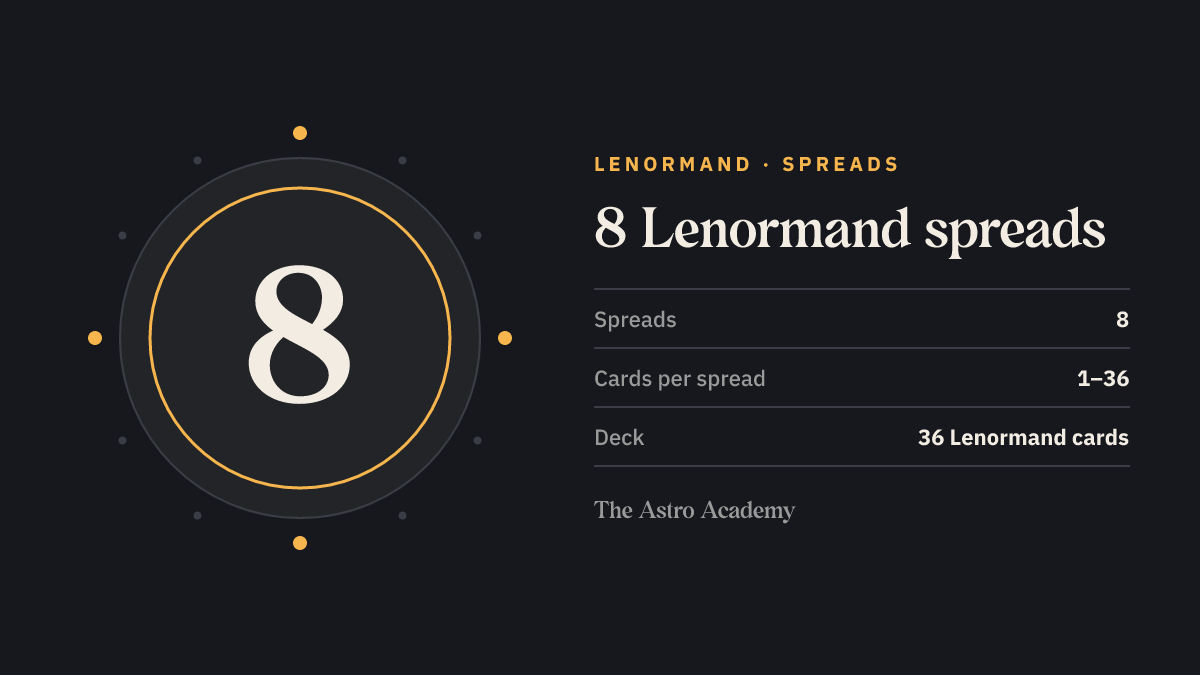
Different questions need different Lenormand spreads. Whether it's a quick check-in with one card or a full overview using the Grand Tableau, the right layout helps clear things up. This guide will help you pick a Lenormand spread that fits what you want to explore.
For every day
For any question
Love
Work & money
Decision
The big spread

Video · 32 seconds
Find your right spread
A big question needs a big spread, but sometimes a single card is much clearer. Find out how to match the Lenormand spread to your question for better readings. Calculate it for free: theastroacademy.com
Read along
The biggest Lenormand spread isn't always the best one. Think about it. You wouldn't pack a huge suitcase just to go out for a coffee. It's the same with the cards. A small question doesn't need a huge layout. A single card of the day gives you a clear focus. The Grand Tableau shows you the whole picture at once. Your question is the key. Check in with yourself: what do you really want to know right now? Find the right spread for your question at theastroacademy.com.
Contents
Choosing the right Lenormand spread
Start by matching the spread to how big your question is. A single card of the day works well for setting a theme, while a three-card or five-card spread can show a simple progression over time.
These smaller layouts give you a focused look at one specific issue. For bigger topics, like a tough decision or a situation with lots of moving parts, a nine-card spread gives you more detail. Specific layouts for love or work can also help by keeping the reading focused on that part of your life. The questions for each card position guide how you interpret things.
When you need a complete picture of where things stand, the Grand Tableau shows many connected themes all at once. It's the biggest Lenormand spread, using all 36 cards. It's best to save that one for when you have plenty of time to sit with the cards and understand how they relate.
- A quick check-in: Card of the Day
- A simple timeline: Three Cards
- A clear decision: Yes or No Spread
- A specific topic: Love or Work Spread
- A detailed overview: Nine-Card Square
- The whole picture: Grand Tableau
| Spread | Purpose |
|---|---|
| Card of the Day | quick check-in |
| Three Cards | simple timeline |
| Yes or No Spread | clear decision |
| Love or Work Spread | specific topic |
| Nine-Card Square | detailed overview |
| Grand Tableau | the whole picture |
Preparing for your reading
A clear question usually leads to a clearer reading. Try asking an open-ended question about your own situation, like “What should I focus on regarding this project?” instead of a simple yes or no. This gives the cards more room to offer useful ideas.
- Focus on question: Shuffling the cards is your moment to focus on your question.
- Use whatever method feels comfortable.
- Cut the deck: When you're ready, you can cut the deck into one or more piles and put them back together. Then you can draw the cards for your chosen spread.
- Lay out cards: Lay the cards out following the spread's pattern.
- See whole picture: Take a moment to see the whole picture before you start looking at individual cards or pairs.
- Jot down first impression: Your first impression often points to the main theme, which you can jot down in a journal.
How often to ask the cards
It's usually best to let a situation develop a bit before asking the exact same question again. Reading on the same topic too often can lead to confusing answers. This urge often comes from feeling anxious, not from a real need for new info.
- Unclear reading: If a reading feels unclear, try sitting with it for a few days instead of immediately re-drawing cards.
- Meaning becomes obvious: Sometimes the meaning becomes obvious with time or as events unfold.
- General guidance: For general guidance, a daily or weekly draw can be a good routine to build your intuition and get to know the cards better.
| Spread | Cards | Good for |
|---|---|---|
| Lenormand card of the day | 1 | Which keyword goes with me today? |
| Three-card Lenormand | 3 | How did my topic develop, and where is it going? |
| Lenormand yes or no | 3 | Does more speak for yes or for no? |
| Five-card Lenormand cross | 5 | What belongs to my topic? |
| Lenormand love spread | 5 | What is showing in my love life right now? |
| Lenormand spread for work and money | 5 | How are my work and my money doing? |
| Lenormand nine-card square | 9 | How does everything in my situation connect? |
| Lenormand grand tableau | 36 | What does the whole picture of my life show right now? |
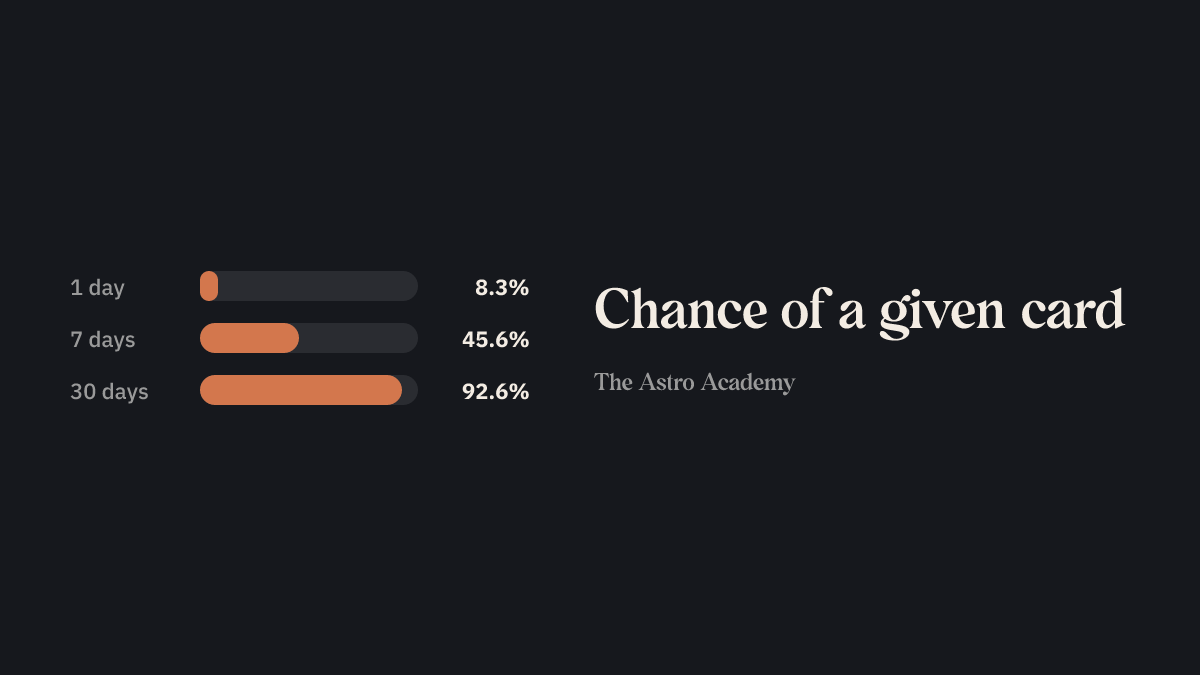
How often does a given card turn up in “three cards”?
With 3 cards out of 36 Lenormand cards, every single card is in your spread with 8.3 %. Lay it every day for a week and a given card shows up at least once with 45.6 %, within a month with 92.6 %.
Until you have seen each of the 36 cards at least once takes 49 days on average. The last missing cards take the longest, because fewer new ones are left each day.
| Case | Value |
|---|---|
| Cards in the deck | 36 |
| Cards in the spread | 3 |
| Chance per card and spread | 8.3 % |
| At least once in 7 days | 45.6 % |
| At least once in 30 days | 92.6 % |
| Two given cards on consecutive places | 0.32 % |
| Days until every card was laid once (mean) | 49 |
Pure probability: every card equally likely, every spread freshly shuffled, no card twice in one spread. The mean until every card was laid is computed exactly over all intermediate states.
Frequently asked questions
- What is the best Lenormand spread for beginners?
- A three-card spread is a great place to start. It's simple enough to understand but gives enough detail to show a small story or a past, present, and future dynamic. This layout helps you practice reading card combinations without feeling overwhelmed.
- Can I create my own Lenormand spread?
- Yes, you can make your own layouts. Once you're comfortable with what the cards mean and how they work together, you can create a spread that fits your specific question. Just make sure to assign a clear meaning or question to each position before you draw the cards.
- How many cards should be in a Lenormand spread?
- Lenormand spreads can use any number of cards, from a single daily card to all 36 in the Grand Tableau. The most common layouts use three, five, or nine cards. The number you pick depends on how much detail your question needs.
- What if my Lenormand spread makes no sense to me?
- If a spread feels confusing at first, take a break and come back to it later with fresh eyes. It can help to write down your first impressions and the card positions in a notebook. The meaning might get clearer after a day or two as you think about it.
- Do I always use the Man or Woman card in a reading?
- No, not always. These person cards are key to many spreads, representing you or someone else in the situation. But if your question is about a general theme or an abstract idea, they might not show up in the cards you draw, and that's totally fine.