
Lenormand spread · 9 positions
Lenormand 9 card spread: reading a detailed snapshot
Lenormand nine-card square
Focus on your question and draw all 9 cards.
9 cards to go.

Video · 39 seconds
9-Card Spread Explained
The Lenormand 9-card spread offers a detailed look at any topic. It shows the past, the present, and a possible future direction. Calculate it for free: theastroacademy.com
Read along
Nine cards can tell a whole story. Here is how you read them. Imagine a square of nine cards. Each spot has a special role. The middle column shows the present. The left the past, the right a possible future. The card in the very center is the main topic. It is the heart of your question. The top row can show your thoughts. The bottom row shows the foundation. This is an invitation to see your topic from nine angles. Check which view feels clearest to you. Lay out your own nine-card spread for free at theastroacademy.com.
Contents
The Lenormand 9 card spread gives you a detailed look at a situation by putting nine cards in a three-by-three square. This layout offers more depth than a simple three-card line. It helps you see connections across different parts of your topic. This spread, also called the Lenormand nine card square, is great for really digging into a complex question.
Understanding the 3x3 grid
The nine cards are laid out in three rows and three columns.
- Middle card: The card right in the middle is the main point. It shows the core theme of your question.
- Middle horizontal row: The middle horizontal row (cards 4, 5, and 6) often means the present and the main issue you're dealing with.
- Top row: The top row (1, 2, 3) can show your thoughts or what you're aware of.
- Bottom row: The bottom row (7, 8, 9) might point to the foundation or what's happening behind the scenes. The three vertical columns give you a timeline.
- Left column: The left column (cards 1, 4, 7) usually relates to the past or what led to the current situation.
- Middle column: The middle column (2, 5, 8) highlights the present, showing what's active right now.
- Right column: The right column (3, 6, 9) suggests a possible direction or outcome. These spots work together to build a full picture around the central theme.
| Position | Cards | Meaning |
|---|---|---|
| Middle card | 5 | Core theme of your question |
| Middle horizontal row | 4, 5, 6 | Present, main issue |
| Top row | 1, 2, 3 | Thoughts, what you're aware of |
| Bottom row | 7, 8, 9 | Foundation, behind the scenes |
| Left column | 1, 4, 7 | Past, what led to current situation |
| Middle column | 2, 5, 8 | Present, what's active right now |
| Right column | 3, 6, 9 | Possible direction or outcome |
How to read the combinations
Start your reading with the center card, as it sets the main topic. If your question is about your home and the House card is in the center, the whole spread will focus on that. The cards right around the center card affect it most directly.
- Card above: The card above can show your hopes or thoughts about your home, while the one below might point to its foundation.
- Lines through center: Next, read the lines that go through the center. For example, if the Mice card is to the left of House and the Sun is to the right, it could mean that annoying small problems at home are clearing up, leading to a happy and clear solution.
- Card combinations: The card combinations tell a story. The first card acts like the subject, and the next one describes it.
- Diagonals and corners: You can also find more insights by looking at the diagonals and corners. The two diagonal lines that cross through the center (cards 1-5-9 and 3-5-7) can show hidden currents or how things might develop long-term for your question.
- Four corner cards: The four corner cards (1, 3, 7, and 9) often give you a broader frame, showing the bigger picture of the situation.
See for yourself which of these layers feels most important.
A simple guide to your reading
A clear, step-by-step process helps you understand all the details in a Lenormand nine card square. It's usually best to go from the general to the specific. This keeps you from getting lost in too many card combinations at once and helps you build a clear story from the spread.
- 1. Focus on the Center: Identify the main theme by interpreting the central card first.
- 2. Read the Central Cross: Read the middle horizontal row and the middle vertical column to understand the core timeline and dynamics.
- 3. Check the Diagonals: See what the two diagonal lines add to the story. Do they suggest a hidden influence?
- 4. Examine the Corners: Look at the four corner cards as the outer frame or boundary of the situation.
- 5. Synthesize the Story: Bring all the pieces together. What is the main story the cards seem to be telling about your topic?
When to use the nine card square
The nine-card square is perfect when you need more detail than a three or five-card spread offers, but you're not ready for the complexity of a full grand tableau. It hits a sweet spot, giving you a rich, multi-layered view of one topic.
It's especially helpful for exploring a specific situation, like a new project or a relationship question, from several angles. While a three-card spread might give a simple “yes” or “no” about a possible career change, the nine-card square offers more context.
It could show the old job (Anchor), the decision-making process (Crossroads), and the new opportunity (Key) in the main timeline. At the same time, it can show your thoughts about it (Clouds) and the financial impact (Fish), creating a much fuller picture.
| Spread | Detail level | Use case |
|---|---|---|
| Three card spread | Simple | Yes or no questions |
| Nine card square | Rich, multi-layered | Specific situations, context |
| Grand tableau | Complex | Full, detailed reading |
The positions at a glance
“Lenormand nine-card square” has 9 positions. Each one asks the card lying there its own question.
| No. | Position | Guiding question |
|---|---|---|
| 1 | Past, above | What was conscious? |
| 2 | Present, above | What is conscious now? |
| 3 | Future, above | What becomes conscious? |
| 4 | Past | What brought you here? |
| 5 | Your topic | What is it about at its core? |
| 6 | Future | What comes next? |
| 7 | Past, below | What lay underneath? |
| 8 | Present, below | What works in the background? |
| 9 | Future, below | What grows unnoticed? |
How often does a given card turn up in “Lenormand nine-card square”?
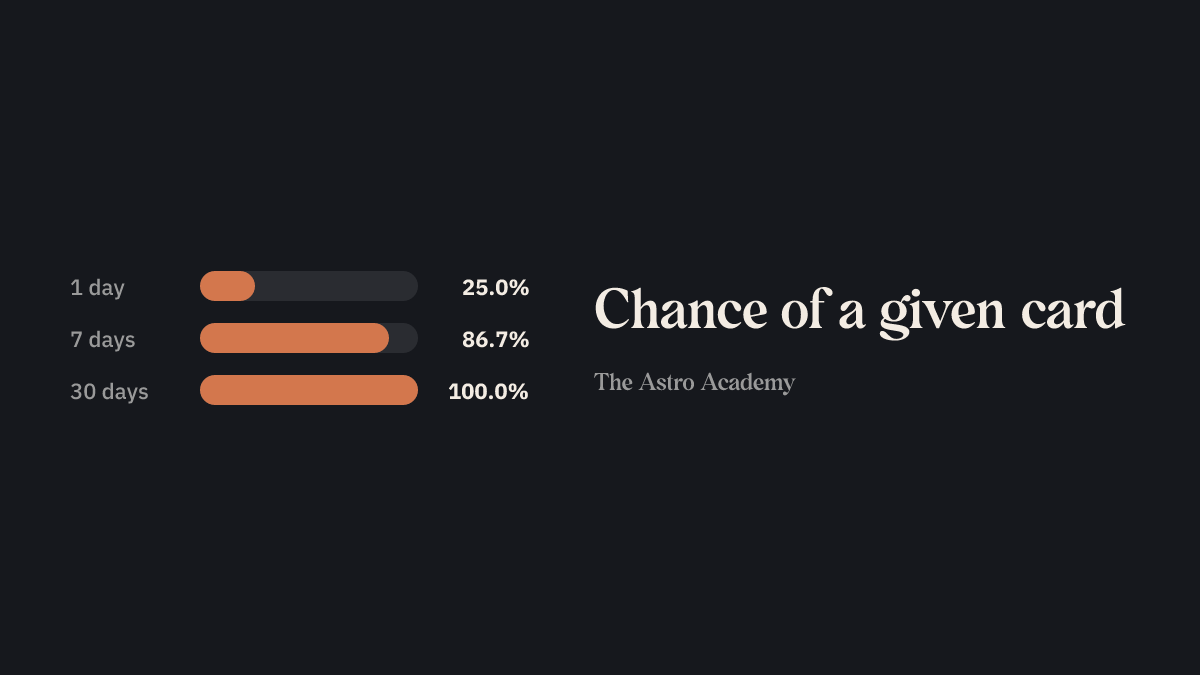
With 9 cards out of 36 Lenormand cards, every single card is in your spread with 25.0 %. Lay it every day for a week and a given card shows up at least once with 86.7 %, within a month with 100.0 %.
Until you have seen each of the 36 cards at least once takes 15.2 days on average. The last missing cards take the longest, because fewer new ones are left each day.
| Case | Value |
|---|---|
| Cards in the deck | 36 |
| Cards in the spread | 9 |
| Chance per card and spread | 25.0 % |
| At least once in 7 days | 86.7 % |
| At least once in 30 days | 100.0 % |
| Two given cards on consecutive places | 1.27 % |
| Days until every card was laid once (mean) | 15.2 |
Pure probability: every card equally likely, every spread freshly shuffled, no card twice in one spread. The mean until every card was laid is computed exactly over all intermediate states.
Frequently asked questions
- What is the most important card in a Lenormand 9 card spread?
- The most important card is the one in the center. It shows the main theme or the heart of what you're asking about. All other cards in the spread add details and context to this central card, describing its past, future, and different influences.
- Can you read the rows and columns of the 9 card spread differently?
- Yes, there are a few accepted ways to read the rows and columns. While “Past-Present-Future” for columns is common, some readers use other meanings. The key is to decide on your system before you start the reading and stick with it for clarity.
- How do I read knighted cards in a 9 card spread?
- Knighting means reading cards that are a knight's move away in chess. It connects corners to the middle cards of opposite sides. For example, card 1 knights to cards 6 and 8. It's a more advanced technique that can add another layer of detail by showing unexpected connections within the spread.
- Is the nine card square good for a daily reading?
- A nine-card spread can be too detailed for a simple daily reading, where one or three cards are usually enough. But if you're facing a really complex day or want to explore a daily theme deeply, it can be very useful. It gives you a much broader view than a single card.
- What if a person card like Man or Woman is in the center?
- If one of the main person cards, like Man or Woman, lands in the center, the reading becomes very focused on that individual. If the card is you, the surrounding cards describe your current situation and how you're feeling. If it's someone else, the spread offers a look at their circumstances or their relationship to you.