
Astrology events
Eclipses
Two to four times a year a new or full moon falls close enough to the lunar nodes to become an eclipse. Astrologically eclipses read as an accelerated version of the underlying phase — the same meaning, with considerably more force.
Coming up next
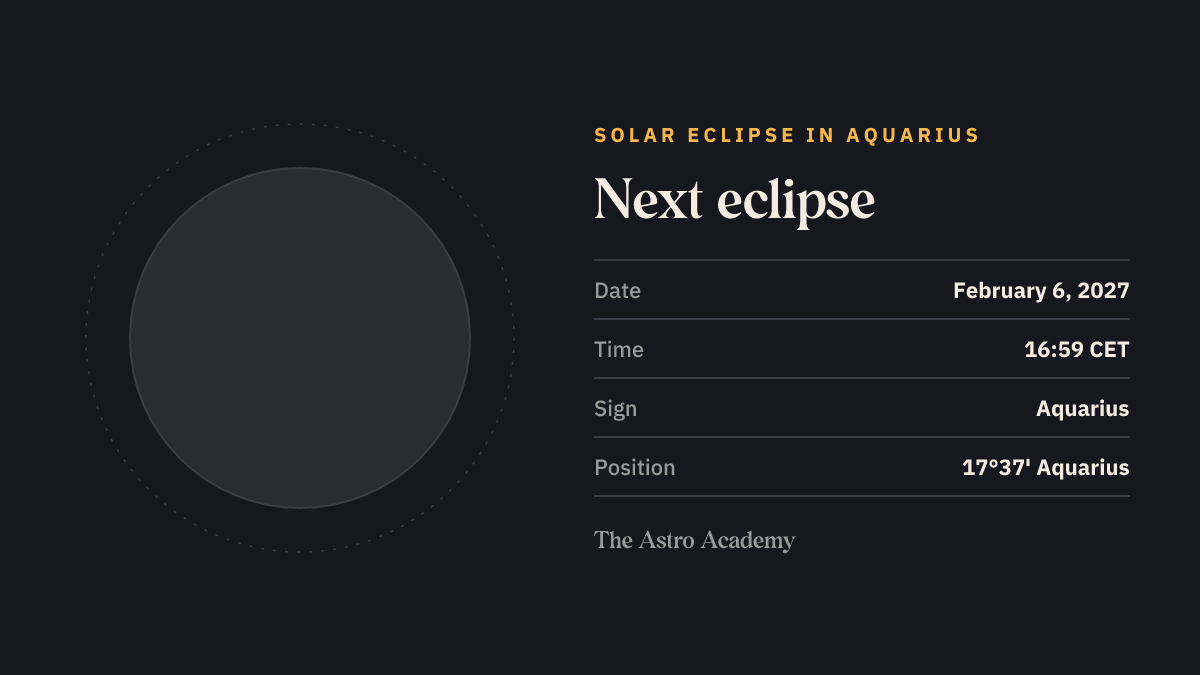
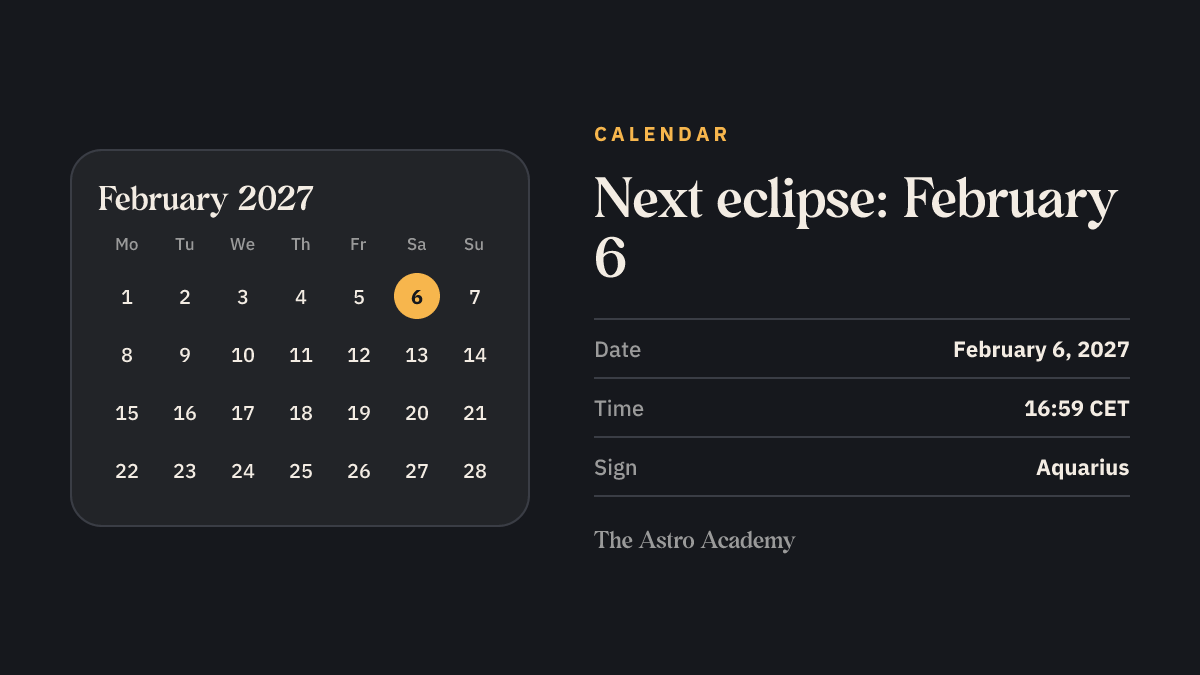
February 6, 2027
Solar and lunar eclipses
A solar eclipse is a new moon in which the Moon covers the Sun — read as a particularly emphatic beginning. A lunar eclipse is a full moon in which the Earth casts its shadow on the Moon — read accordingly as a culmination or an ending. Both are astronomical facts; the interpretation sits on top of them.
Why eclipses arrive in series
Eclipses come in pairs and in series that stay in the same pair of signs for roughly 18 months before moving on. That is why themes cluster: if something happened at an eclipse in a given sign, the theme often returns half a year later. The underlying cycle — the Saros cycle — runs a little over 18 years.
The next solar and lunar eclipses
The next eclipse is the Solar Eclipse in Aquarius on February 6, 2027 at 16:59 (CET). The table lists every eclipse after it with its type and exact position. 2026 has 4 eclipses in total.
| Date | Eclipse | Type | Position |
|---|---|---|---|
| February 6, 2027 | Solar Eclipse in Aquarius | annular | 17°37' Aquarius |
| February 21, 2027 | Lunar Eclipse in Virgo | penumbral | 1°58' Virgo |
| July 18, 2027 | Lunar Eclipse in Capricorn | penumbral | 25°57' Capricorn |
| August 2, 2027 | Solar Eclipse in Leo | total | 9°55' Leo |
| August 17, 2027 | Lunar Eclipse in Aquarius | penumbral | 24°04' Aquarius |
Why there are only a few eclipses a year
The Moon's path is tilted about five degrees against the Sun's. Only when a new or full moon falls close to one of the two crossing points — the lunar nodes — do Sun, Earth and Moon line up. That happens in two windows a year, the eclipse seasons, each about five weeks long.
That is why eclipses come in pairs: a solar eclipse, and roughly two weeks before or after it a lunar eclipse.
The lunar nodes drift slowly backwards through the zodiac, one full circle in about 18.6 years. So eclipses stay in one pair of signs — Aries and Libra, for instance — for around a year and a half before moving into the previous pair. After about 19 years an eclipse often falls on nearly the same date again.
Visibility and safety
Whether you can see an eclipse depends on where you are. A lunar eclipse is visible wherever the Moon is above the horizon at the time. A solar eclipse is only visible from a narrow strip of the Earth.
- Never look at the Sun without certified eclipse glasses — not even during a partial eclipse.
- A lunar eclipse is safe to watch with the naked eye.
- The astrological moment is the same worldwide; only local visibility differs.
Eclipses in astrology
Astrologically what counts most is the sign an eclipse falls in and its degree. If that degree sits near a point in your chart, that is the eclipse you are most likely to notice. What the next eclipse's sign is about is in the Aquarius sign profile. Your birth chart shows where the degree falls for you; every date of the year is in the 2026 astrology calendar.
Types of eclipse, briefly explained
The table above names each eclipse's type. Here is what that means:
- Total solar eclipse — the Moon covers the Sun completely; along a narrow track it turns almost dark for a few minutes.
- Annular solar eclipse — the Moon is further from Earth and looks smaller, so a bright ring of Sun stays visible around it.
- Partial eclipse — only part of the Sun or Moon is covered.
- Total lunar eclipse — the Moon sits fully in Earth's core shadow and often turns copper-red.
- Penumbral lunar eclipse — the Moon only grazes the outer shadow; to the naked eye the difference is often barely visible.
Eclipses — common questions
- When is the next eclipse?
- The next eclipse is the Solar Eclipse in Aquarius on February 6, 2027 at 16:59 (CET, Berlin time).
- How many eclipses are there in 2026?
- 2026 has 4 eclipses (solar and lunar combined).
- What is the difference between a solar and a lunar eclipse?
- In a solar eclipse the new moon passes in front of the Sun. In a lunar eclipse the Earth’s shadow falls on the full moon.
- What is the Saros cycle?
- After a little over 18 years eclipses repeat in very similar form. That period is called the Saros cycle and was already known in antiquity.
The current planetary positions show where every planet is right now. How a date lands in your own chart is what the personal daily horoscope shows — built on your birth chart. Moon dates are listed under next full moon.
Every date
Full 2026 calendar · All events
 Reviewed by Theresa Touhey · Astrologer & Tarot Reader