
Learn tarot for beginners
Learn tarot in 30 days, 5 minutes a day is all it takes.
After 30 days you can read
- all 78 cards without a book beside you: image, number and suit tell you what it is about
- your card of the day and the one question it leaves you with for today
- a three-card spread as one story, not three keywords
- reversed cards calmly: what is missing, stalling or turning inward
The first five questions are free, no sign-up needed.
Learn tarot for beginners: read the cards one by one, 5 minutes a day. The 22 Major Arcana in your first month, then the whole deck. Start free.
Tarot
5 minutes a day is enoughThe cards show pictures. You're the one who reads what they say.
0 of 320 lessons
Daily challenge
Continue learning

The Journey Begins
Beginning
Your path
Certification
Coming soonOnce you have finished every course in a discipline and passed the exam, you receive your official certificate. We are switching this on shortly.
Tarot Certificate
Complete all 320 lessons to unlock it.

Video · 31 seconds
Tarot in 5 Minutes
Tarot cards are a mirror for your questions. You just need to understand their language, and that works card by card. Your guide for the first 30 days.
Read along
5 minutes a day. That's all it takes to understand the Tarot cards. Think of the deck like the cast list for a play. There are 22 main characters. They are called the Major Arcana. They show the big turning points in life, from the first step to the final chapter. Each day, you meet one of these cards. You give its story a voice. See how this works for you. Get started for free at theastroacademy.com.
Learn tarot: how it works
Learning tarot comes in two parts. First you learn to read single cards: what the picture shows, which theme the card carries, how it sounds against a real question. Then you learn to read several cards together, which is what a spread is. The second part rests on the first. If you still have to look up every card, a spread loses its thread fast.
So the path goes card by card. You don’t need a thick book or a weekend workshop for that. Your own deck helps, but to begin with the picture on your screen is enough.
One unit takes about 5 minutes: a short read, then a few questions that check whether it has stuck. Anything you get wrong comes back at the end of the unit. No prior knowledge needed.
Your first month
The tarot path takes on the 22 Major Arcana first, one card per unit, and then moves to the Minor Arcana. At one unit a day, the first month looks like this:
| Days | Module | Topics |
|---|---|---|
| Day 1 | Beginning · Let's Start | The Journey Begins |
| Days 2–23 | Tarot Cards · Major Arcana | Card 0 - The Fool, Card 1 - The Magician, Card 2 - The High Priestess, Card 3 - The Empress, Card 4 - Emperor, Card 5 - The Hierophant … |
| Day 24 | Tarot Cards · Minor Arcana - Intro | Introduction to the Minor Arcana |
| Days 25–30 | Tarot Cards · Minor Arcana - The Wands | Card 1 - Ace of Wands, Card 2 - Two of Wands, Card 3 - Three of Wands, Card 4 - Four of Wands, Card 5 - Five of Wands, Card 6 - Six of Wands |
So after 30 days you know the 22 Major Arcana, you know how the Minor Arcana are built, and you have read the first six Wands. That is the foundation, not yet the whole deck. The rest of the Wands, then the Cups, Swords and Pentacles follow in the same section; at one unit a day you will have read all 78 cards in their upright meaning after about 80 days. After that come the reversed cards, combinations of two cards and, last, the “Tarot + Astrology” section.
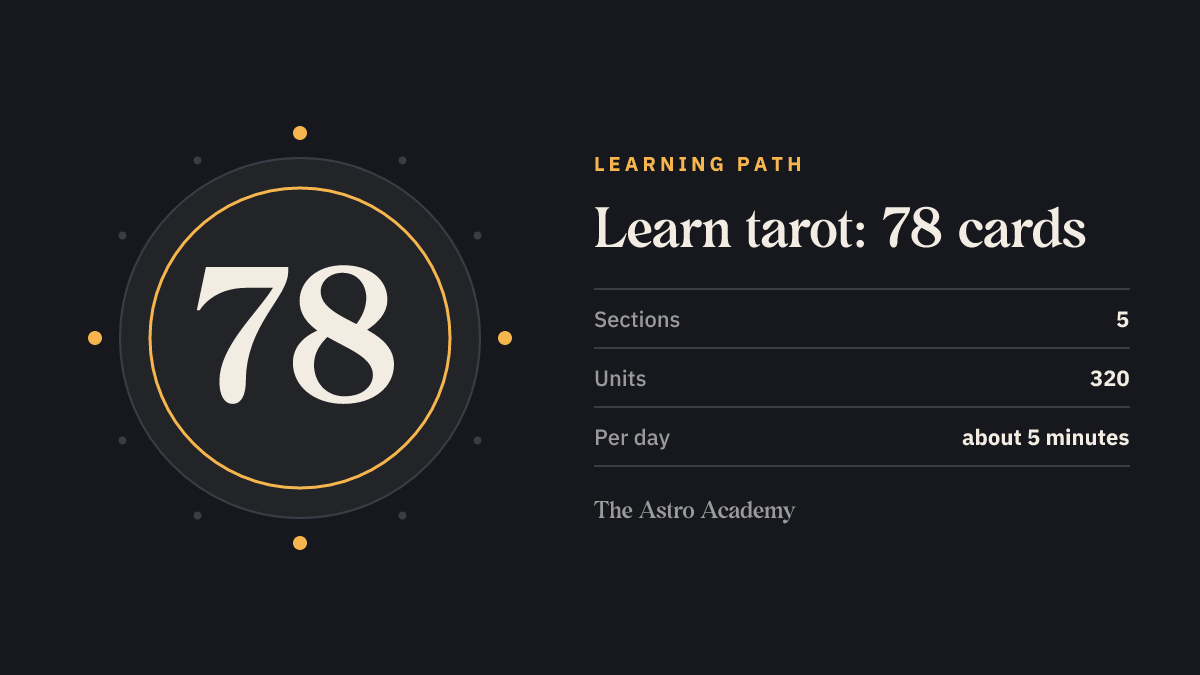
Every section at a glance
- Beginning: 1 unit
- Tarot Cards: 79 units
- Tarot Reversed: 79 units
- Tarot Combinations: 80 units
- Tarot + Astrology: 81 units
Practise with one card a day
Tarot is easiest to learn as a small habit: draw the daily card in the morning, and in the evening note where it showed up in your day. When you want to look a card up, each of the 78 has its own page in the tarot card library, for instance The Fool as card 0 or The Sun as card XIX.
A small exercise for today: draw a card before you put your phone away at 6 pm and write one sentence about it without looking anything up. Tomorrow, compare it with the meaning. The gap between your sentence and the library shows you what you can already read. Several cards together come later, with the tarot spreads.
The “Tarot + Astrology” section connects both systems; the groundwork is under learn astrology. If northern symbols appeal to you, have a look at learn runes.
How many cards do you need to know?
78 cards: 22 Major Arcana and 56 Minor Arcana in four suits of 14 cards each, Ace to Ten plus four court cards.
That sounds like a lot, but it follows a pattern. 40 of the 56 Minor Arcana are number cards: once you understand the four suits and the numbers one to ten, you can already read them roughly. That is why the 30-day path starts with the Major Arcana and builds up the suits step by step afterwards.
From 78 cards there are 456,456 different three-card spreads in a fixed order. In 63.6 % of them at least one Major Arcana card turns up.
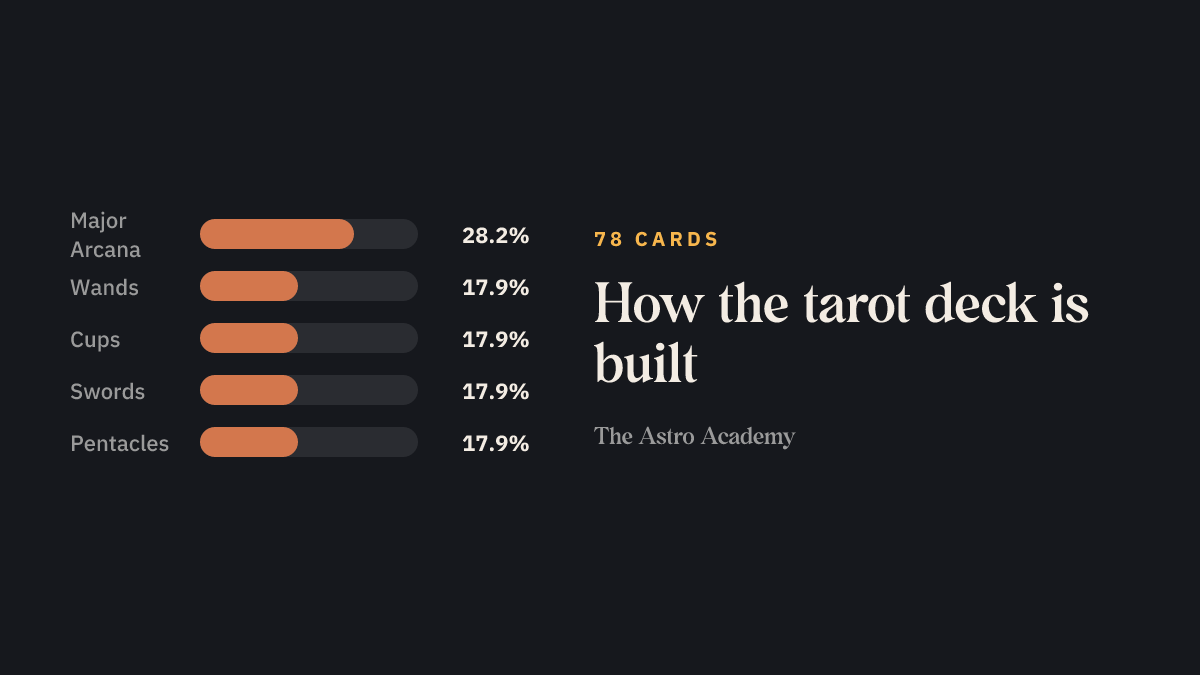
| Item | Value |
|---|---|
| Cards in the deck | 78 |
| Major Arcana | 22 (28.2 %) |
| Minor Arcana | 56, 40 number and 16 court cards |
| Three-card spreads | 456,456 |
| At least one Major in three cards | 63.6 % |
Calculated from the structure of the deck: ordered draws without replacement, every card equally likely.
Common questions
- How do I learn to read tarot cards?
- In two steps. First the 22 Major Arcana, each with its core theme, then the 56 Minor Arcana, one suit at a time. On the path that is one card per unit, about 5 minutes a day, with questions that check whether you can read the card. The Major Arcana are done after a little over three weeks, the whole deck in its upright meaning after about 80 days.
- How do I learn to lay tarot spreads?
- Once you can read single cards. A spread is simply several cards read in relation to each other, each on a position with its own question. Start with three cards, for example the situation, what stands in the way and the next step. The positions of the common spreads, from three cards to the Celtic Cross, are explained on our free tarot spread pages. On the path you practise reading cards together in the Tarot Combinations section: joining two meanings into one sentence.
- How long does it take to learn tarot?
- It depends on what you mean by learned. At 5 minutes a day you know the 22 Major Arcana and the first Wands after 30 days. You will have read all 78 cards in their upright meaning after about 80 days. Reversed cards and combinations are roughly another 80 units each. Confidence in bigger spreads like the Celtic Cross comes mostly from practice on real questions, not from reading more.
- Is tarot hard to learn?
- It looks hard because 78 cards sounds like a lot. But each card has one core theme: the Fool stands for a beginning, Death for change, the Lovers for a choice. Once you know those themes, you have an anchor for every reading. It gets hard mostly when you memorise keyword lists. It gets easier when you test each card against a question straight away.
- Can you teach yourself to read tarot?
- Yes, without a teacher or a circle. What you need is a fixed order, a few minutes a day and a way to check yourself. Your own deck helps but isn’t required at the start. Many beginners pick the Rider-Waite deck because most books and sites refer to it. The path gives you the order, and the questions after each card do the checking.
- How much does an online tarot course cost?
- The first five questions are free, no sign-up needed. After it you unlock the whole tarot course once for €12.99, no subscription, and it stays yours for good. All courses together cost €104.40. You see the price before you pay.
- How do I become a professional tarot reader?
- Tarot has no regulated training. The way in runs through solid card knowledge, plenty of practice on real questions and, if you want one, a certificate from a private school. The path here covers the first part: all 78 cards upright and reversed, combinations and the link to astrology. Reading for other people is something you learn mostly through practice after that.
- Is there a tarot certification?
- There is no officially accredited tarot certification. Certificates come from private schools, and they are worth as much as the reputation behind them. Our own completion certificate for the tarot path is in the works and coming soon, for everyone who has unlocked the full course. What matters more than the paper is that you can actually read the cards afterwards.
- Is there a free tarot course?
- The start, yes. The first five questions of the path are free, no sign-up needed. Your daily card and the card library with the meanings of all 78 cards stay free as well. You can learn tarot for free from videos and blogs too; what is usually missing there is a fixed order and a question that checks whether it stuck. For the whole path you unlock the course once afterwards, no subscription.
- Tarot for beginners: which cards should I learn first?
- Not all 78 at once. Start with the 22 Major Arcana, they carry the big themes. Then one suit of the Minor Arcana, not all four at the same time. The path keeps exactly that order: the Major Arcana first, then a short introduction to the Minor Arcana, then the Wands, followed by Cups, Swords and Pentacles.
- Where do I look up individual tarot card meanings?
- In the tarot card library: all 78 cards with their meanings, upright and reversed. It is built for looking things up, when you have drawn a card and want to know what it stands for. The path is the counterpart: with it you learn to read the cards without looking them up.
- Which tarot books should a beginner read?
- Rachel Pollack’s Seventy-Eight Degrees of Wisdom and the guidebooks written for the Rider-Waite deck come up most often. They explain every card in depth and work well for looking things up. Learning goes easier in a fixed order: the Major Arcana first, then one suit at a time, one card a day. That is how the path here is built, and a book stays useful beside it whenever you want to go deeper on one card.
- How much time do I need each day?
- Five minutes is enough. The units are deliberately short so they fit into any day, with your morning coffee or in bed at night. You can always do more; you never have to.
- Do I need a subscription?
- No. The first five questions are free, and after it you unlock the whole course once. Nothing renews, so there is nothing to cancel.
- What if it's not for me?
- If you unlock a course and it turns out not to fit, email us within 14 days and you get your money back, no reason needed.
- Can I use the app on multiple devices?
- Yes. As long as you sign in with the same account, your progress is there on every device.