
Ephemeris — the planets day by day
Free tables with the position of the Sun, Moon and every planet for each day, at 00:00 Universal Time. With the lunar node, Chiron and Lilith, retrogrades, stations, lunar phases and sign changes. Computed with the Swiss Ephemeris.
Where the Sun, Moon and every planet stood on a day: sign, degree and ℞. With a time and place the houses are added.
Your date
For which date?
Any date from 1900 to 2100.
Today in the ephemeris
21 October 2026, 00:00 UT · calculated with the Swiss Ephemeris
- Sun
- ♎︎ 27°36'
- Moon
- ♒︎ 23°27'
- Mercury
- ♏︎ 20°18'
- Venus
- ♏︎ 2°39' ℞
- Mars
- ♌︎ 12°53'
- Jupiter
- ♌︎ 22°51'
- Saturn
- ♈︎ 10°02' ℞
- Uranus
- ♊︎ 5°02' ℞
- Neptune
- ♈︎ 2°20' ℞
- Pluto
- ♒︎ 3°04'
- Node (mean)
- ♒︎ 26°39'
- Chiron
- ♈︎ 28°35' ℞
- Lilith (mean)
- ♑︎ 4°03'
Video · 36 seconds
Your chart is unique
Your birth chart is more than just your birthday. It's a precise snapshot of the sky. An ephemeris helps you find the planets for any given day.
Read along
Two people with the same birthday can have completely different birth charts. Imagine a timetable for the planets. That's called an ephemeris. Each row shows one day. It lists the planet, the sign, and the degree. The planet has a job to do. The sign is the style it works in. Your date of birth gives you the planets and signs. Your time and place add the houses: the areas of life. Look up the planets for any day. Work it out for free at theastroacademy.com.
What is an ephemeris?
An ephemeris is a table: one row per day, one column per body. Each cell says which zodiac sign the planet is in and at which degree. These used to be thick books that astrologers used to cast every chart by hand. Today a computer does the math, but the table stayed, because it shows at a glance how the sky moves over weeks.
Each sign spans 30 degrees, and a degree has 60 arc-minutes. "10°23′ Capricorn" means just over a third of the way through Capricorn. At 29°59′ the planet is about to enter the next sign.
How to read a row
Take 26 February 2026. In the 2026 table, that row reads, among others:
- Sun ♓︎ 7°23' — the Sun is at 7 degrees Pisces. It moves on by just under one degree a day.
- Moon ♊︎ 26°56' — the next day it is already at ♋︎ 11°05', about 14 degrees on. The Moon is the fastest value in the table and changes sign about every two and a half days.
- Mercury ♓︎ 22°33' S — 22 degrees 33 minutes Pisces, and the S says: today Mercury changes direction (exactly at 06:48 UT). The row below reads ♓︎ 22°31' ℞. The ℞ means retrograde, and from now on the minutes get smaller instead of larger.
That is all there is to it: find the day, find the column, read sign and degree. To see whether a planet crosses a point of your chart, put its degree next to the degree in your birth chart. Whether such a crossing stirs anything in you is yours to check, for example with a note on that day.
How to read the table
- ♑︎ 10°23' — sign, then degree and arc-minutes within the sign. Here: 10 degrees 23 minutes Capricorn.
- ℞ — retrograde: seen from Earth the planet seems to move backward, its degree gets smaller day by day.
- S — station: on this day the planet seems to stand still and changes direction. The exact time is listed below the table.
- 00:00 UT — every row is for midnight Universal Time. In London that is midnight in winter and 1 am in summer.
- Node (mean) is the mean lunar node. It always moves backward, so it carries no ℞. Lilith (mean) is mean Black Moon Lilith, the point of the Moon’s orbit farthest from Earth.
What ℞ and S mean
Retrograde (℞) just means: seen from Earth, a planet seems to move backward through the zodiac for a while. It is an effect of viewpoint, as Earth and the planet overtake each other on their orbits. The Sun and Moon are never retrograde.
A station (S) is the turning point. The planet slows down, its degree barely changes for a few days, then it turns. In astrology, station days count as the days when a planet’s theme can be felt most clearly. Whether that holds for you is something you can check on those days. When Mercury next turns retrograde is on Mercury retrograde. How often each planet was retrograde at birth is shown in the study Retrograde at birth.
Universal Time and your clock
All rows are for 00:00 Universal Time (UT), the time on the Greenwich meridian. In the UK that is the same in winter and one hour less than British Summer Time; in New York subtract five hours (four in summer). The times of lunar phases, sign changes and stations below each month are in UT as well.
Slow planets like Saturn or Pluto barely move in a day, so the time hardly matters for them. For the Moon it does: in twelve hours it covers about six to seven degrees. For the exact position at your minute of birth, the birth chart calculator computes it to the minute, and where the planets are right now is shown on the Sky today page. The key dates of the year, explained, are in the astrology calendar.
How far does each planet move in a day?
The Moon moves 13.2 degrees a day on average, sometimes 11.8, sometimes 15.4. That is why its column changes visibly in every row, and it changes sign every two to three days. The Sun manages almost exactly one degree (0.986), and because Earth is closest to the Sun in January, it is 1.020 then and only 0.953 in July.
The further out a planet, the slower it is: Jupiter advances 8 arc-minutes a day on average, Saturn 4.2, Pluto only 1. So Pluto's number in the table often barely moves for days. In return the distant planets carry ℞ most often: Pluto on 44.1 % of days, Mercury on 19.1 %, Venus on only 7.2 %.
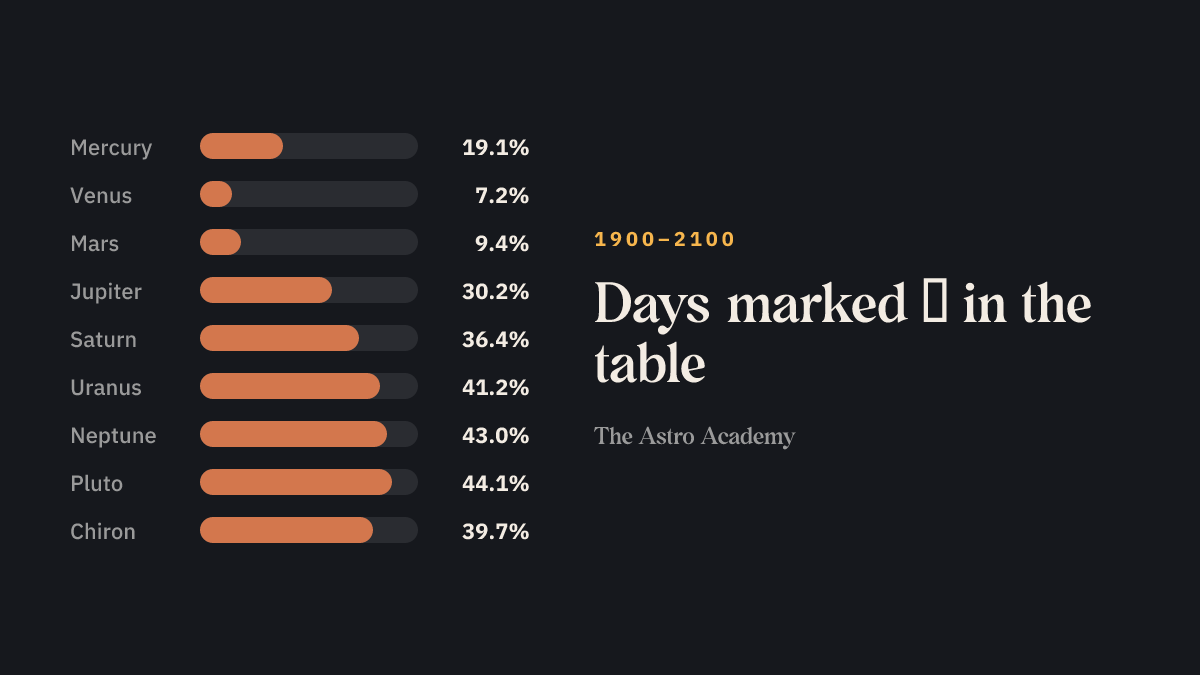
| Body | Average | Fastest day | Days ℞ |
|---|---|---|---|
| Moon | 13.18° | 15.39° | – |
| Sun | 0.986° | 1.02° | – |
| Mercury | 1.22° | 2.20° | 19.1 % |
| Venus | 1.04° | 1.26° | 7.2 % |
| Mars | 0.566° | 0.791° | 9.5 % |
| Jupiter | 0.133° | 0.242° | 30.2 % |
| Saturn | 0.0695° | 0.131° | 36.4 % |
| Uranus | 0.0334° | 0.0646° | 41.2 % |
| Neptune | 0.0212° | 0.0405° | 43 % |
| Pluto | 0.0172° | 0.0405° | 44.1 % |
| Chiron | 0.0479° | 0.146° | 39.7 % |
Computed with the Swiss Ephemeris for each of the 73,414 days from 1900 to 2100, positions at 00:00 UT as in the tables. Average = mean distance per day regardless of direction, ℞ = speed below zero.
Common questions
- What is an ephemeris?
- An ephemeris is a table that lists, for every day, where the Sun, Moon and planets stand in the zodiac. Astrologers use it to cast a chart by hand or to look up when a planet changes sign or turns retrograde.
- What time do these tables use?
- For 00:00 Universal Time (UT). In London that is midnight in winter and 1 am in summer. For another time, read between two rows: the Moon covers about 12 to 15 degrees a day, the Sun just under 1 degree.
- What does ℞ mean in an ephemeris?
- Retrograde. Seen from Earth, the planet seems to move backward through the zodiac for a while, because Earth and the planet overtake each other. You can spot it without the symbol too: the degree gets smaller from row to row.
- What is a station?
- The day a planet changes direction. It slows down, seems to stand still for a moment and then moves the other way. In our tables that day carries an S; the exact time is listed below the month.
- How accurate are the values?
- We compute with the Swiss Ephemeris, the same basis professional astrology software uses. Values are shown to the arc-minute, truncated rather than rounded, exactly like your birth chart on this site.
- Why is the lunar node never marked ℞?
- We show the mean lunar node. It always moves backward, about 3 minutes a day. A ℞ on every row would only be noise, so the legend says it instead.
Read an ephemeris on your own
In the 30-day path you understand signs, planets and retrogrades in 5 minutes a day, until you can read a row like the one above without help. With Pro, every year of the tables also comes as a printable PDF.
See the 30-day path