
Retrograde planets at birth — how common are they?
We recomputed every day from 1940 to 2020, 29,586 days. Mercury was retrograde on 19.1% of them, close to one birth in five. 32.3% of days had at least one personal planet retrograde. Mercury, Venus and Mars retrograde together: not on a single day.
Retrograde just means: seen from Earth, a planet seems to move backward through the zodiac for a while. It is an effect of viewpoint, as Earth and the planet overtake each other.
Which are retrograde for you?
For that, almost only your birth date counts, the hour hardly at all. You see right away which of the eight planets were moving backward on your birthday.
Your birth date
When were you born?
As in the study, we compute at 12:00 Universal Time.
Video · 38 seconds
Retrograde Planets
Retrograde planets are not a rarity. Almost one in three people has one. We explain what it means and how you can find yours. Calculate it for free: theastroacademy.com
Read along
Retrograde planets at birth are not rare. Almost one in three people has one. Imagine you are on a train. The train on the next track seems to move backward as you overtake it. But it is always moving forward. It is just an effect of your point of view. A retrograde planet simply does its job in a different style. More internally, perhaps. This is an invitation to reflect on things first, before you act on them. See if that feels true for you. You can see which of your planets were retrograde just from your birth date. Work it out for free at theastroacademy.com.
How often each planet is retrograde
The further a planet is from the Sun, the more time it spends retrograde. The outer planets Uranus, Neptune and Pluto run backward for almost half the year. Venus is the rarest at 7.3%. Mercury turns back most often — about 3.1 times a year — but each phase is short.
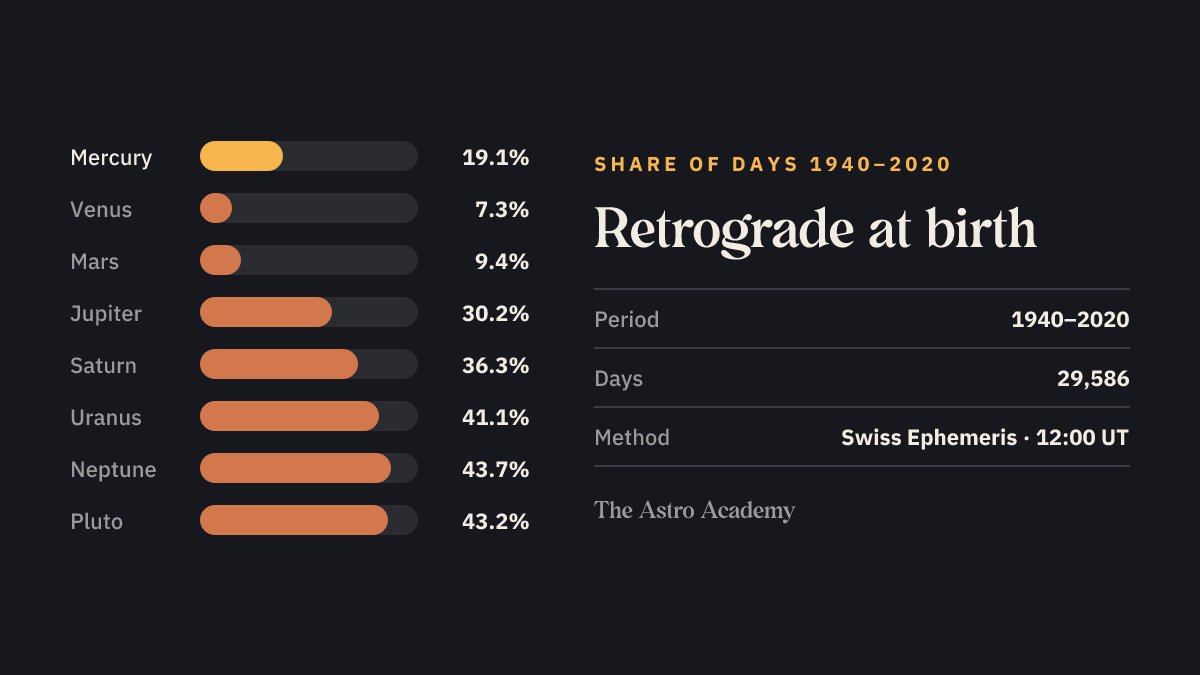
| Planet | Share of days | Births | Phases per year | Avg. phase length |
|---|---|---|---|---|
| Neptune | 43.7% | 1 in 2 | 1.0 | 160 days |
| Pluto | 43.2% | 1 in 2 | 1.0 | 158 days |
| Uranus | 41.1% | 1 in 2 | 1.0 | 152 days |
| Saturn | 36.3% | 1 in 3 | 1.0 | 138 days |
| Jupiter | 30.2% | 1 in 3 | 0.9 | 121 days |
| Mercury | 19.1% | 1 in 5 | 3.1 | 22 days |
| Mars | 9.4% | 1 in 11 | 0.5 | 74 days |
| Venus | 7.3% | 1 in 14 | 0.6 | 42 days |
"Phases per year" means how often the planet changes direction and runs backward, on average. For Venus (0.6) and Mars (0.5) that is less than once a year — which is why there are whole birth years in which they were never retrograde.
How many planets on one day
A birth chart with no retrograde planet is the exception: only 11.4% of days had none. One to three is most common. At most 7 of the eight were retrograde at the same time, last from 13 Jul 1986 to 14 Jul 1986 — only Venus was moving forward then.

| Retrograde | Share of days | Days |
|---|---|---|
| 0 planets | 11.4% | 3,365 |
| 1 planet | 22.0% | 6,501 |
| 2 planets | 22.5% | 6,655 |
| 3 planets | 21.9% | 6,478 |
| 4 planets | 15.2% | 4,502 |
| 5 planets | 5.6% | 1,670 |
| 6 planets | 1.4% | 403 |
| 7 planets | 0.0% | 12 |
Rare combinations
- Mercury and Venus: 1.4% of days, about 1 in 73.
- Mercury and Mars: 2.2% of days, about 1 in 46.
- Venus and Mars: only 12 days in 81 years (12 Feb 1950 – 20 Feb 1950 and 27 Apr 1969 – 29 Apr 1969).
- Mercury, Venus and Mars: not a single day between 1940 and 2020.
- All five outer planets: Jupiter to Pluto retrograde together on 2.3% of days, about 1 in 43.
Every generation has its own numbers
Mercury stays almost the same in every decade because it turns back so often. Venus, Mars and Saturn swing more, depending on how their phases fall into the years. The 2020 row covers a single year and so varies the most.
| Decade | Mercury | Venus | Mars | Jupiter | Saturn | Uranus | Neptune | Pluto |
|---|---|---|---|---|---|---|---|---|
| 1940s | 18.9% | 7.0% | 8.2% | 29.8% | 33.1% | 40.0% | 43.2% | 43.4% |
| 1950s | 19.3% | 8.1% | 9.8% | 29.6% | 38.1% | 39.6% | 43.5% | 43.0% |
| 1960s | 18.9% | 6.9% | 10.7% | 29.5% | 38.0% | 40.0% | 43.7% | 42.5% |
| 1970s | 19.4% | 6.9% | 7.7% | 29.8% | 33.2% | 41.4% | 43.9% | 42.8% |
| 1980s | 18.9% | 7.0% | 9.9% | 31.3% | 38.2% | 41.8% | 43.8% | 42.8% |
| 1990s | 19.4% | 8.0% | 10.7% | 31.4% | 37.6% | 42.2% | 43.9% | 43.1% |
| 2000s | 19.0% | 6.9% | 7.8% | 29.8% | 33.5% | 42.2% | 43.7% | 43.6% |
| 2010s | 19.3% | 6.9% | 10.0% | 29.8% | 38.3% | 41.6% | 43.6% | 44.1% |
| 2020 (1 year) | 18.3% | 11.8% | 17.8% | 33.1% | 38.5% | 40.4% | 43.4% | 44.3% |
How likely was it in your year
Find your birth year. The numbers show on how many days of that year Mercury, Venus or Mars were retrograde. 0% means the planet was not retrograde on any day that year — so it is not retrograde in your chart either. Whether it is in yours depends on your exact birth date.
1940–1949
| Year | Mercury | Venus | Mars | at least one |
|---|---|---|---|---|
| 1940 | 18.3% | 12.0% | 0.0% | 27.6% |
| 1941 | 18.6% | 0.0% | 17.5% | 30.4% |
| 1942 | 18.4% | 11.2% | 0.0% | 23.6% |
| 1943 | 18.6% | 11.5% | 17.8% | 43.6% |
| 1944 | 22.9% | 0.0% | 2.5% | 22.9% |
| 1945 | 18.4% | 11.8% | 7.4% | 27.9% |
| 1946 | 18.4% | 11.2% | 14.3% | 38.4% |
| 1947 | 18.4% | 0.0% | 0.0% | 18.4% |
| 1948 | 18.6% | 11.8% | 22.1% | 39.6% |
| 1949 | 18.4% | 0.0% | 0.0% | 18.4% |
1950–1959
| Year | Mercury | Venus | Mars | at least one |
|---|---|---|---|---|
| 1950 | 20.3% | 11.2% | 22.2% | 46.3% |
| 1951 | 21.4% | 11.8% | 0.0% | 26.9% |
| 1952 | 18.3% | 0.0% | 21.0% | 33.1% |
| 1953 | 18.4% | 11.8% | 0.0% | 27.7% |
| 1954 | 18.6% | 11.2% | 18.4% | 38.1% |
| 1955 | 18.1% | 0.0% | 0.0% | 18.1% |
| 1956 | 18.0% | 11.8% | 16.4% | 38.5% |
| 1957 | 22.7% | 0.0% | 0.0% | 22.7% |
| 1958 | 19.2% | 11.2% | 19.4% | 44.4% |
| 1959 | 18.4% | 11.8% | 0.0% | 28.8% |
1960–1969
| Year | Mercury | Venus | Mars | at least one |
|---|---|---|---|---|
| 1960 | 18.0% | 0.0% | 11.2% | 29.2% |
| 1961 | 18.4% | 11.5% | 9.9% | 39.7% |
| 1962 | 18.4% | 11.2% | 1.6% | 31.2% |
| 1963 | 20.0% | 0.0% | 20.6% | 34.8% |
| 1964 | 22.1% | 12.0% | 0.0% | 34.1% |
| 1965 | 18.4% | 0.0% | 22.2% | 34.8% |
| 1966 | 18.4% | 11.2% | 0.0% | 29.6% |
| 1967 | 18.9% | 11.5% | 21.4% | 49.3% |
| 1968 | 18.3% | 0.0% | 0.0% | 18.3% |
| 1969 | 18.1% | 11.8% | 19.7% | 42.2% |
1970–1979
| Year | Mercury | Venus | Mars | at least one |
|---|---|---|---|---|
| 1970 | 22.2% | 11.2% | 0.0% | 33.4% |
| 1971 | 20.0% | 0.0% | 16.7% | 30.4% |
| 1972 | 18.3% | 11.8% | 0.0% | 30.1% |
| 1973 | 18.4% | 0.0% | 18.4% | 31.0% |
| 1974 | 18.4% | 11.2% | 0.0% | 29.6% |
| 1975 | 18.4% | 11.8% | 15.1% | 45.2% |
| 1976 | 19.4% | 0.0% | 5.5% | 22.9% |
| 1977 | 22.7% | 11.5% | 5.2% | 32.3% |
| 1978 | 18.4% | 11.5% | 16.4% | 45.5% |
| 1979 | 18.4% | 0.0% | 0.0% | 18.4% |
1980–1989
| Year | Mercury | Venus | Mars | at least one |
|---|---|---|---|---|
| 1980 | 18.6% | 11.8% | 22.1% | 43.7% |
| 1981 | 18.4% | 0.0% | 0.0% | 18.4% |
| 1982 | 18.4% | 11.2% | 21.9% | 46.3% |
| 1983 | 21.4% | 11.8% | 0.0% | 29.3% |
| 1984 | 21.0% | 0.0% | 20.5% | 35.0% |
| 1985 | 18.1% | 11.5% | 0.0% | 23.3% |
| 1986 | 18.4% | 11.2% | 17.5% | 35.1% |
| 1987 | 18.1% | 0.0% | 0.0% | 18.1% |
| 1988 | 18.3% | 11.8% | 16.9% | 34.7% |
| 1989 | 18.6% | 0.8% | 0.0% | 19.2% |
1990–1999
| Year | Mercury | Venus | Mars | at least one |
|---|---|---|---|---|
| 1990 | 22.7% | 10.4% | 19.7% | 43.0% |
| 1991 | 18.9% | 11.8% | 0.3% | 24.1% |
| 1992 | 18.3% | 0.0% | 9.0% | 26.8% |
| 1993 | 18.4% | 11.8% | 12.3% | 39.2% |
| 1994 | 18.4% | 11.5% | 0.0% | 25.2% |
| 1995 | 18.4% | 0.0% | 22.2% | 34.8% |
| 1996 | 20.5% | 11.8% | 0.0% | 30.1% |
| 1997 | 21.4% | 1.4% | 22.2% | 41.4% |
| 1998 | 18.4% | 9.9% | 0.0% | 28.2% |
| 1999 | 18.4% | 11.8% | 21.1% | 45.5% |
2000–2009
| Year | Mercury | Venus | Mars | at least one |
|---|---|---|---|---|
| 2000 | 18.3% | 0.0% | 0.0% | 18.3% |
| 2001 | 18.4% | 11.5% | 18.9% | 42.2% |
| 2002 | 18.4% | 11.2% | 0.0% | 29.6% |
| 2003 | 21.9% | 0.0% | 16.4% | 32.3% |
| 2004 | 19.9% | 11.8% | 0.0% | 31.7% |
| 2005 | 18.4% | 2.2% | 18.9% | 34.0% |
| 2006 | 18.4% | 9.0% | 0.0% | 27.4% |
| 2007 | 18.4% | 11.8% | 12.9% | 43.0% |
| 2008 | 18.3% | 0.0% | 8.2% | 26.0% |
| 2009 | 19.7% | 11.5% | 3.0% | 32.9% |
2010–2019
| Year | Mercury | Venus | Mars | at least one |
|---|---|---|---|---|
| 2010 | 22.2% | 11.5% | 18.9% | 48.5% |
| 2011 | 18.4% | 0.0% | 0.0% | 18.4% |
| 2012 | 18.3% | 11.8% | 22.1% | 45.9% |
| 2013 | 18.6% | 2.7% | 0.0% | 21.4% |
| 2014 | 18.6% | 8.5% | 21.6% | 48.8% |
| 2015 | 18.4% | 11.8% | 0.0% | 30.1% |
| 2016 | 21.6% | 0.0% | 19.9% | 35.0% |
| 2017 | 20.3% | 11.5% | 0.0% | 30.4% |
| 2018 | 18.4% | 11.2% | 17.0% | 40.0% |
| 2019 | 18.4% | 0.0% | 0.0% | 18.4% |
2020
| Year | Mercury | Venus | Mars | at least one |
|---|---|---|---|---|
| 2020 | 18.3% | 11.8% | 17.8% | 40.2% |
What retrograde in a birth chart means
In your chart, a retrograde planet carries the symbol ℞, an R with a crossed tail. Astrologers often read this as a hint that the theme of that planet runs more inward: think first, show later. That is a hypothesis to check, not a verdict on you. And because the outer planets are retrograde almost every other year, they carry little weight for one person.
- Mercury retrograde (19.1%) — Mercury stands for thinking and talking. Many with this placement read messages twice before replying, or find the right answer only in the evening. Do you know that from yourself?
- Venus retrograde (7.3%) — Venus stands for closeness and taste. People with Venus retrograde often say they take a long time before showing someone they like them. Check for yourself whether that is true for you.
- Mars retrograde (9.4%) — Mars stands for drive and anger. Some only notice their anger hours later, say after the phone call with their mother. How is that for you?
- Jupiter to Pluto retrograde (30.2% to 43.7%) — so common that whole birth years share them. What matters for you personally is more which house they sit in, meaning which area of life.
Whether and which planets are retrograde for you shows up in your free birth chart. How the planets work together is explained in the aspects and the overview Planets & points. When Mercury goes retrograde next is on Mercury retrograde.
Common questions
- How rare is Mercury retrograde at birth?
- Not that rare. Between 1940 and 2020 Mercury was retrograde on 19.1% of all days, so roughly one birth in 5. It turns back about 3.1 times a year, and each phase lasts 22 days on average.
- Which planet is least often retrograde at birth?
- Venus. It was retrograde on only 7.3% of days — about every year and a half, for around 42 days. The planet most often retrograde is Neptune at 43.7%.
- What does Venus retrograde in a birth chart mean?
- Venus stands for what you find beautiful and how you show closeness. Many people with Venus retrograde describe testing affection before they show it, or keeping old relationships on their mind for a long time. Whether that fits you is yours to check. It is rare either way: only 7.3% of days.
- What does Mars retrograde in a birth chart mean?
- Mars is your drive — how you start things, push back and show anger. With Mars retrograde, many say anger turns inward first and surfaces later, or that they plan for a long time before they move. That is a question for you, not a verdict. Mars was retrograde on 9.4% of days, about every two years for around 74 days.
- How many retrograde planets are normal?
- On an average day 2.3 of the eight planets were retrograde. 88.6% of all days had at least one retrograde planet. Only 11.4% of days had none at all — about one in nine.
- Can you be born with Mercury, Venus and Mars all retrograde?
- Between 1940 and 2020 there was not a single day with all three retrograde at once. Even Venus and Mars together happened on only 12 days (February 1950 and April 1969).
- Does the time of birth matter?
- Hardly ever. A planet only changes direction on its station days — on 4.9% of all days at least one of the eight was at such a turn. Only then can the hour decide whether it is retrograde in your chart.
- Can the Sun and Moon be retrograde?
- No. Seen from Earth, the Sun and Moon always move forward through the zodiac. Only the planets go retrograde, which is why this study counts Mercury to Pluto.
Method
For every calendar day from 1 Jan 1940 to 31 Dec 2020 (29,586 days) we computed the positions of Mercury, Venus, Mars, Jupiter, Saturn, Uranus, Neptune and Pluto at 12:00 Universal Time (UT) with the Swiss Ephemeris. A planet counts as retrograde when its speed along the zodiac, seen from Earth, is below zero. The average phase length only counts phases that lie fully inside the period.
Assumption: days stand for births. That only holds if births are spread evenly over the year — in reality there are small swings by month and weekday. So the study is an astronomical approximation, not birth statistics. The hour of birth is ignored. It almost never changes anything: on only 4.9% of days did any planet change direction at all.
How to cite this study:"Source: The Astro Academy, Swiss Ephemeris, 1940–2020" with a link to https://theastroacademy.com/en/astrology/retrograde-at-birth.