
Flip a coin: online heads or tails

Want to flip a coin online? This page makes it easy. Just click or tap the button, and you'll get a random heads or tails result. It's a 50/50 chance, so you get a quick, clear answer for those small decisions where either option works.

Flip a coin

Heads or tails, fair and random.

Optional. For the decision trick after the flip.

Contents

Video · 32 seconds

What the coin reveals

A coin can't make a decision for you. But it can show you what you've already decided. Here is a small psychological trick to help you see it.

Read along

Heads or tails? The most important answer doesn't come from the coin. The key moment is when the coin is spinning in the air. Notice what you are secretly hoping for in that brief second. Your first reaction to the result tells you what you actually want. Do you feel relieved, disappointed, or do you not mind either way? This is an invitation to take that feeling more seriously than the random outcome. Try the trick for yourself at theastroacademy.com.

How it works

Using the onlinecoin toss

To use the coin flip tool at the top of this page, all you have to do is hit the "Flip" button. You'll see an animated coin spin on your screen, then land on heads or tails, showing you the result clearly.

We designed the process to be as simple as a real-world coin toss, with no settings or options to mess with. A computer algorithm generates the result, making sure each side has exactly a 50 percent chance.

This means that if you flip it many times, heads and tails will show up almost equally. Feel free to flip as many times as you need, whether it's for one choice or to keep score for a game with a friend.

Chance

How fair a coin flipreally is

An online coin toss, like this one, is set up for a perfect 50/50 split between heads and tails over many flips. That's what most people expect from a coin flip.

It's a perfect example of pure, balanced probability, without all the physical things that can mess with a real coin. Physical coins, when you flip them by hand, act a little differently. Researchers have found that a real coin has a tiny, but real, physical bias. It tends to land on the same side it started on more often than not.

This happens because of how the coin spins and wobbles in the air. A big study in 2023 looked at over 350,000 flips and confirmed this. It found that the starting side came up about 50.8 percent of the time. This small effect is too tiny for you to notice in everyday life, but it shows that a well-made digital flip can actually be more balanced than a physical one.

Decision trick: your first reaction
ReactionWhat it shows you
RelievedThen the result probably matches what you wanted anyway. The coin just said it out loud.
DisappointedThat disappointment is the real answer: part of you was hoping for the other side. Take that more seriously than the coin.
I don’t mindIf both sides feel the same to you, both paths are probably workable. Then take the coin at its word and get started.
Insight

What you hope for while thecoin is spinning

A coin flip can do more than just pick something for you. It can be like a mirror, helping you see a preference you might not have fully realized you had. The trick is to really pay attention to how you feel the moment the result shows up.

Applications

When to use a coin toss andsome variations

A coin toss works best for simple, low-stakes decisions where you're fine with either outcome. It's a great way to break small tie-ups, like who gets the last piece of cake, which movie to watch from a short list, or who goes first in a board game.

It takes the pressure off making a trivial choice. This method isn't for big choices with serious consequences, like career moves, money decisions, or important relationship questions. Those situations need careful thought. For thinking about deeper topics, other tools on this site, like the decision oracle, might give your thoughts a more helpful structure.

If a single flip feels too quick or random, you can try a common variation. A popular one is "best two out of three." You flip the coin up to three times, and the first side to show up twice wins. This approach can make the result feel a bit more final without adding any real complications.
Statistics

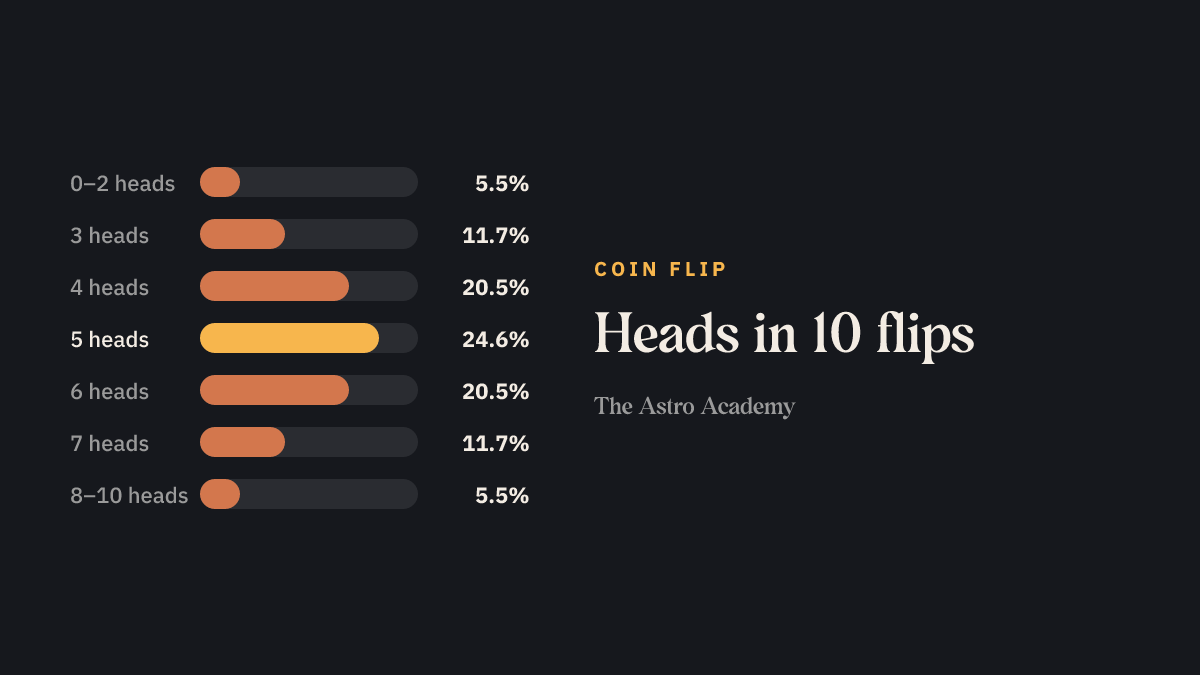
How often do 10 flips give exactly five heads?

24.6% of the time. Of 1,024 possible sequences, 252 have exactly five heads. That makes 5 to 5 the most common result, and it still shows up in only about one round in four.

Seven or more heads come up 17.2% of the time, five heads in a row in 3.1% of all five-flip runs. In best of 3 the winner is settled after two flips 50% of the time. Real coins, by the way, land slightly more often on the side they started on: in a study of 350,757 flips it was 50.8%.

Bar chart of the binomial distribution: number of heads in 10 fair flips, most often exactly 5 at 24.6%, 4 and 6 at 20.5% each.
Number of heads in 10 flips
HeadsSequencesProbability
010.098%
1100.98%
2454.4%
312011.7%
421020.5%
525224.6%
621020.5%
712011.7%
8454.4%
9100.98%
1010.098%

Method: binomial distribution with 50% for heads, every flip independent, the way our coin flip draws (the browser’s random number generator, 50/50). Pure math, no usage data. The figure on real coins comes from Bartoš et al. (2023).

FAQ

Coin flip FAQ

Is an online coin flip truly random?
Yes, for all practical purposes. A digital coin flip uses a pseudo-random number generator. That's an algorithm designed to create results that have no clear pattern. It makes sure the chance for heads or tails is always 50/50, which many people consider even fairer than a physical coin.
What is the heads or tails trick for making a decision?
The trick uses a coin toss to show you what you really want. Before you flip, assign one choice to heads and the other to tails. Your immediate feeling when you see the result, whether it's relief or a slight letdown, can tell you which outcome you were actually hoping for.
Can I use a coin flip for a big life decision?
Generally, we don't recommend it. A coin flip is great for small choices that don't have a big impact. For major life decisions, it's better to use methods that involve careful thought and considering your values and goals, since a random outcome doesn't account for those things.
What are the odds of getting heads or tails?
The odds are 50 percent for each side. In any given flip, there's an equal chance of getting heads or tails. This probability doesn't change, no matter how many times you've flipped the coin before.
How does a “best two out of three” coin toss work?
In this version, you flip the coin several times until one side has won twice. For example, if you get heads, then tails, then heads again, heads is the winner. This method needs at least two and at most three flips to get a result.