
Rauhnächte calendar
for 2027: twelve nights, twelve months
The Rauhnächte calendar lays each of the twelve nights on a month of 2027 and shows the theme your birth chart has in that month. Enter your birth date; with time and place it gets more precise. Free, calculated with the Swiss Ephemeris.
Rauhnächte 2026/27
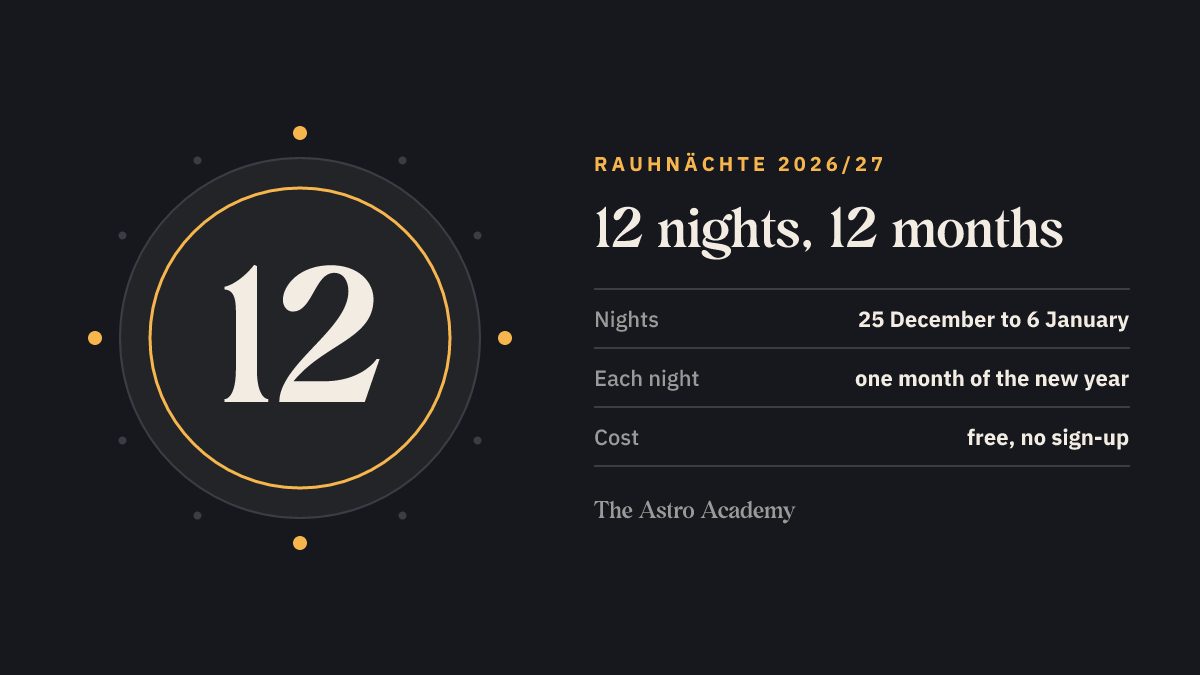
The Rauhnächte 2026/27: from December 25 to January 6, twelve nights for twelve months.
Prepare your 13 wishesYour birth data
When were you born?
The date sets the Sun, Moon and every planet.
Contents
In three steps
Enter your birth data
The date is enough; time and place make houses and Moon more precise.
See twelve months
Every night with its month and the strongest transit in it.
One theme each evening
Take the month’s theme into its night.

Video · 36 seconds
Your Year in 12 Nights
The Rauhnächte, or 12 Holy Nights, each represent a month of the coming year. Use astrology to find out which themes will be important for you in 2027. Calculate it for free: theastroacademy.com
Read along
The 12 nights after Christmas are like the table of contents for your next year. It's an old custom. Each of these nights represents one month of the year ahead. Imagine looking at one chapter title each evening. You get a sense of what that chapter will be about. Astrology can calculate these themes just for you. It looks at which planets will interact with your personal birth chart each month. This is an invitation to prepare for the themes of 2027. Check for yourself what shows up for your January. Find your personal themes for all 12 months at theastroacademy.com.
See the main themes for each month of the coming year with our free Rauhnächte calendar. Old custom connects the twelve nights between Christmas and Epiphany with the twelve months ahead. This tool shows you the strongest astrological influence for each month, calculated from your personal birth chart.
From your birth chart to your Year
The Rauhnächte calendar connects the movement of the planets to your personal birth chart. When you enter your birth data, the tool calculates the most significant astrological transits for you for each month of the coming year.
This gives you a specific theme to consider for that period. A transit happens when a planet currently in the sky forms a specific angle to a planet's position at the moment you were born. We focus on the slow outer planets: Jupiter, Saturn, Uranus, Neptune, and Pluto. Because they move slowly, their influence can shape the background of a whole month, which makes them ideal for this yearly overview.
The calculations are made with the Swiss Ephemeris for high accuracy. If you know your birth time, the themes related to your Ascendant, MC, and the Moon will be more precise. If you do not have it, the tool simply uses noon, and the result is still very helpful.
Which Night stands for which month
The tradition of the twelve nights, or Rauhnächte, assigns each night to a future month, creating a bridge between the old year and the new. The first night, which begins after sunset on December 25, stands for January.
The second night corresponds to February, the third to March, and so on. The cycle continues in order through the twelve nights months. The seventh night, over New Year's Eve, looks at July.
The final, twelfth night, ending on the morning of January 6, represents the following December. This gives you twelve opportunities to look ahead, one month at a time.
| Night | Date | Month |
|---|---|---|
| First | after sunset December 25 | January |
| Second | December 26 | February |
| Third | December 27 | March |
| Seventh | over New Year's Eve | July |
| Twelfth | ending morning January 6 | December |
How to use the twelve nights
This calendar is a tool for reflection, not a set of predictions. On each of the twelve nights, you can look at the theme shown for the corresponding month.
- Ask yourself: Ask yourself where this theme already exists in your life or where you might want to focus your attention.
- Note the theme: A simple practice is to note the theme in a journal each evening.
- Draw a card: You could also draw a card from the Rauhnacht oracle to get another perspective on the topic.
- Write down dreams: In the morning, you might write down any dreams you remember, as they can sometimes connect to the night's theme.
Consider the calendar a map of possibilities. It highlights areas that may call for your awareness in the coming year. It's an aid for your own planning and thinking, helping you to prepare for what lies ahead with more intention.
Which of the twelve nights gets the full moon most often?
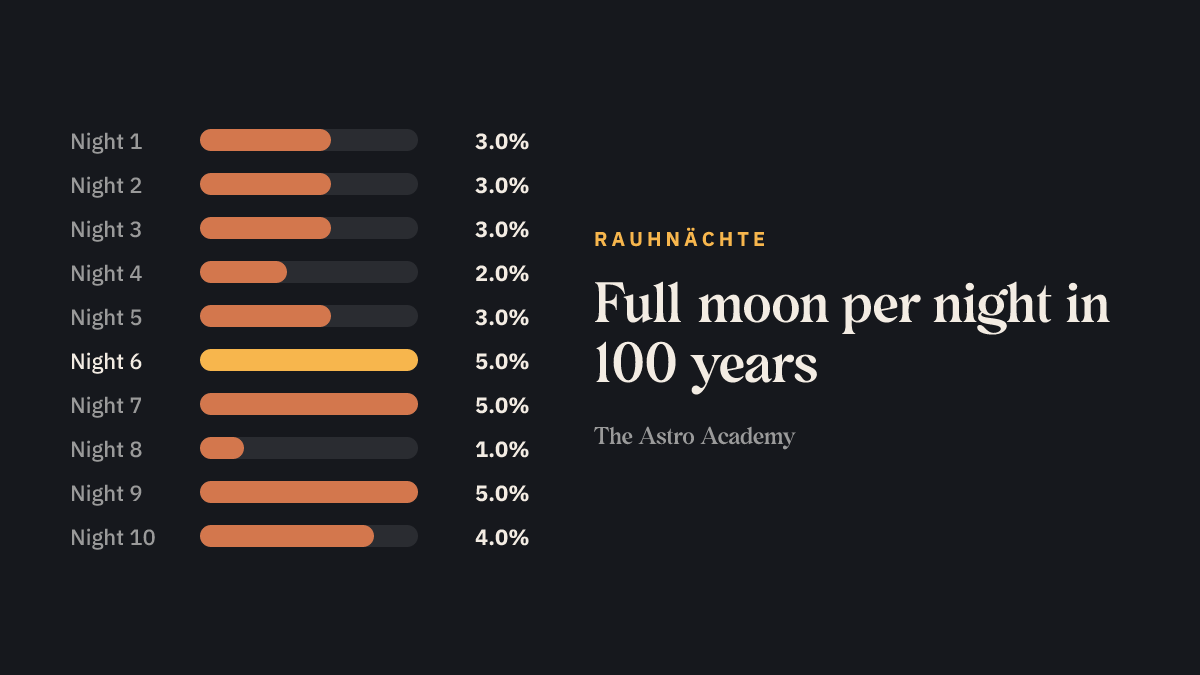
Counted over 100 years, the full moon fell most often on Rauhnacht 6, in 5 years. The differences between the nights are small and random: the Moon needs about 29.5 days for a cycle and spreads almost evenly over the years.
In the Rauhnächte 2026/27 neither a full moon nor a new moon falls into the twelve nights: the full moon comes just before, the new moon just after.
| Season | Moon in the nights |
|---|---|
| 2026/27 | none |
| 2027/28 | New moon, December 27, 2027, night 3 |
| 2028/29 | Full moon, December 31, 2028, night 7 |
| 2029/30 | New moon, January 4, 2030, night 11 |
| 2030/31 | none |
| 2031/32 | Full moon, December 28, 2031, night 4 |
| 2032/33 | New moon, January 1, 2033, night 8 |
| 2033/34 | Full moon, January 4, 2034, night 11 |
Calculated with the Swiss Ephemeris for the seasons 1950/51 to 2049/50. The day of the exact full or new moon in German time counts; the nights are the evenings from December 25 to January 5.
Rauhnächte calendar FAQ
- What is a Rauhnächte calendar?
- A Rauhnächte calendar connects the twelve nights between Christmas and Epiphany to the twelve months of the upcoming year. This one uses your birth chart to find the main astrological theme for each month, giving you a personal guide for reflection.
- Do I need to know my exact birth time?
- No, your birth date and place are enough. The calendar will use noon as a default time if the birth time is unknown. An exact time makes the calculation for the Moon, Ascendant, and MC more precise, but the themes from the other planets will still be accurate.
- Which night stands for which month?
- The first Rauhnacht, from the evening of December 25 to the morning of December 26, stands for January. The second night corresponds to February, and so on, with the twelfth night representing December. This pattern is the same every year.
- Is this calendar a prediction of my future?
- No, think of it as a mirror, not a forecast. The themes it shows are astrological energies you might notice in the corresponding months. It's a tool to help you reflect, plan, and pay attention to certain areas of your life throughout the year.
- Why does the calendar use slow planets?
- Slower planets like Jupiter, Saturn, Uranus, Neptune, and Pluto stay in one area of the sky for a long time. Their transits to your birth chart can influence a period of weeks or months. This makes them well suited to describe the underlying theme of a whole month.
Your year, month by month
The calendar shows you the theme. The twelve nights give you twelve evenings to think about it.
To the twelve nightsFree, no sign-up.