
Tarot spread · 1 position
Daily Yes-or-No Card: your tarot card for today
Daily Yes-or-No Card
Focus on your question and draw the card.
1 card to go.

Video · 35 seconds
Daily Card? Ask it right.
A tarot card isn't an oracle, it's a signpost. It gives you a leaning for your yes-or-no question, but the decision is yours to make. Calculate it for free: theastroacademy.com
Read along
A tarot card won't give you a yes or no. It gives a clear leaning. Think of the card as a signpost. It does not force you down one path. It just shows you where things are pulling today. The final choice is still yours. The principle is simple. Active cards, like The Sun, tend to lean towards yes. Still or withdrawing cards, like The Hanged Man, point towards no. What's the leaning for your question? Work it out for free at theastroacademy.com.
Contents
Your daily card for yes or no
The daily yes-or-no card is one card read against exactly one question: yes or no? You get one card and one leaning.
It won't make the decision for you. It gives you a clear hint about which way the energy points today and leaves the choice in your hands. That's why it's the quickest tool when your head keeps bouncing between two options, say, call tonight or wait.
What the daily yes-or-no card is for
Not every question needs a ten-card story. Some only want a direction.
With yes or no, read the card's energy first. Active, forward cards such as the Sun, the Chariot or the Aces lean yes. Still or withdrawing ones like the Hanged Man, the Four of Swords or the Eight of Cups lean no.
The symbolism shows in what sense the yes or no is meant. In ten seconds you hold an honest leaning, a signpost and not fate.
When the daily yes-or-no card is the right tool
It fits when you:
- have a specific yes-or-no question and want a quick leaning
- are stuck between two options and need a nudge
- want a clear direction for a decision today
- are breaking a bigger question into single yes-or-no steps
How to read your daily yes-or-no card
Word your question as clearly as you can, because a vague question brings a vague answer. First read the card's basic energy: active leans yes, passive leans no.
Then use its symbolism for context. An active card that comes up reversed tips toward "maybe" or "not yet". Treat the leaning as information and not as an order.
You still make the decision. The card only shows where things are pulling at the moment.
Layout: 1 position at a glance
The “Daily Yes-or-No Card” spread works with a single card in the “Yes or no” position. One card means one statement you can read in two minutes and carry through the day.
With a single card, the question carries all the weight: “Yes or no — what is the card leaning toward today?” Read the image first, then the meaning, and check in the evening whether the theme showed up. It often turns up in a message, a conversation or a small decision. If the card lands reversed, read the held-back version of the same meaning.

| No. | Position | Guiding question | Place in the layout |
|---|---|---|---|
| 1 | Yes or no | Which way is the card leaning today: yes or no? | centre |
Where this spread belongs
- Topic: Daily cards tarot spreads
- Related spreads: Daily Card for the Future (1 card) and Aries Daily Card (1 card)
- Every card you draw has its own page: all 78 tarot card meanings, upright and reversed.
- For a quick look at today: draw today's tarot card, or the Celtic Cross spread for a big question.
- All tarot spreads sorted by topic, and the tarot start page with the daily spread.
How likely is the same card twice with "Daily Yes-or-No Card"?
Drawing the same card two days running happens 1.3% of the time with the full deck and 4.5% with the 22 Major Arcana. Every day starts from zero when the stack is shuffled.
Still, repeats come sooner than you would think. Draw one card a day for a week from the full deck and at least one shows up twice 24.2% of the time; after 30 days 99.8%. With 22 cards it is 65.5% after a single week. It is the same idea as two people sharing a birthday in a group: there are so many possible pairs that one almost always matches.
Until you have drawn each of the 78 cards at least once takes 385 days on average, just over a year; for the 22 Major Arcana 81 days. The last few cards take longest, because the chance of a missing card shrinks every day.
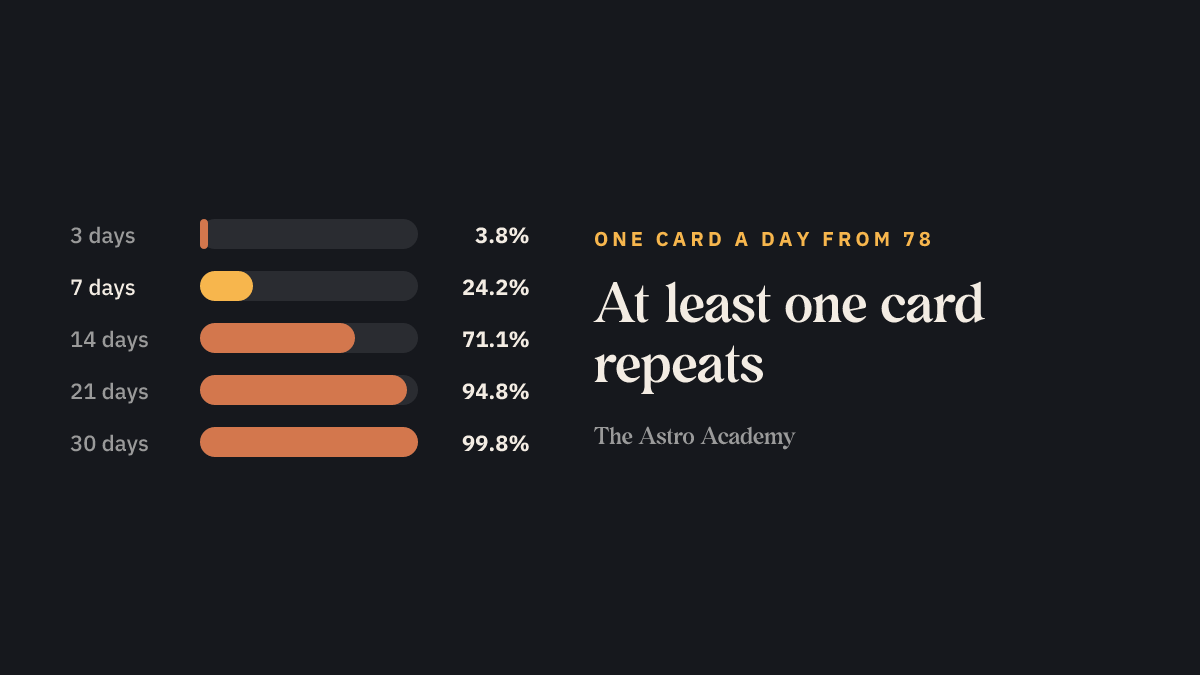
| Case | Value |
|---|---|
| Possible outcomes | 78 cards, 156 with reversals |
| Chance per card, full deck | 1.3% |
| Chance per card, 22 Majors | 4.5% |
| A repeat within 7 days (78) | 24.2% |
| A repeat within 7 days (22) | 65.5% |
| All 78 cards seen, on average | 385 days |
| All 22 Majors seen | 81 days |
Method: pure combinatorics over our 78-card deck (22 Major, 56 Minor Arcana), the way our reading table deals: without replacement, the 22 Majors by default, reversed cards only on request and then at 30% per card. Repeats: the birthday problem; seeing every card: the coupon-collector formula n · (1 + 1/2 + … + 1/n). No usage data.
Daily yes-or-no card: FAQ
- How does a tarot card show yes or no?
- Through its energy. Active, forward cards lean yes, and still or withdrawing ones lean no. The symbolism adds context, and an active card that appears reversed often tips toward maybe.
- How is it different from the single card?
- The single card answers any free-form question; the daily yes-or-no card is sharpened entirely on the yes-or-no leaning for today.
- Is the daily yes-or-no card free?
- Yes, completely free and no sign-up needed.