
Kipper card spreads: a practical guide
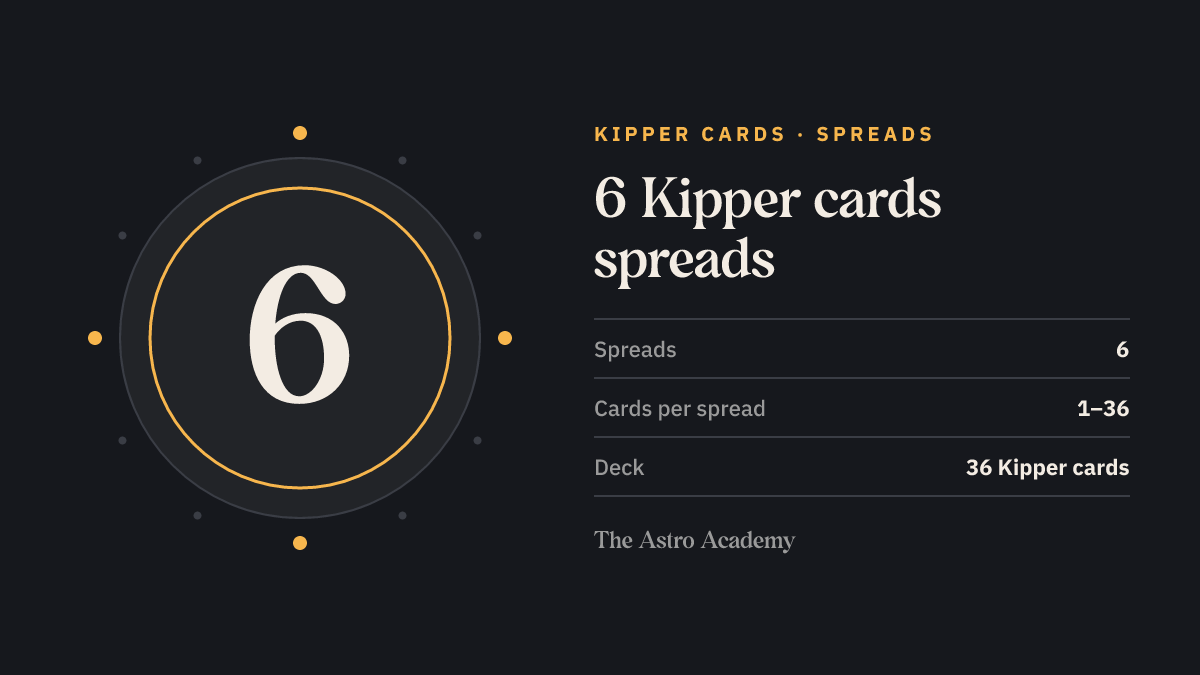
Kipper card spreads help you understand a situation by arranging the cards in a certain way. The right layout depends on what you're asking, from a single daily card to the full thirty six card grand tableau. Finding the best Kipper card spreads for your needs is the first step to getting a clear reading.
For every day
For any question
Love
Work & money
The big spread

Video · 30 seconds
Kipper Spreads Made Simple
Not every question needs the grand tableau. Sometimes a single card is enough to find clarity. This guide shows you how to choose the right spread for what you're asking. Calculate it for free: theastroacademy.com
Read along
One question, 36 cards? That's often way too many. Think of it like cooking. For a quick snack, a simple recipe is enough. For a big dinner party, you need a more detailed plan. It's the same with Kipper cards. The spread gives your question the right size and structure. This is an invitation to organize your thoughts and see things more clearly. Find the right spread for your question at theastroacademy.com.
Contents
Which spread fits your question?
Start by thinking about how much detail you need for your question. A single card is great for a daily focus, while larger Kipper spreads can show how different areas of your life fit together.
The layout you choose helps organize the story the cards tell. For a simple overview or a question about a sequence of events, a three card spread often gives you enough information. Other layouts are made for certain topics.
For example, a five card spread might be set up to look at how a relationship is working. The nine card spread gives you a good look at a situation, and the grand tableau uses all 36 cards for a really deep exploration. It's often helpful to start with smaller spreads to get used to how the cards work together before moving on to the bigger ones.
- Card of the Day: A single theme or person for your attention today.
- Three Cards: A simple timeline for a specific issue.
- Love Spread: The dynamics within a relationship.
- Nine Card Spread: A detailed snapshot of a current situation.
- Grand Tableau: An extensive overview of your life's circumstances.
| Spread | Purpose |
|---|---|
| Card of the Day | A single theme or person for your attention today |
| Three Cards | A simple timeline for a specific issue |
| Love Spread | The dynamics within a relationship |
| Nine Card Spread | A detailed snapshot of a current situation |
| Grand Tableau | An extensive overview of your life's circumstances |
Selecting the Main person card
Before you shuffle, you usually need to pick the card that stands for you in the reading. Kipper has two main person cards for that.
- Main person (man): If you identify as a man, you'll typically use Main person (man).
- Main person (woman): If you identify as a woman, you'll use Main person (woman).
For many spreads, you put this card to the side, face up, and then shuffle the remaining 35 cards. In some big layouts, your card is shuffled into the deck, and you find its spot after all the cards are on the table. For most Kipper spreads, though, your card is the main spot.
Seeing yourself represented by a card on the table is a key part of reading Kipper. The other cards' meanings often depend on how close they are and how they relate to your Main Person card.
The nine card spread and the grand tableau
The nine card spread, also known as a 3x3, gives you a much deeper look than smaller layouts. Your Main Person card can sit in the center, with the surrounding eight cards showing what's influencing you from different sides.
You can read the rows, columns, and diagonals to see how different ideas connect. The grand tableau is the biggest of all Kipper spreads, using the entire deck. It gives you a full map of a situation, with your Main Person card as the main point. The cards closest to your card are the things influencing you right now, while those farther away are less important or further away in time.
In these larger spreads, the direction the figures on the cards are looking really matters. A card like the Good Lady looking toward your Main Person card could mean a supportive connection. A figure turning away might mean someone's pulling away or focusing elsewhere. Check for yourself which interpretation feels more fitting.
Shuffling, drawing, and laying out
Once you have your question and have chosen a spread, hold the cards and think about your situation. There's no one right way to shuffle.
- Do what feels comfortable for you, whether that's a simple overhand shuffle or a more complex mix.
- You just want to mix up the cards.
- Draw cards: When you feel ready, you can cut the deck and draw the number of cards your spread needs.
- Lay them out: Lay them out in the pattern of the spread you chose.
- For example, for a three card spread, you'd lay them out in a row, usually from left to right, to show how things unfold.
- Look at the whole picture: Take a moment to look at the whole picture before looking at each card.
- Notice which people appear and where they are in relation to each other.
- Reading Kipper is like looking at a scene from a play, so observing the entire layout first can give you helpful context.
| Spread | Cards | Good for |
|---|---|---|
| Kipper card of the day | 1 | What does today bring me? |
| Three-card Kipper reading | 3 | How is my situation developing? |
| Kipper love spread | 5 | How is my relationship doing? |
| Kipper cards for work and money | 3 | What is happening at work? |
| Nine-card Kipper spread | 9 | What surrounds my question? |
| Kipper grand tableau | 36 | What does the whole picture around me show? |
How often does a given card turn up in “three cards”?
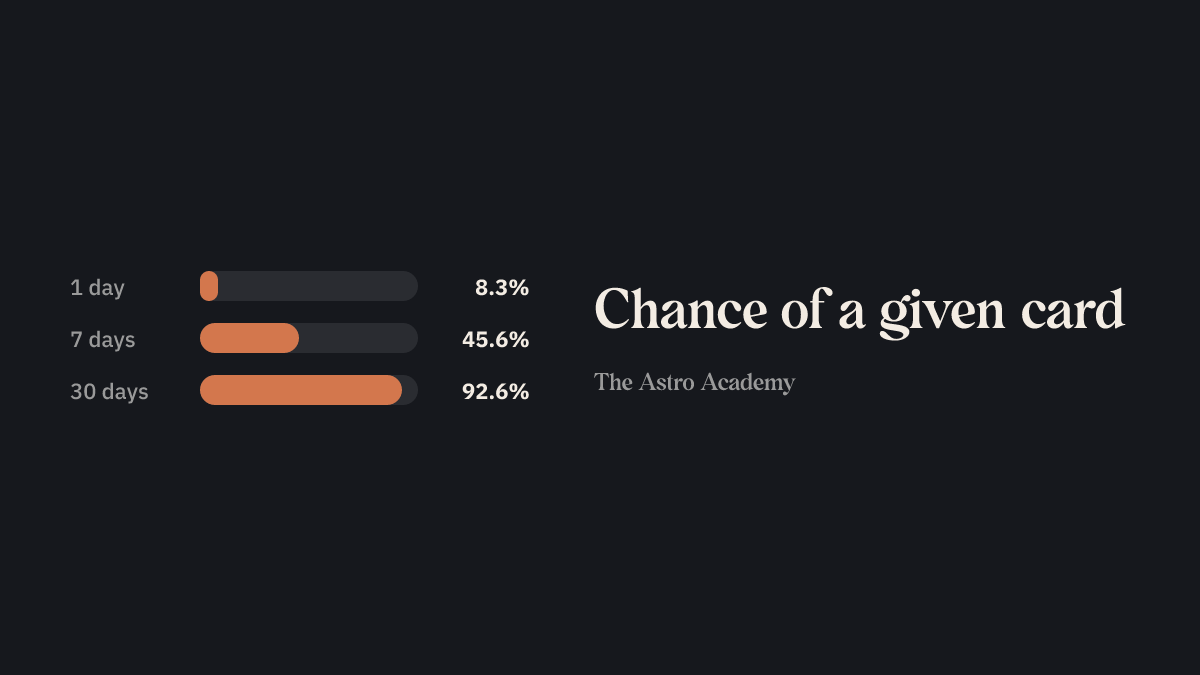
With 3 cards out of 36 Kipper cards cards, every single card is in your spread with 8.3 %. Lay it every day for a week and a given card shows up at least once with 45.6 %, within a month with 92.6 %.
Until you have seen each of the 36 cards at least once takes 49 days on average. The last missing cards take the longest, because fewer new ones are left each day.
| Case | Value |
|---|---|
| Cards in the deck | 36 |
| Cards in the spread | 3 |
| Chance per card and spread | 8.3 % |
| At least once in 7 days | 45.6 % |
| At least once in 30 days | 92.6 % |
| Two given cards on consecutive places | 0.32 % |
| Days until every card was laid once (mean) | 49 |
Pure probability: every card equally likely, every spread freshly shuffled, no card twice in one spread. The mean until every card was laid is computed exactly over all intermediate states.
Frequently asked questions
- What is the best Kipper spread for a beginner?
- The three card spread is an excellent starting point. It's simple enough not to be overwhelming but gives enough detail to show a small story or sequence. This layout helps you get used to how Kipper cards, which focus on people and events, connect with one another in a line.
- How do you read Kipper cards literally?
- Reading Kipper literally means taking the images at face value. The card named “Meeting” often points to an actual meeting, and a “Pleasant Letter” can mean receiving good news through a message. The person cards frequently represent actual people in your life, so a card journal can be very helpful to track who is who.
- Can I use Kipper cards for a yes or no question?
- Kipper cards aren't made for simple yes or no answers. They're great at showing the context, people, and sequence of events around a situation. Instead of a yes or no question, try asking “What should I consider regarding this situation?” to get a more descriptive and useful answer from the cards.
- What's the difference between a nine card spread and the grand tableau?
- The main difference is scope. A nine card spread gives a focused snapshot of a specific issue, using just nine cards. The grand tableau uses all 36 cards to create a broad overview of your entire life situation, showing how various aspects are interconnected.
- Do I have to use a Main Person card in my spread?
- For most Kipper spreads, using a Main Person card is fundamental because the reading is interpreted in relation to that card. An exception is the daily card draw, where you're simply drawing one card for general focus. For any spread with more than one card, picking your Main Person is a key step.