
Kipper cards spread · 9 positions
Kipper 9 card spread: a clear overview
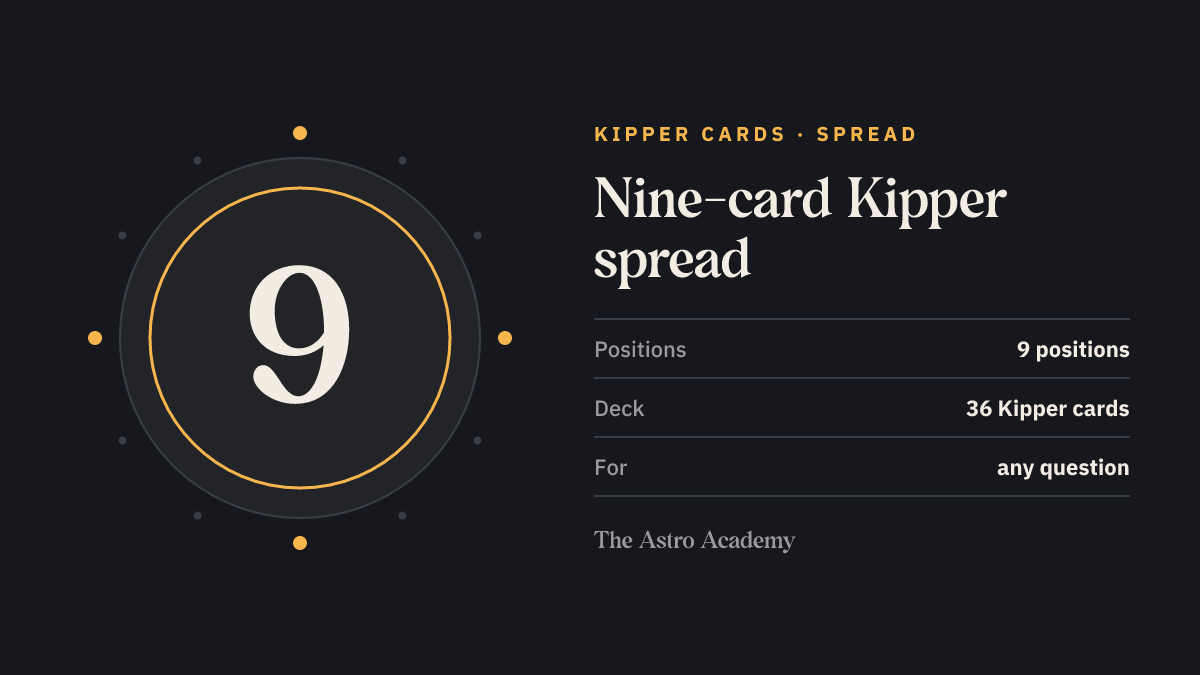
Nine-card Kipper spread
Focus on your question and draw all 9 cards.
9 cards to go.

Video · 34 seconds
Nine Cards, One Picture
The Kipper 9-card spread helps you look at a situation from all angles. This video explains how the central card sets the theme and the surrounding cards give context. Calculate it for free: theastroacademy.com
Read along
A single card rarely tells the whole story. The Kipper nine-card spread is designed to give you a fuller picture. Think of it like a group photo. The card in the centre is your main topic. The eight cards around it add the context. They can point to the past and what's next. This helps you see how things are connected, instead of just looking at separate pieces. It's an offer to look at your question from all sides. See for yourself what resonates. Try the spread for free at theastroacademy.com.
Contents
The Kipper 9 card spread gives you a close look at a specific situation. You put one card in the middle for your question and eight more around it. These other cards show different parts of the topic. This popular layout, also called the Kipper nine card spread, helps you understand your question's background clearly.
The nine positions and their meaning
This spread focuses on one main idea. The first card you place in the middle is the heart of your question.
The other eight cards go around it in a three-by-three square. This setup gives you a full picture of what's going on. Each spot has a job to do in explaining the main topic. Think of the cards around the center as giving you context from all sides.
They show what's on your mind, what happened in the past, and what might be coming. They also point to the basics of the issue and how things could play out. This structure offers way more detail than smaller spreads.
- Center: The core of your question.
- Card above: What you are consciously thinking about.
- Card below: The foundation or what is already established.
- Card to the left: Recent past events influencing the situation.
- Card to the right: The immediate next step or near future.
- Corners: These four cards provide background information and show the broader outcome.
| Position | Meaning |
|---|---|
| Center | The core of your question |
| Card above | What you are consciously thinking about |
| Card below | The foundation or what is already established |
| Card to the left | Recent past events influencing the situation |
| Card to the right | The immediate next step or near future |
| Corners | These four cards provide background information and show the broader outcome |
Reading rows, columns, and diagonals
You read the cards in this spread one by one, and also in rows.
- The three rows: The three rows often show a timeline. The top row can mean thoughts or things coming up, the middle row describes what's happening now, and the bottom row points to the past or the main idea behind it all.
- Columns: Columns offer another way to look at things. The left column can show past influences, the center column focuses on the main issue right now, and the right column points to what's ahead.
- Diagonal lines: Diagonal lines can also matter. They sometimes show hidden links or unexpected things that connect different parts of your story.
When people show up in your reading
Kipper cards often feature people, so you'll usually see a few in a nine card spread. When a person card like Good Lady or Rich Man shows up, it usually means a real person tied to your question.
Where they are in the spread can suggest their role. For example, a person in the “past” spot might be someone you've interacted with lately. If a person card lands in the middle, the whole reading might be about that person or your relationship with them.
Also, notice where they seem to be looking, if the card shows a direction. Like we explain in the grand tableau, a figure looking toward another card can mean a focus or connection. Looking away might suggest a separation or not caring about that part of the situation.
How the nine cards tell a story
A nine card spread does more than just give nine separate answers, it tells a story. Look for common themes by noticing if certain card types appear together.
A group of cards like Work, High Honor, and Official might mean a strong focus on your career. Many relationship cards could point to your social life. How the cards interact is key.
A card like Sad News might feel less harsh if a Great Fortune card is right next to it. See for yourself how the cards seem to talk to each other across the grid. This interplay between people, places, and events is what gives the Kipper nine card spread its depth.
The positions at a glance
“Nine-card Kipper spread” has 9 positions. Each one asks the card lying there its own question.
| No. | Position | Guiding question |
|---|---|---|
| 1 | Above you | What is conscious |
| 2 | What moves you | What drives you |
| 3 | What awaits you | What comes next |
| 4 | What was | What lies behind you |
| 5 | Your question | What it is about |
| 6 | What comes | What shows |
| 7 | Background | What you do not see |
| 8 | What carries you | What you can build on |
| 9 | How it turns out | Where it leads |
How often does a given card turn up in “Nine-card Kipper spread”?
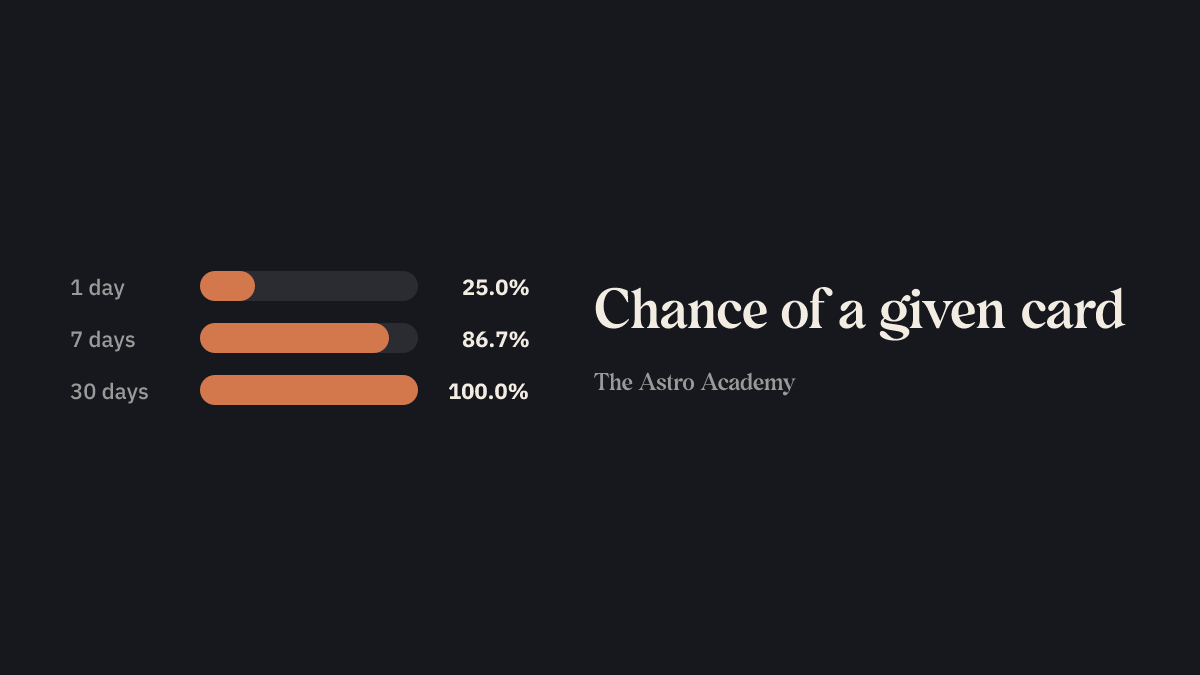
With 9 cards out of 36 Kipper cards cards, every single card is in your spread with 25.0 %. Lay it every day for a week and a given card shows up at least once with 86.7 %, within a month with 100.0 %.
Until you have seen each of the 36 cards at least once takes 15.2 days on average. The last missing cards take the longest, because fewer new ones are left each day.
| Case | Value |
|---|---|
| Cards in the deck | 36 |
| Cards in the spread | 9 |
| Chance per card and spread | 25.0 % |
| At least once in 7 days | 86.7 % |
| At least once in 30 days | 100.0 % |
| Two given cards on consecutive places | 1.27 % |
| Days until every card was laid once (mean) | 15.2 |
Pure probability: every card equally likely, every spread freshly shuffled, no card twice in one spread. The mean until every card was laid is computed exactly over all intermediate states.
Frequently asked questions
- What is the Kipper 9 card spread best for?
- This spread is great for getting a detailed look at one specific question. It's helpful when you need more background than a simple three-card reading can give. For example, it works well when you're looking at a new project or a tricky personal decision.
- Can I use this spread for a daily reading?
- You can definitely use it daily, but it's often more detailed than you need for a quick check-in. Many people find a one or three-card spread works better for a simple daily message or focus point.
- What if my Main Person card lands in the center?
- When your own Main Person card is in the center, the reading really focuses on you. The cards around it then usually describe how you're feeling, things directly affecting you, and your immediate surroundings.
- How do I read the direction the people on the cards are looking?
- Where the figures on the cards are looking adds another layer of meaning. A person looking toward a future card might show anticipation or a connection. If they turn away from a card in the past spot, it can suggest moving on from that issue.
- Does the order of laying the cards matter?
- Having a consistent method is most important. A common way is to place the center card first, then the cards directly above, below, left, and right. Finishing with the four corner cards is a popular technique. But the main thing is to pick an order and stick with it for consistent readings.