
Up to 7 positions · 29 to choose from
Tarot spread builder: make your own
Choose your positions, put them in order, then draw the cards. Each position is read for its own question.
Starting points
- The situationWhat does the situation look like when you look honestly?
- The obstacleWhat is standing in your way right now?
- The adviceWhich piece of advice fits you in this situation?

Video · 35 seconds
Your own spread
A tarot spread breaks down one big question into smaller ones. Find out how to ask clear questions to get clear answers from your cards. Calculate it for free: theastroacademy.com
Read along
Clear questions get you clear answers from your tarot cards. Think of it like a recipe. You cook a meal one step at a time. A tarot spread breaks your big question into smaller ones. Each card answers exactly one of them. A good order often starts with where you are now. It looks at an obstacle, then at your next step. This is an invitation to build your own spreads. One clear question at a time. Build your own custom spread for free at theastroacademy.com.
Contents
Create your own tarot spread: step by step
With the spread builder you create your own tarot spread in a few steps. A spread is simply a question broken into smaller questions. Each one gets a place, the position, and you lay one card on each position. Classic spreads set those smaller questions for you. Here you decide them yourself.
- Write down in one sentence what the question is about.
- Pick a starting point or add positions from the library, which holds 29. If one is missing, write it yourself, with a name and a question.
- Put the positions in the order you want to read them in.
- From four positions on, choose a layout: row, arc, two rows or cross.
- Draw the cards. Each position gets a reading that follows its question.
If you want to share the spread, send the link. It carries your positions and the layout. Whoever opens it draws their own cards in your spread.
What makes a good position
A good position asks an open question. "What helps me move forward?" leaves room for the card, while "Will I get the job?" demands a yes or no that no card can honestly give. So phrase it with "what", "how" or "where". For help with rephrasing, see the page with good questions to ask the cards.
Give each position exactly one theme. If you pack "What do I feel and what should I do?" into one position, you get one card for two questions and won't know which one it answers. A proven order goes from where things stand, through the obstacle, to the next step. That way the spread ends on something you can do yourself.
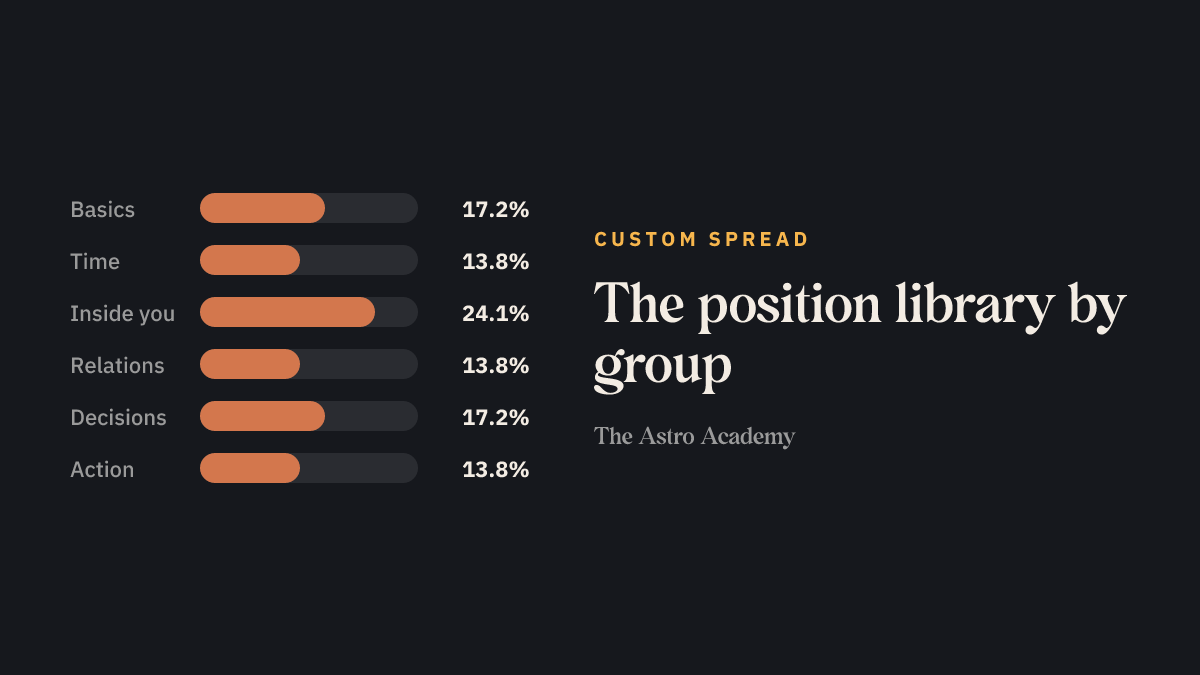
| Group | Count | Positions |
|---|---|---|
| Basics | 5 | The situation, The heart of it, The obstacle, The advice, The direction |
| Time | 4 | What was, What is, What is coming, This week |
| Inside you | 7 | What you feel, What you think, What you need, What unsettles you, Your strength, What you can let go of, What you overlook |
| Relationships | 4 | You, The other person, as you see them, What connects you, What stands between you |
| Decisions | 5 | Path A, Path B, What speaks for it, What speaks against it, What matters to you |
| Taking action | 4 | Next step, What supports you, What holds you back, What to watch for |
Which layout fits?
Up to three cards always sit in a row, which reads like a sentence from left to right. From four positions on, you can choose:
| Layout | Fits when … |
|---|---|
| Row | your question has a sequence, say from earlier to later |
| Arc | one position is at the center: the arc lifts the middle card |
| Two rows | you separate two levels, for example the paths on top and what guides you below |
| Cross | one card lies in the middle and four around it, like the heart of a question with the things pulling on it |
If you would rather start with a proven system, you can find all tarot spreads sorted by topic, from the three-card spread to the Celtic Cross.
How many different spreads can you build?
From the 29 library positions alone you can build 8.2 billion different spreads with one to seven positions, if each position appears at most once and the order counts. With just three positions it is 21,924. Your own positions come on top of that.
On the card side the number grows even faster. Three cards from 78 can land in three positions in 456,456 ways, seven cards in 13 trillion ways. That is why a larger spread practically never repeats card for card.
For any single card this means: the more positions you lay, the more likely it shows up. With three positions the chance for a given card is 3.8%, with seven it is 9%.
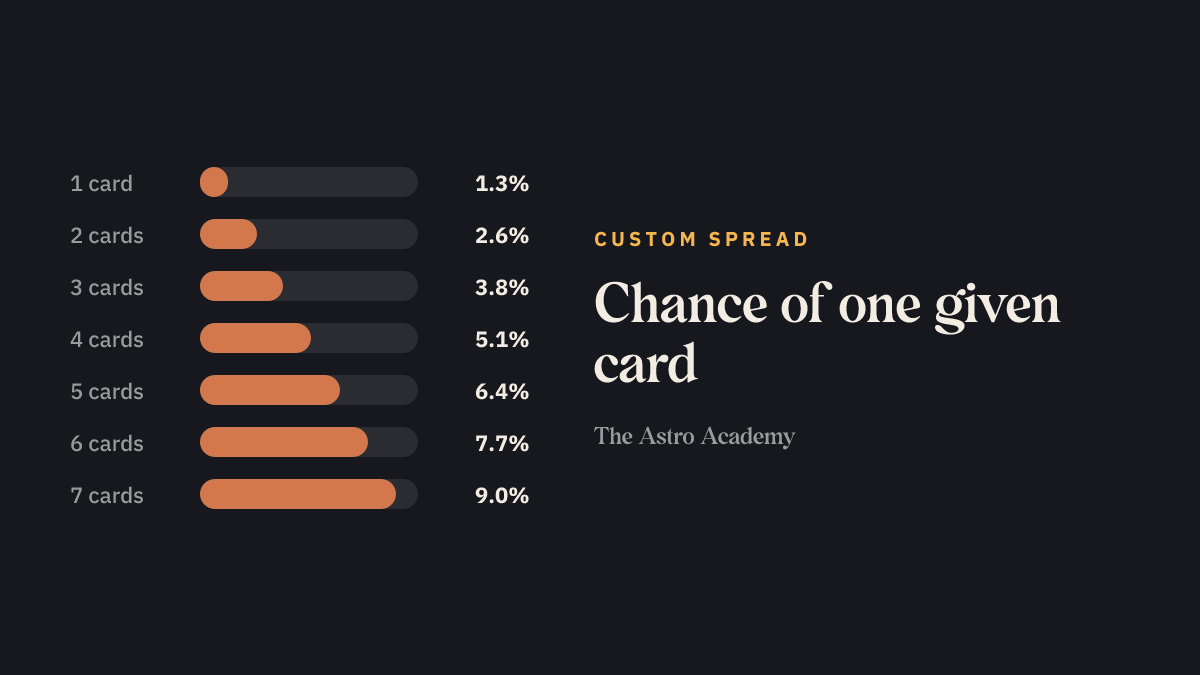
| Positions | Spreads from the library | Draws from 78 cards | Chance per card |
|---|---|---|---|
| 1 | 29 | 78 | 1.3% |
| 2 | 812 | 6,006 | 2.6% |
| 3 | 21,924 | 456,456 | 3.8% |
| 4 | 570,024 | 34 million | 5.1% |
| 5 | 14 million | 2.5 billion | 6.4% |
| 6 | 342 million | 185 billion | 7.7% |
| 7 | 7.9 billion | 13 trillion | 9% |
Method: pure combinatorics. Spreads = ordered selection from the 29 library positions without repeats, draws = ordered selection from 78 cards without replacement, reversals not counted. No usage data.
Custom spread: frequently asked questions
- How do I create my own tarot spread?
- Start with what you want to know and give each part of the question its own position. Pick positions from the library above or write your own, put them in order and choose a layout. Then you draw the cards like in any other spread and get a reading for every position.
- How many cards should a custom spread have?
- Three to five cards cover almost any question. Every extra card is one more answer you have to fit together with the others. You can lay up to seven positions here, since more gets hard to read on a phone.
- Do my own positions get a reading too?
- Yes. The reading for each card follows the name and question of its position, even when you wrote both yourself. The clearer the question for a position, the better the reading fits.
- Can I share or save my spread?
- Sharing always works: the link carries your whole spread, and whoever opens it draws their own cards in your positions. Saving spreads to your account and loading them later is part of the full package.
- How is a custom spread different from the classic spreads?
- Classic spreads like the Celtic Cross have proven themselves over many years and are well explained. A custom spread fits your question exactly instead. Many people start with a classic layout and adapt it later, for example by adding a position for the next step.