
Astrocartography
your birth chart on the world map
Where were your planets highest, lowest, rising and setting at the moment you were born? Each of those spots is a line on the Earth. Calculated with the Swiss Ephemeris from your birth date, time and place.
Your birth data
When and where were you born?
The date sets the Sun, Moon and every planet.
In three steps
Enter your birth data
Date, time and place. The time decides where the lines fall.
See your lines
Sun, Moon, Venus and Mars as lines on the world map, free.
Check a place
Enter a city and see the three nearest lines with their distance.
Video · 32 seconds
Your Chart on the World Map
Astrocartography draws your birth chart as lines on a world map. These places can highlight a planet's themes for you. Calculate it for free: theastroacademy.com
Read along
Your birth chart isn't just a circle. It's also a world map. Imagine each planet is a spotlight. At the moment you were born, it was shining on the Earth. This creates lines on the map. For example, where a planet was rising for you, or at its highest point. Venus is what you love. Many people feel especially good on their Venus line. See if that's true for you. Find out where your personal lines are. Work it out for free at theastroacademy.com.
The four line types
At the moment you were born, every planet stood directly overhead somewhere on Earth, directly underfoot somewhere else, and on the eastern and western horizon in other places. Connect those places and each planet draws four lines. With ten planets, that is 40 lines on your map.
MC line: career and how people see you
Here the planet stood at its highest point when you were born. The line runs as a straight north–south line across the map. Astrologers link it with career, reputation and how strangers see you.
IC line: home and roots
The counterpart of the MC, exactly 180 degrees away: there the planet stood beneath your feet. It is linked with home, family and the feeling of having roots.
AC line: how you come across and feel in your body
Here the planet was just rising in the east. The line is curved because rising depends on latitude. It is linked with presence, body feeling and first impressions.
DC line: encounters and partnership
Here the planet was just setting in the west. This line is curved too. It is linked with partnership, close friendships and the people you meet.
How to read the map
Start with a place you know well: your city, a holiday spot, your parents' town. See which line runs closest and compare with your experience. Did you meet more people there, work more, sleep better? You will quickly see whether the map tells you something.
The colour shows the planet, the dash the line type: solid for MC and AC, dashed for IC and DC. Where two lines cross, astrologers speak of a crossing. Both themes mix there, along the whole latitude too.
What the map cannot do
The lines depend on your birth time. Four minutes off moves them by one degree of longitude, an hour by 15 degrees. If you only roughly know your time, read the map as a rough direction.
Near the poles the rising and setting lines spread out very fast, and some planets never rise or set there. That is why we draw them only between 66 degrees north and south.
Above all: a line decides nothing. It is a lens for looking at a place anew. Whether you feel at home somewhere is something your own everyday life there will show you.
The lines are calculated with the Swiss Ephemeris by Astrodienst, the same basis professional astrology software uses.
More about the planets themselves: your birth chart.
How likely is a line near you?
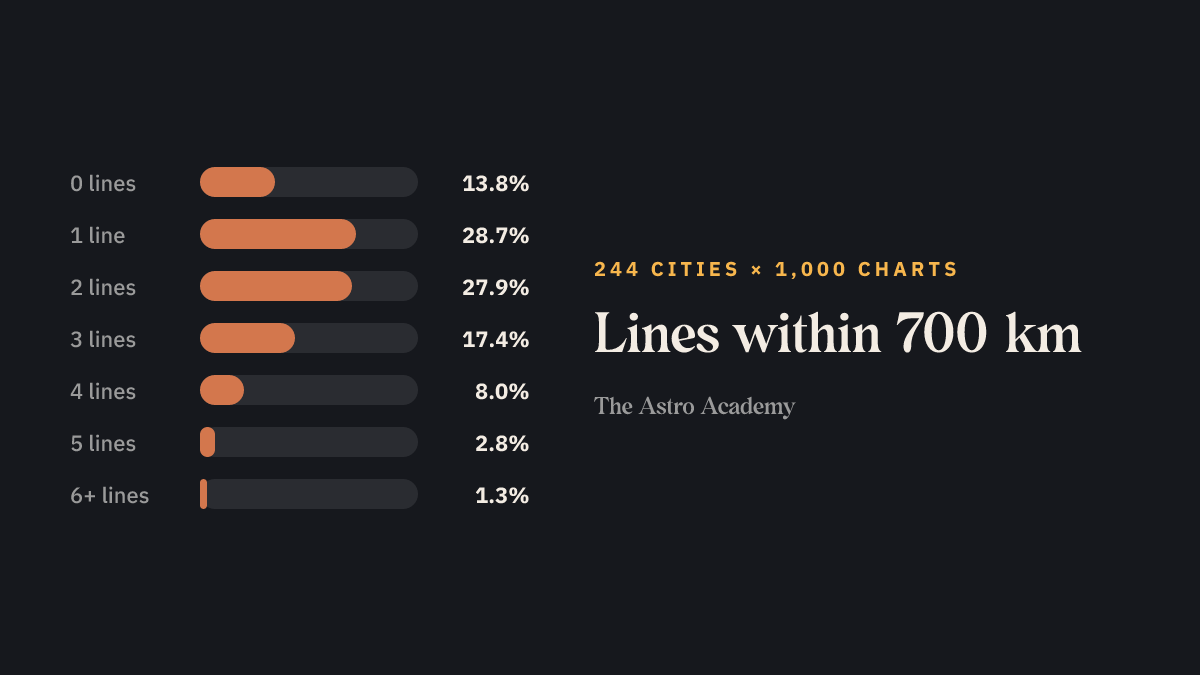
Very likely. For 86.2 % of all cities on our list at least one of the 40 lines runs within 700 km, 1.92 on average. Even within a tight 300 km it is still 56.4 %. With the four free planets, so 16 lines, it is 56.1 % within 700 km.
Why so often? Half of the lines are meridians: the MC and IC lines run from pole to pole and move closer together towards the poles. The rising and setting lines lie almost flat in the far north. That is why most lines gather there, 3.82 on average in Reykjavik, 3.52 in Anchorage, and the fewest near the equator, 1.36 in Nairobi. Berlin gets 2.52, Vienna 2.27, Zurich 2.2.
On average 7.3 of the 40 lines cross Europe, 1 to 18 depending on the chart. So a line nearby is not a rare find but the normal case. What makes it interesting is which planet it is and how close the line runs. Check at a place you know whether its theme feels familiar there.
| Place | Average lines | At least one line |
|---|---|---|
| All cities on the list | 1.92 | 86.2 % |
| Berlin | 2.52 | 92.9 % |
| Vienna | 2.27 | 91.6 % |
| Zurich | 2.2 | 90.1 % |
| Hamburg | 2.57 | 92.5 % |
| Munich | 2.25 | 90.2 % |
| London | 2.41 | 90.8 % |
| Reykjavik | 3.82 | 96.4 % |
| Singapore | 1.49 | 80.7 % |
| Sydney | 1.74 | 84.8 % |
| New York | 1.95 | 89.3 % |
| Anchorage | 3.52 | 96 % |
| Bergen | 3.39 | 95.9 % |
| Nairobi | 1.36 | 77.5 % |
| Addis Ababa | 1.36 | 77.7 % |
| Darwin | 1.37 | 78.1 % |
1,000 sample charts, spread at random over the years 1950 to 2010 and every time of day, computed exactly like the map above (Swiss Ephemeris, 40 lines, distance to the line on the globe), measured against the 244 cities on our place list. Europe: 36 to 71 degrees north, 10 degrees west to 40 degrees east.
Astrocartography FAQ
- What is astrocartography?
- Astrocartography projects your birth chart onto the world map. For each planet it shows where, at the moment you were born, it was rising, setting, at its highest or at its lowest point. That gives four lines per planet, along which its theme is traditionally said to be felt more strongly.
- Do I need my exact birth time?
- Yes. The Earth turns one degree of longitude every four minutes — an hour off moves every line by 15 degrees, about 1,670 km at the equator. Without a time we use 12:00 noon; the map is then only an example, not a statement about you.
- How close to a line do I need to be?
- Most astrologers read a line as clear within about 300 km and as fading out to about 700 km. That is why we show every line within 700 km with its distance — check for yourself whether you notice a difference in those places.
- Does the map tell me where to move?
- No. A line is a hypothesis, not a promise. Many use the map to travel more consciously or to understand a place they already know in a new way. Whether a move is good depends on people, work and everyday life — not on a line.
- What is included for free?
- For free you see the lines of the Sun, Moon, Venus and Mars on the world map and, for one place, the three nearest lines with a short meaning. Your personal astrologer adds Mercury, Jupiter, Saturn, Uranus, Neptune and Pluto, as many places as you like, your top places for love, career and calm, and every line read in depth.
- How accurate is the calculation?
- We calculate with the Swiss Ephemeris, the same basis professional astrology software uses: each planet's right ascension and declination at the moment of your birth, plus sidereal time at Greenwich. The lines are accurate to about ten kilometres — the biggest uncertainty is almost always the birth time.
Read your own chart
Learn Astrology & Tarot in 30 Days — 5 minutes a day is all it takes.
Start freeFree, no sign-up.