
Single points
in your birth chart, looked up one at a time
Your chart holds many points, such as the rising sign, Moon, Venus and MC. Your star sign is only one of them. Each point tells its own part of the story. Look them up here one at a time, free and in plain language.
Your birth data
Which placements do you have?
The date sets the Sun, Moon and every planet.
Contents
From one point to the whole picture
Start with one point
Most people begin with their rising sign or Moon sign. Those two are usually the quickest to recognize in yourself.
Check it against yourself
Read the interpretation as a question rather than a verdict. What do you recognize, and what misses completely? Both tell you something.
Put the points together
Single points are building blocks. Only the full birth chart shows how they work together, and that is where the parts turn into a picture.


Video · 28 seconds
Your chart is more
Your birth chart is made of many individual points, not just your sun sign. Each one tells a different part of your story. Get to know the building blocks of your chart.
Read along
Two people with the same birthday can have completely different birth charts. That is because your sun sign, what people call your star sign, is only one part. You also have a moon sign and a rising sign, for example. Think of your chart as a house. Each of these points is a building block. Each block answers a different question about you. Just start with one. Find out what your points are for free at theastroacademy.com.
Nine points in your chart
Each point answers a different question about you. Start with whichever one you are curious about. Further down you can see what each one covers.
Moon sign
What do you need in order to feel safe?
Venus
How do you love, and what do you truly value?
South Node
What comes so easily you overlook it?
Lilith
Where are you untamed, and where did you hide it?
Which placement do you need, and do you need your birth time?
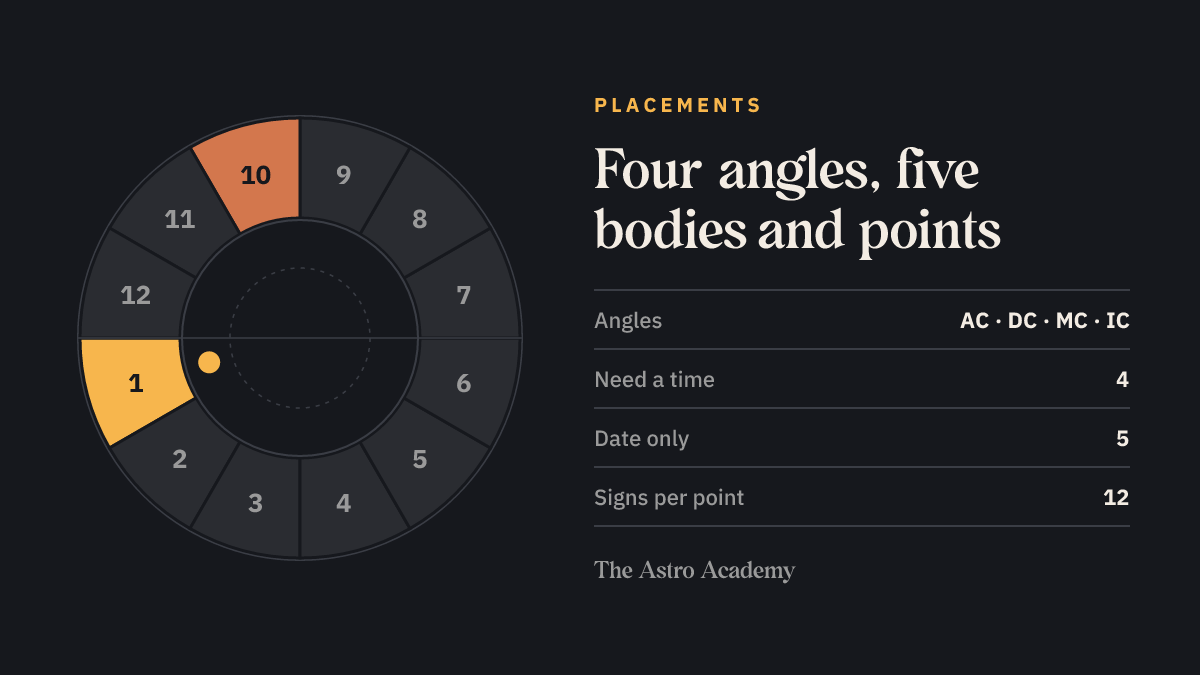
The nine points in this overview come in three different kinds. Four of them are angles: Ascendant, Descendant, MC and IC. They come from the horizon and meridian of your birthplace and turn through all twelve signs once a day, which is why they cannot be found without an exact time. The Moon, Venus and Neptune are real bodies whose sign only needs your date. Lilith and the South Node are calculated points of the Moon's orbit, and they too need only the date. If you do not know your birth time, start with the date-only points and add the angles later.
| Point | Kind | Time needed | Per sign | Opposite |
|---|---|---|---|---|
| Rising sign | Angle | yes | about 2 h | Descendant |
| Descendant | Angle | yes | about 2 h | Ascendant |
| MC | Angle | yes | about 2 h | IC |
| IC | Angle | yes | about 2 h | MC |
| Moon sign | Body | no | about 2.5 days | — |
| Venus | Planet | no | 3–5 weeks | — |
| Lilith | Calculated point | no | about 9 months | — |
| South Node | Calculated point | no | about 1.5 years | North Node |
| Neptune | Planet | no | about 14 years | — |
An order for beginners
- Start with your Big Three: Sun, Moon and rising sign.
- Then Venus and the Descendant: how you love and what draws you to others.
- The MC and IC form the second axis: public role and roots.
- Finish with the slow points: South Node, Lilith and Neptune. Mercury to Pluto are in the sign calculator.
Your birth chart shows every point at once, with houses and aspects. Our guide to the 12 houses explains what the houses mean.
How long do the points stay in one sign?
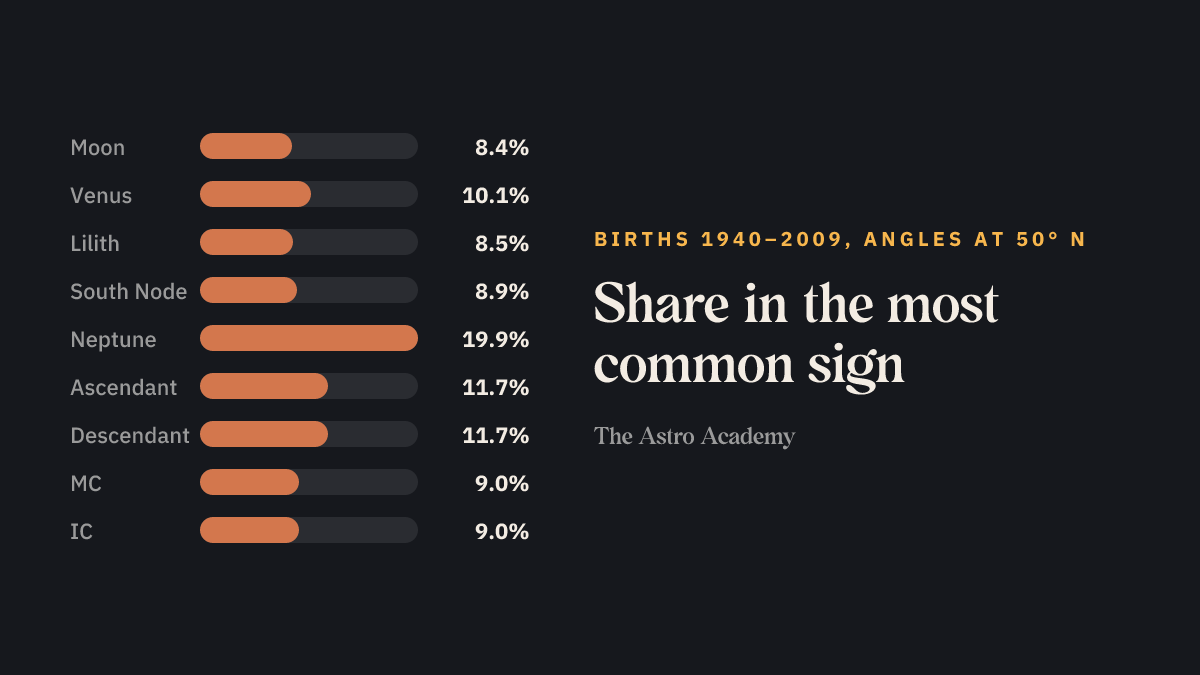
Anywhere from 55 hours to 14.6 years: on average the Moon changes sign after 55 hours, Venus after 33 days, Lilith after 269 days, the South Node after 1.6 years and Neptune only after 14.6 years.
The four angles, by contrast, turn through every sign once a day. At 50° north a sign stays on the Ascendant for 55 to 167 minutes. That is why the Ascendant, Descendant, MC and IC need your birth time, while the slow points only need the date.
| Point | Stay in a sign | Most common sign |
|---|---|---|
| Moon | 55 hours | Virgo 8.4% |
| Venus | 33 days | Aries 10.1% |
| Lilith | 269 days | Virgo 8.5% |
| South Node | 1.6 years | Leo 8.9% |
| Neptune | 14.6 years | Sagittarius 19.9% |
| Ascendant | 55–167 minutes a day | Libra 11.7% |
| Descendant | 55–167 minutes a day | Aries 11.7% |
| MC | 111–129 minutes a day | Gemini 9% |
| IC | 111–129 minutes a day | Gemini 9% |
Counted with the Swiss Ephemeris: every moment from 1940 to 2009 at three-hour steps, each counted equally (not official birth records). Stays from a daily scan 1900–2100, from the first entry to the final change of sign. Angles: Placidus, one sidereal day sampled every 30 seconds, births evenly spread over the day.
Common questions
- Which point should I start with?
- Your rising sign or your Moon sign. The rising sign describes how you come across to others. The Moon shows what you need inside. Add your Sun sign and you have the "big three" most people begin with.
- Do I need my birth time for all of these?
- No. Moon, Venus, Neptune and South Node can usually be found from your birth date alone. Rising sign, Descendant, MC and IC are angles. They pass through all twelve signs within a single day, which is why they need a time and a place.
- What is the difference between a point and a house?
- The point is the "what": Venus, for example, stands for love and for what you value. The sign describes the "how", the house the "where" in your life. You find the houses in the house calculator and the links between points under aspects.
See every point at once
A single point is one puzzle piece. Calculate your full birth chart and see how they fit together.
Calculate freeFree, no sign-up.