
Kipper cards spread · 36 positions
Kipper grand tableau: reading all 36 cards
Kipper grand tableau
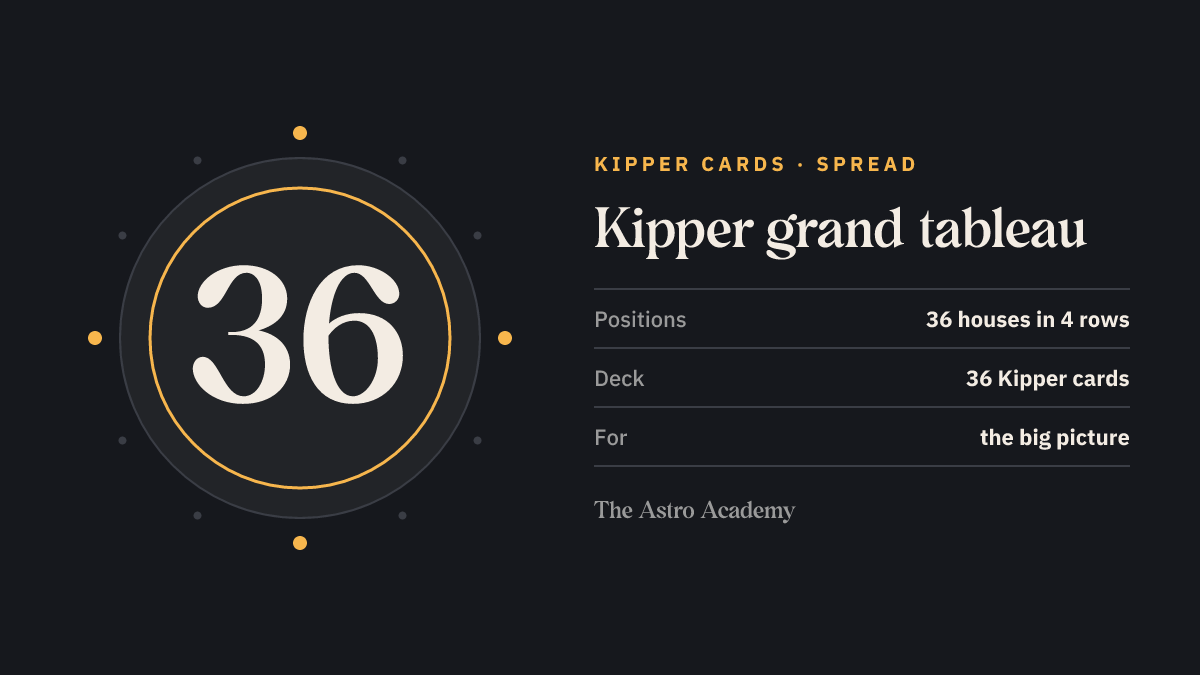
All 36 cards in four rows around your main person.

Video · 38 seconds
Kipper Cards Grand Tableau
The grand tableau with all 36 Kipper cards can feel overwhelming. But it's easy to get started once you know the right place to begin your reading. Calculate it for free: theastroacademy.com
Read along
In a full 36-card spread, you don't start reading at card number one. Think of the cards as a map of your current situation. Some places are closer to you than others. Your starting point is always you. So the first step is to find your own person card. The cards right next to yours show what's most important in your life right now. This is an invitation to see how different parts of your life connect. Check for yourself which themes feel familiar in your day-to-day. Lay your own grand tableau for free at theastroacademy.com.
Contents
The Kipper grand tableau shows you all 36 cards to map out your current situation. You'll see the cards in four rows of nine. To start a reading, you find your main person card, then look at the cards around it to get a bigger picture.
Finding your card in the full spread
To begin a Kipper cards grand tableau, you lay out the whole deck in a grid: four rows with nine cards in each. Your first step is to find your own card, either the Main Person (male) or Main Person (female).
This card is the center of your reading; everything else relates back to it. Once you find your card, the reading moves outward. The cards touching yours, even diagonally, have the most direct impact on you.
They often show the key people, events, or feelings in your life right now. Cards further away are less direct, but still connect to what's happening.
What the figures look at or away from
Many Kipper cards show people, and where they're looking is a big clue.
- Looks toward: If a person card looks toward your Main Person card, it suggests they're focused on you or that a connection is coming. This could be someone thinking about you or an event heading your way.
- Looks away: When a figure looks away from your card, it can mean a few things. It might point to something in the past, something you're moving on from, or an area you're not paying attention to.
For example, if the Good Lady looks away from you, check if you feel a distance in a relationship or if you're overlooking her qualities right now.
Near, far, above, and below
How far any card is from your main person card matters.
- Close cards: Close cards suggest strong, present influences.
- Far away cards: Cards that are far away represent themes from the distant past, far in the future, or simply things that aren't as important right now. The rows and columns add another layer.
- Cards above: Cards above your main person can show your thoughts and what you're aware of.
- Cards below: Cards below might point to what's fundamental, already set, or in your subconscious.
Reading the columns your card is in can sometimes show a flow of events from the past (bottom) to the future (top).
When a grand tableau makes the most sense
A Grand Tableau reading isn't for a simple, everyday question. It's best when you want a broad overview of your life or need to understand how different areas connect.
It gives a detailed snapshot, so it's most useful for exploring complex situations without focusing on just one thing. Interpreting all 36 cards together takes time and careful thought.
It links themes like love from relationship cards, work from career cards, and personal events all in one spread. For a full look at how these dynamics fit together, a personal reading with Theresa can give you detailed guidance.
The positions at a glance
Here all 36 cards lie in four rows of nine houses. Each row stands for its own area of your life.
| Row | Houses | What they stand for |
|---|---|---|
| 1 | 1–9 | What is in the foreground right now |
| 2 | 10–18 | What moves and drives you |
| 3 | 19–27 | What happens around you |
| 4 | 28–36 | What shows as the foundation |
How often does a given card turn up in “Kipper grand tableau”?
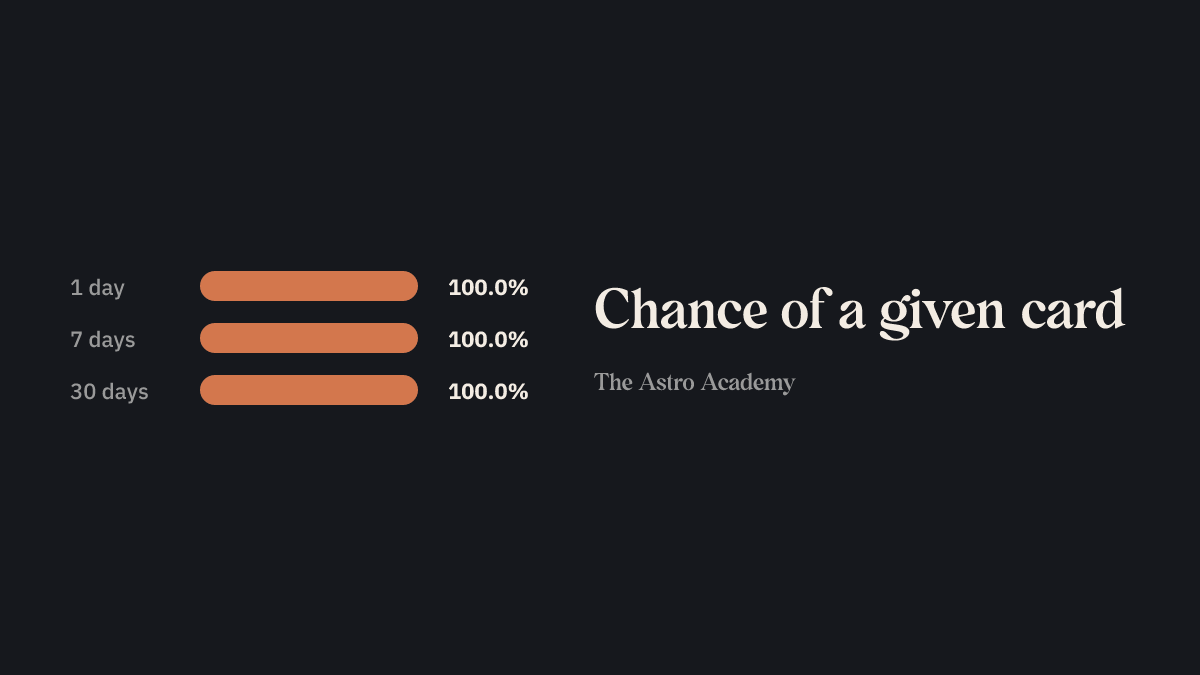
With 36 cards out of 36 Kipper cards cards, every single card is in your spread with 100.0 %. Lay it every day for a week and a given card shows up at least once with 100.0 %, within a month with 100.0 %.
Until you have seen each of the 36 cards at least once takes 1 days on average. The last missing cards take the longest, because fewer new ones are left each day.
| Case | Value |
|---|---|
| Cards in the deck | 36 |
| Cards in the spread | 36 |
| Chance per card and spread | 100.0 % |
| At least once in 7 days | 100.0 % |
| At least once in 30 days | 100.0 % |
| Two given cards on consecutive places | 5.56 % |
| Days until every card was laid once (mean) | 1 |
Pure probability: every card equally likely, every spread freshly shuffled, no card twice in one spread. The mean until every card was laid is computed exactly over all intermediate states.
Frequently asked questions
- How do you lay out a Kipper Grand Tableau?
- You shuffle the 36 Kipper cards and place them face up one by one, from left to right. The first nine cards form the top row, the next nine form the second row, and so on, until you have a large 4x9 grid.
- Where do I start reading a Kipper Grand Tableau?
- A reading always starts from your significator card's position, either Main Person (male) or Main Person (female). Once you find it, you interpret the cards immediately surrounding it, as these have the most direct impact.
- What do the rows mean in a Grand Tableau?
- While interpretations can differ, a common way is to see the top row as representing the future and your thoughts. The two middle rows often show your current situation, and the bottom row can stand for the past or the foundation of the issue.
- What if my main person card is at the edge?
- If your Main Person lands at the edge or in a corner, its position is part of the reading. A position on the right might mean a strong focus on the future, while being on the left could mean the past has a heavy influence. It also means you have fewer immediate cards to consider.
- Can I read about another person in a Grand Tableau?
- Yes, you can find other person cards, like the Rich Man or a Good Lady, and look at the cards around them. This can offer ideas about their situation and how it connects to yours, though the reading's main focus stays on your own card.