
Kipper cards spread · 3 positions
Kipper cards career: your Work, people, and money
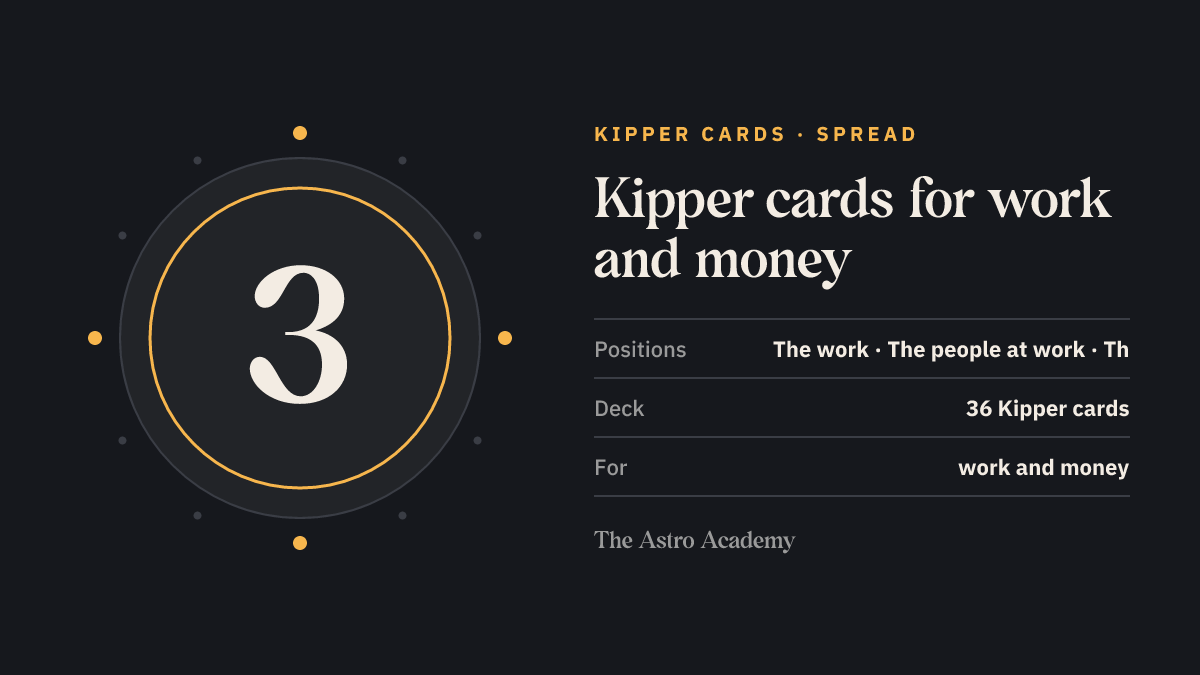
Kipper cards for work and money
Focus on your question and draw all three cards.
3 cards to go.

Video · 36 seconds
Job Clarity in 3 Steps
This simple three-card Kipper spread helps you make sense of your professional life. It separates it into your work, the people, and your finances, so you can reflect on each one. Calculate it for free: theastroacademy.com
Read along
You want clarity in your job, but you're not sure where to begin? A three-card Kipper spread separates your work life into three distinct areas. The first card acts as a mirror for your daily tasks and projects. The second card shows you something about the people in your work environment. And the third card shines a light on the financial side of your job. Consider it an invitation to look at these topics one by one. Check what they reflect for you. Draw your three cards for free at theastroacademy.com.
Contents
This three-card spread gives you a clear look at your professional life. It separates your daily tasks, the people you work with, and the money side of your job. Using Kipper cards career readings this way helps you check where you stand and what to focus on next.
What these three cards stand for
The three spots in this spread are for specific work questions. The first card, “The work,” shows your daily tasks, projects, and bigger responsibilities.
It can point to what you're doing now or a new area to focus on. The second card, “The people at work,” covers how you interact with colleagues, bosses, or clients. A person card here might suggest a specific individual.
An event card, like Meeting, could point to the general vibe of communication. Finally, the third card, “The money,” is all about your salary, income, and what you earn from your job. It shows the material side of your work, from your regular paycheck to a possible bonus.
| Position | Card | Meaning |
|---|---|---|
| First | The work | daily tasks, projects, bigger responsibilities |
| Second | The people at work | interact with colleagues, bosses, clients |
| Third | The money | salary, income, what you earn |
Key cards for your professional life
Several Kipper cards directly relate to your professional life.
- The Work card: The Work card itself often points to your daily labor and the effort you put in. It can mean you're busy or have a heavy workload.
- High honor: Cards like High honor suggest recognition, success, and public praise for your efforts. This might look like a manager's compliment or a project you finished well.
- The Official: The Official can mean bureaucracy, contracts, or formal steps you need to follow, like when you deal with HR.
- A Uniformed person: A Uniformed person might mean an authority figure, someone in a specific regulated job, or the need to follow set rules.
- The Rich man: The Rich man often symbolizes an influential boss, a mentor, or a wealthy client who can really impact your career.
What the cards show about finances
When you look at Kipper cards money often shows up very directly.
- Lots of money: The Lots of money card points to financial security, a good salary, or a profitable business. It suggests that the money side of your work is solid.
- Unexpected money: Unexpected money can mean a bonus, a raise, or some other sudden financial gain you weren't expecting.
- The Theft card: On the other hand, the Theft card is a warning. This card doesn't always mean someone's literally stealing something.
At work, it could mean you feel your efforts aren't paid enough, a bad business investment, or a deal where you might lose out. It's a reminder to check the fine print.
Colleagues, bosses, and clients as person cards
Kipper has many person cards, and in a career reading, they often mean the people you work with. Try to see them as roles or types of behavior instead of judging someone's character.
For instance, a Good lady could be a helpful colleague or a supportive mentor. The main person cards, Main person (man) and Main person (woman), represent you if you identify with them, or maybe a very close business partner. Other cards can point to specific roles. An Official could be someone from a government agency you work with.
A Rich girl might represent a younger client with resources. When a person card shows up, ask yourself who at your workplace comes to mind. Which part of their behavior or their role fits the card's general meaning? This can help you understand your professional relationships better.
Good questions for new opportunities
If you're thinking about changing jobs or applying for a new one, the cards can help you think about your approach. Instead of asking “Will I get the job?” (which is asking for a prediction), you can ask more open questions.
This helps you look at the situation from different angles. For example, you could ask about the company culture, the kind of work you'd be doing, or the people you might work with. The cards can offer a hypothesis for you to check.
A Meeting card might suggest a very collaborative environment. The Work card could point to a hands-on, demanding role.
- What should I highlight in my application?
- What might the team atmosphere be like?
- Which of my skills will be most valued in this role?
- What is one thing to be aware of during the interview?
The positions at a glance
“Kipper cards for work and money” has 3 positions. Each one asks the card lying there its own question.
| No. | Position | Guiding question |
|---|---|---|
| 1 | The work | How is it going? |
| 2 | The people at work | Who plays a part? |
| 3 | The money | What shows with money? |
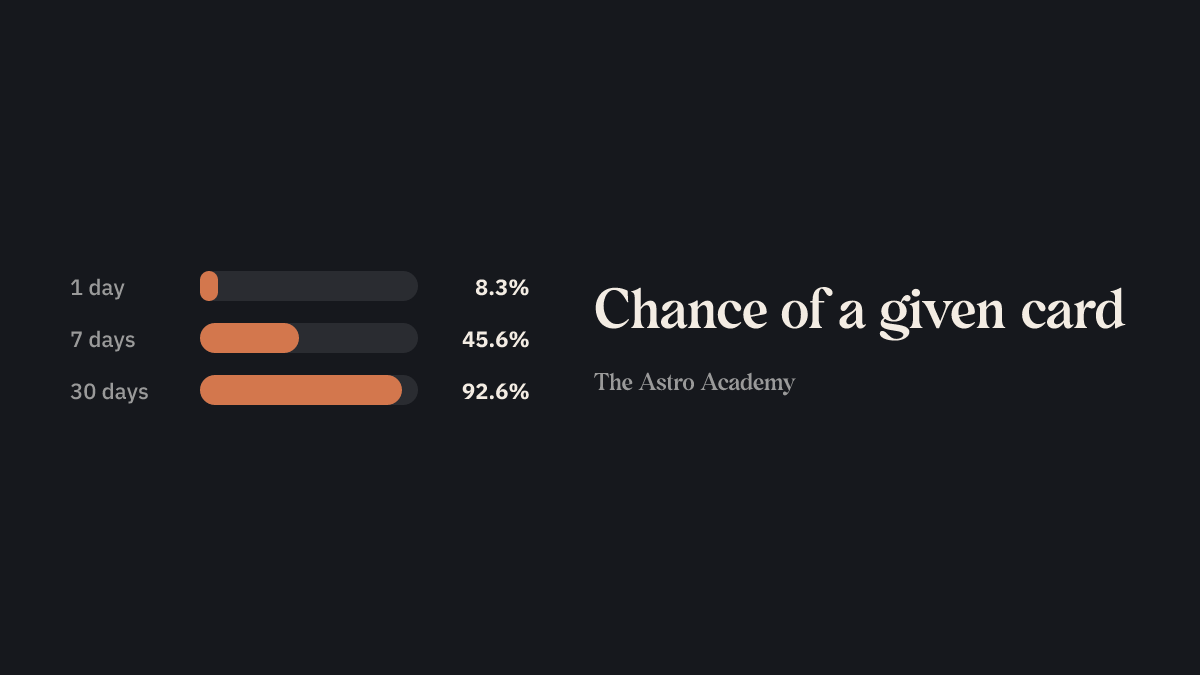
How often does a given card turn up in “Kipper cards for work and money”?
With 3 cards out of 36 Kipper cards cards, every single card is in your spread with 8.3 %. Lay it every day for a week and a given card shows up at least once with 45.6 %, within a month with 92.6 %.
Until you have seen each of the 36 cards at least once takes 49 days on average. The last missing cards take the longest, because fewer new ones are left each day.
| Case | Value |
|---|---|
| Cards in the deck | 36 |
| Cards in the spread | 3 |
| Chance per card and spread | 8.3 % |
| At least once in 7 days | 45.6 % |
| At least once in 30 days | 92.6 % |
| Two given cards on consecutive places | 0.32 % |
| Days until every card was laid once (mean) | 49 |
Pure probability: every card equally likely, every spread freshly shuffled, no card twice in one spread. The mean until every card was laid is computed exactly over all intermediate states.
Frequently asked questions
- Can Kipper cards predict if I will get a promotion?
- Kipper cards don't predict future events like promotions. Instead, they can highlight themes that are active right now. If you see cards like High honor or Lots of money, you can check for yourself if this points to growing recognition or financial improvement in your current role.
- What does the Theft card mean in a career reading?
- In a career context, the Theft card is rarely about someone stealing office supplies. It more often suggests feeling undervalued, a loss of resources, or an unfair deal. It's a reminder to pay close attention to agreements and make sure you get fair pay for your work.
- How do I read person cards for my colleagues?
- Think of person cards as professional roles or dominant traits in a work setting. The Official could be the person who handles contracts. The Rich man might be your boss or an important client. It's less about their whole personality and more about their function in your professional life.
- Which Kipper cards are best for money questions?
- For direct financial questions, Lots of money and Unexpected money are the clearest signs of your income situation. But other cards can add detail. The Rich man can point to a source of wealth or investment. The Work card often connects directly to what you earn from your labor.