
Lenormand spread · 1 position
Lenormand card of the day: your daily focus
Lenormand card of the day
Focus on your question and draw the card.
1 card to go.

Video · 32 seconds
Your Daily Card for Today
A single Lenormand card isn't a prediction. It gives you a theme, a keyword to focus on for the day. This helps you notice things that are already happening in your life. Calculate it for free: theastroacademy.com
Read along
A daily card won't predict exactly what will happen today. Think of it more like a headline for your day. It gives your mind one theme to be aware of. A single keyword. If you pull the Key, your theme could be solutions. You might notice yourself finding a clever fix for a problem. The card is an invitation to pay attention. It mirrors a topic that is already present in your life. Find your theme for today. Draw your daily card for free at theastroacademy.com.
Contents
A Lenormand card of the day gives you one main idea to focus on. It acts like a keyword or a helpful hint, drawing your attention to something that might come up during your day. Think of it as a quick, mindful check-in, not a prediction of what's going to happen.
What a daily Lenormand card is, and isn't
A single daily Lenormand card gives you a theme, like a headline for your day. It's meant to make you aware of something, not to predict exactly what will occur.
For example, if you pull the Key, your theme could be solutions. You might then notice how you find a clever fix for a broken drawer handle or have a moment of clarity about a work problem. The card simply brings a concept into focus. It's good to know what the card can't do.
It won't tell you specific events, help with big life decisions, or give you health information. The daily card is like a mirror for your own experience, showing a theme that might already be there. If you have more complex questions about a situation, Lenormand spreads with more cards work better.
| What it is | What it isn't |
|---|---|
| gives a theme, headline | predict exactly what occurs |
| makes you aware of something | tell specific events |
| brings a concept into focus | help with big life decisions |
| mirror for your experience | give health information |
| simple focus | for complex questions |
How to use your card from morning to evening
In the morning, look at your card and think about its main meaning. You don't need to spend a lot of time on it.
- Make a mental note: If you pull the Ship, for instance, you can make a mental note to watch for themes of travel, distance, or things moving forward. This could be as literal as planning a trip or as subtle as a chat with someone far away.
- Look back in evening: Later, in the evening, take a moment to look back.
- Observe connection: Did the card's theme show up in your day?
Maybe the Ship appeared when you got a package you'd been waiting for, or perhaps you just felt a sense of wanting to be somewhere else. The connection is sometimes obvious and other times very personal. The goal isn't to prove the card right.
It's to practice observing and build your own understanding of the deck. This simple habit helps you connect with the Lenormand card meanings in a practical way. Over time, it can become a useful starting point for keeping a more detailed Lenormand journal.
When a difficult card like Coffin shows up
Pulling a card like the Mountain, Clouds, or Coffin can feel a bit unsettling at first. It's natural to feel some concern.
Remember that as a daily card, it's not a literal prediction of something terrible. Instead, it points to a common human experience, a feeling, or a type of situation you might notice.
- The Coffin: The Coffin, for example, often points to an ending. This could be as simple as finishing a long, boring project at work or deciding to drop an old habit.
- The Mountain: The Mountain might show up as a frustrating roadblock, like your computer freezing during an important task.
- The Clouds: The Clouds can mean a moment of confusion or a conversation where things felt unclear.
Seeing these cards as a daily theme can be surprisingly helpful. It gives a name to an experience, which can make it feel more manageable. The card acknowledges that some days involve delays, goodbyes, or muddled moments.
A single card versus a three card spread
Your daily Lenormand card is a single, short keyword for the day. A three card Lenormand spread, however, tells a small story by creating a sentence.
That type of reading gives more context by showing how different energies work together, as explained on the page about our free Lenormand reading. A single card offers the benefit of being simple and having a clear focus. It's a great way to get to know the deck, one card at a time, without feeling overwhelmed. A spread of three or more cards is better for looking into a specific question or understanding how a situation develops, since different Lenormand spreads are made for different things. You can also collect your daily cards over a period of time.
At the end of a month, lay them all out in the order you pulled them. Do you notice any patterns or cards that keep coming up? Maybe the Fox appeared several times during a week when you had to be clever at your job. This review process turns individual observations into a bigger, more meaningful picture of your month.
| Single Card | Three Card Spread |
|---|---|
| short keyword for day | tells a small story |
| simple and clear focus | gives more context |
| get to know the deck | for specific questions |
| one card at a time | how a situation develops |
The positions at a glance
“Lenormand card of the day” has 1 position. Each one asks the card lying there its own question.
| No. | Position | Guiding question |
|---|---|---|
| 1 | Your card for today | What do you watch for today? |
How often does a given card turn up in “Lenormand card of the day”?
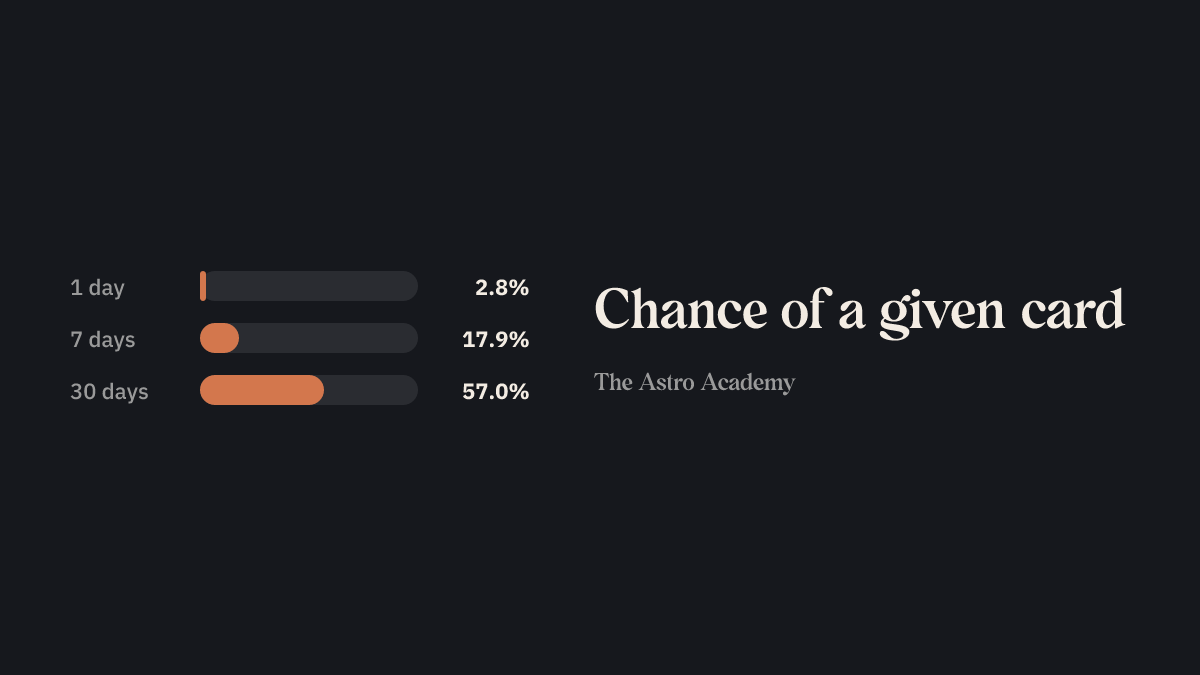
With 1 card out of 36 Lenormand cards, every single card is in your spread with 2.8 %. Lay it every day for a week and a given card shows up at least once with 17.9 %, within a month with 57.0 %.
Until you have seen each of the 36 cards at least once takes 150.3 days on average. The last missing cards take the longest, because fewer new ones are left each day.
| Case | Value |
|---|---|
| Cards in the deck | 36 |
| Cards in the spread | 1 |
| Chance per card and spread | 2.8 % |
| At least once in 7 days | 17.9 % |
| At least once in 30 days | 57.0 % |
| Days until every card was laid once (mean) | 150.3 |
Pure probability: every card equally likely, every spread freshly shuffled, no card twice in one spread. The mean until every card was laid is computed exactly over all intermediate states.
Frequently asked questions
- What does the daily Lenormand card mean?
- The daily Lenormand card offers one main idea or keyword for you to think about during your day. It's not a prediction but more of a gentle suggestion of what to pay attention to. For example, the Dog card might point your focus toward themes of friendship and loyalty.
- How do I interpret a negative Lenormand card of the day?
- When you pull a card like the Scythe or the Mice, try to see it as a symbol for a type of event or feeling, not a bad sign. The Scythe could point to a sudden decision, and the Mice might suggest a minor annoyance or loss. The card simply names a challenge you might notice.
- Can I use the daily card for a yes or no question?
- A single card of the day isn't great for a yes or no answer. Its purpose is to give you a theme, not a simple yes or no. For yes or no questions, a specific spread is more helpful because it uses several cards to give a clearer idea.
- How is a daily Lenormand card different from a daily tarot card?
- While both give you a daily point of focus, their style is different. Lenormand cards have very direct, concrete meanings, like Letter for news or House for home. Tarot cards often stand for broader archetypes and psychological states, leaving more room for abstract interpretation.
- How often should I draw a daily Lenormand card?
- As the name suggests, pulling one card each day is the usual practice. This creates a consistent routine and helps you build a personal connection with the cards. Treating it as a small morning ritual can be a great way to start the day with something to focus on.