
Lenormand spread · 3 positions
3 card Lenormand spread: reading the flow
Three-card Lenormand
Focus on your question and draw all three cards.
3 cards to go.

Video · 35 seconds
3 Cards One Story
A three-card spread shows you the background of a situation, where you are now, and where it might be headed. Here is how to read the cards like a sentence. Calculate it for free: theastroacademy.com
Read along
Three cards don't predict the future. They tell a story from A to B. The first card on the left is the starting point. It shows what was, or the background to your question. The middle card is where you are right now. It is the heart of your reading. The third card on the right suggests where things are headed. It is a tendency, not a promise. The trick is to read them like a single sentence. This creates a clear picture of your situation. Lay your own three cards for free at theastroacademy.com.
Contents
The 3 card Lenormand spread is a straightforward way to see how a situation is unfolding. It uses one card for the background, one for what's happening now, and one for where things are going. This simple timeline helps you get the context for your question and see the bigger picture.
The three positions: past, present, and future tendency
This spread uses three spots to tell a short story.
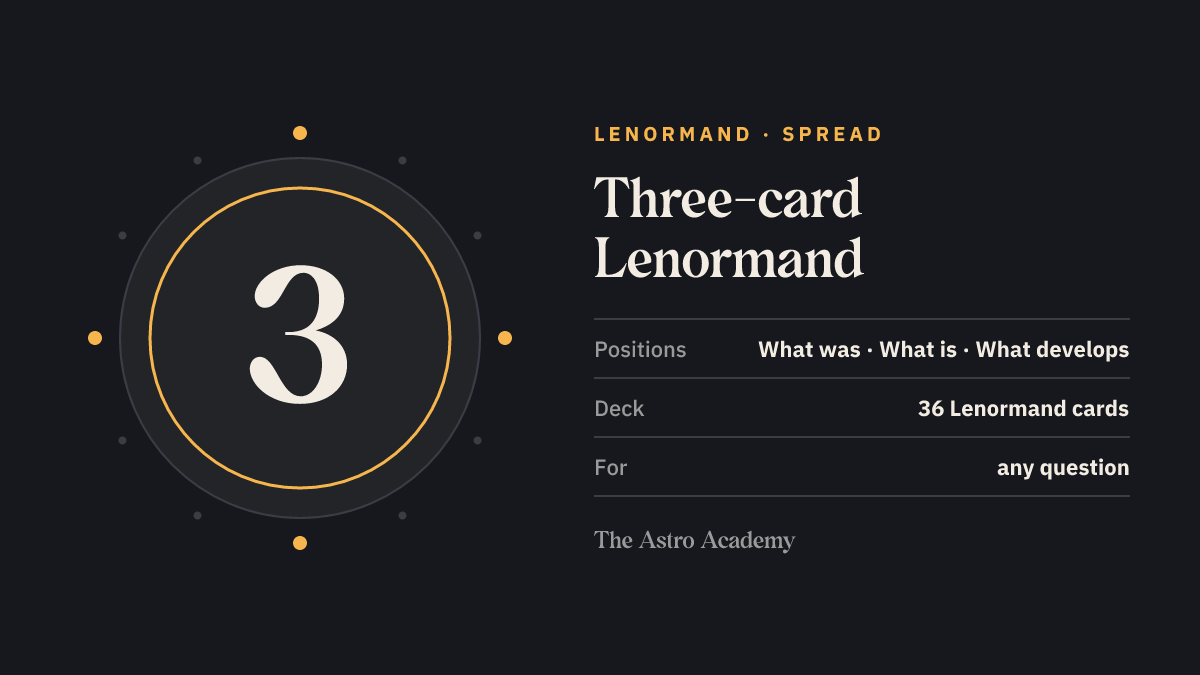
- First card: The first card, on the left, shows 'What was.' It can represent the past, the base of the current situation, or something that's just ending. It gives you the backstory for your question.
- Middle card: The middle card shows 'What is.' This is the core of the issue, showing where you are right now. It points out the main idea or central problem at this moment. Pay close attention to this card, because it's the heart of your reading.
- Third card: The third card, on the right, points to 'What develops.' This card suggests a likely path or where the situation is headed. It's not a set prediction, but rather the next logical step based on the first two cards. It gives you a peek at what might come next if things continue as they are.
| Position | Meaning | Focus |
|---|---|---|
| First card left | What was | Past, current situation base |
| Middle card | What is | Core issue, main idea |
| Third card right | What develops | Likely path, where situation heads |
How to read the cards as a single sentence
A common mistake is reading each of the three cards on its own. The trick to Lenormand is seeing how the cards connect and affect each other.
Think of them as three words that form one clear sentence. The story moves from left to right, creating a straightforward narrative.
- Start with middle card: Start with the middle card as your main topic. Then, look at the first card to see where that topic comes from.
- Read third card: Finally, read the third card to see where the topic is going.
The cards on the sides add color and detail to the center card, changing its meaning. For example, let's say you asked about a new project and drew Scythe, Fox, and Fish.
You could read this as: a sharp decision (Scythe) about your work (Fox) is likely heading toward a change in your finances (Fish). Your job is the main theme, with a past decision affecting its money outcome.
Which questions work best for a three card spread
This spread works best for looking at developments and getting an overview. It's great with open-ended questions that start with 'How' or 'What.' These kinds of questions let the cards show you a process instead of forcing a simple yes or no answer.
Try to be specific, but not too narrow. A question like 'What should I know about my apartment search?' gives the cards enough room to give you helpful context. If a question is too broad, like 'What about my life?', your reading might be hard to use.
Don't ask about other people's feelings or plans, and stay away from questions about health or legal results. Instead, keep the focus on your own situation and the things you can influence. This spread is for thinking things over, not for predicting events you can't control.
- Development: “How is my relationship with my new colleague developing?”
- Overview: “What is the main theme around my move to a new city?”
- Advice: “What should I focus on to improve my creative writing?”
- Context: “What lies behind my recent feelings of restlessness?”
The positions at a glance
“Three-card Lenormand” has 3 positions. Each one asks the card lying there its own question.
| No. | Position | Guiding question |
|---|---|---|
| 1 | What was | What lies behind the topic? |
| 2 | What is | Where do you stand now? |
| 3 | What develops | Where is it moving? |
How often does a given card turn up in “Three-card Lenormand”?
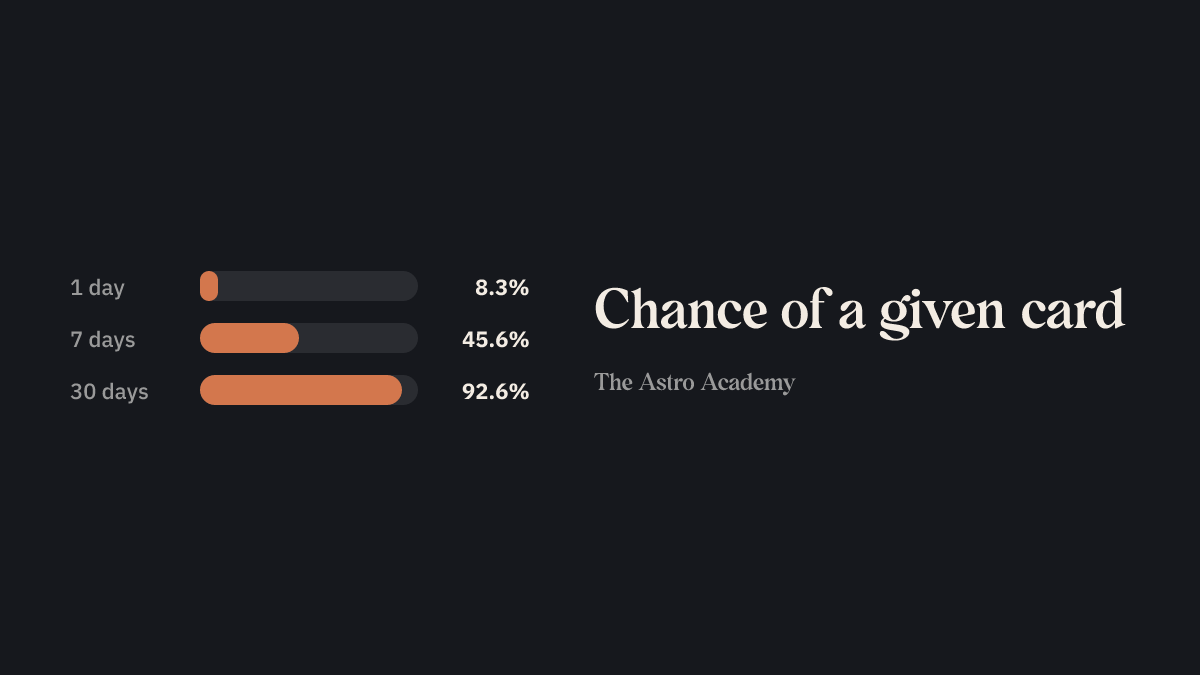
With 3 cards out of 36 Lenormand cards, every single card is in your spread with 8.3 %. Lay it every day for a week and a given card shows up at least once with 45.6 %, within a month with 92.6 %.
Until you have seen each of the 36 cards at least once takes 49 days on average. The last missing cards take the longest, because fewer new ones are left each day.
| Case | Value |
|---|---|
| Cards in the deck | 36 |
| Cards in the spread | 3 |
| Chance per card and spread | 8.3 % |
| At least once in 7 days | 45.6 % |
| At least once in 30 days | 92.6 % |
| Two given cards on consecutive places | 0.32 % |
| Days until every card was laid once (mean) | 49 |
Pure probability: every card equally likely, every spread freshly shuffled, no card twice in one spread. The mean until every card was laid is computed exactly over all intermediate states.
Frequently asked questions
- What does the middle card in a three card spread mean?
- The middle card shows the present moment and the core of what you asked about. The cards on the left and right give it context, showing where the situation came from and where it's likely headed. Always see the center card as the main subject of your reading.
- Is the 3 card Lenormand spread good for beginners?
- Yes, it's a great spread to begin with. It teaches you the basic Lenormand skill of putting cards together to form a story, but it's simple enough to understand clearly. It gives you a solid base before you move on to bigger, more complex layouts.
- Can I use a 3 card spread for a yes or no question?
- While the middle card can sometimes hint at a 'yes' or 'no' tendency, this spread is meant to show how things develop, not to give a simple answer. For clearer yes or no answers, a spread made for that purpose might be more helpful, as it often uses more cards to weigh the outcome.
- How do you read a 3 card Lenormand spread as a sentence?
- Treat the cards like words that flow from left to right. The first card is the subject or starting point, the middle card is the main action or theme, and the third card is the result or direction. Together, they create a short story that directly answers your question.
- How often can I ask about the same topic?
- It's best to let some time pass and for the situation to change before you ask the exact same question again. If you feel you need more clarity, try rewording your question to look at the issue from a different angle. This often gives you a fresh perspective.