
Lenormand spread · 36 positions
Lenormand grand tableau: the full picture
Lenormand grand tableau
All 36 cards in four rows, the whole picture at once.

Video · 41 seconds
Grand Tableau: Your Place
The Lenormand Grand Tableau lays out all 36 cards at once. We'll show you the simplest way to understand it: always start with your own person card. The cards around you tell your story.
Read along
You lay out all 36 cards. Then you just look for yourself. This is the Grand Tableau spread in Lenormand. All the cards at once, in four rows. Think of it like a big group photo. The first thing you do is find your own face. Who is standing next to you? Who is looking your way? That tells the story of that moment. The Grand Tableau works the same way. You find your person card, the Man or the Woman. The cards around it show your current themes. It’s an invitation to see how things connect. Lay your own spread for free at theastroacademy.com.
Contents
The Lenormand grand tableau uses all 36 cards to create a detailed map of your current situation. It's laid out in four rows and gives you a full look at how different parts of your life connect. It's the biggest Lenormand spread, so you get the full picture for your questions.
How the cards are placed and what that means
The grand tableau arranges all 36 cards face up, usually in four rows of nine. You might also see it as four rows of eight cards, with the last four placed at the bottom center.
This big grid sets up the whole reading. Each of the 36 spots in the spread is called a “house.” A house matches the card with that same number.
So, spot 1 is the House of the Rider, spot 8 is the House of the Coffin, and so on. The card that lands in a house adds another layer of meaning. For example, if the Ring card lands in the House of the Fox (position 14), it might hint at a commitment related to your job.
Where you stand in the spread
First, find your person card, which is either the Man or the Woman. Your card's spot is the center of your reading. Everything centers on where you land within the bigger picture.
- Cards right around: The cards right around your person card often show the most immediate themes.
- Cards below: Cards above it can point to what's on your mind, while cards below might stand for what you're building on or what's really foundational.
- Cards to the right: Cards to the left often relate to the past, and those to the right suggest what's coming up.
- Cards physically far: Cards that are physically far from your person card can show things that aren't a big deal right now, or are further off in time.
A card like the Ship in a faraway corner might mean a trip isn't an immediate concern, or it could be a long-held wish. Check for yourself which idea feels more accurate to your situation.
Different ways to read the cards
It's not just about how close cards are. Several techniques help you find stories in the grand tableau.
You can read the row and column your person card sits in to see the main horizontal and vertical themes affecting you. Diagonals moving away from your card can show how things develop over time. Two other classic methods are mirroring and knighting. Mirroring links cards that are symmetrical opposites in the grid.
This often shows hidden connections or subconscious influences. Knighting follows a chess knight's L-shaped move to connect cards that are close but not right next to each other. These connections can point to surprising events or thoughts.
- Rows: Horizontal lines that show a continuing theme.
- Columns: Vertical lines that can represent what is on your mind and what is supporting you.
- Diagonals: Lines that show progressions or influences moving forward or backward.
- Mirroring: Pairing cards by reflecting them across the vertical or horizontal center of the spread.
- Knighting: Connecting cards using the knight's move from chess.
| Technique | Description | Meaning |
|---|---|---|
| Rows | Horizontal lines | Continuing theme |
| Columns | Vertical lines | What is on your mind and supporting you |
| Diagonals | Lines from your card | Progressions or influences |
| Mirroring | Symmetrical opposites | Hidden connections or subconscious influences |
| Knighting | Chess knight's L-shaped move | Surprising events or thoughts |
Why a full reading takes time
The grand tableau doesn't give a quick answer. It's a method for deep understanding, combining many different card combinations to tell a story.
Because it's complex, it takes patience and practice to read all its layers. This spread works best when you want a broad overview of your life, rather than an answer to one specific question.
It can help you see how your career, relationships, and personal wellbeing all tie together. Theresa offers a full, professional reading of a grand tableau if you're looking for a guided interpretation.
The positions at a glance
Here all 36 cards lie in four rows of nine houses. Each row stands for its own area of your life.
| Row | Houses | What they stand for |
|---|---|---|
| 1 | 1–9 | What is in the foreground right now |
| 2 | 10–18 | What moves and drives you |
| 3 | 19–27 | What happens around you |
| 4 | 28–36 | What shows as the foundation |
How often does a given card turn up in “Lenormand grand tableau”?
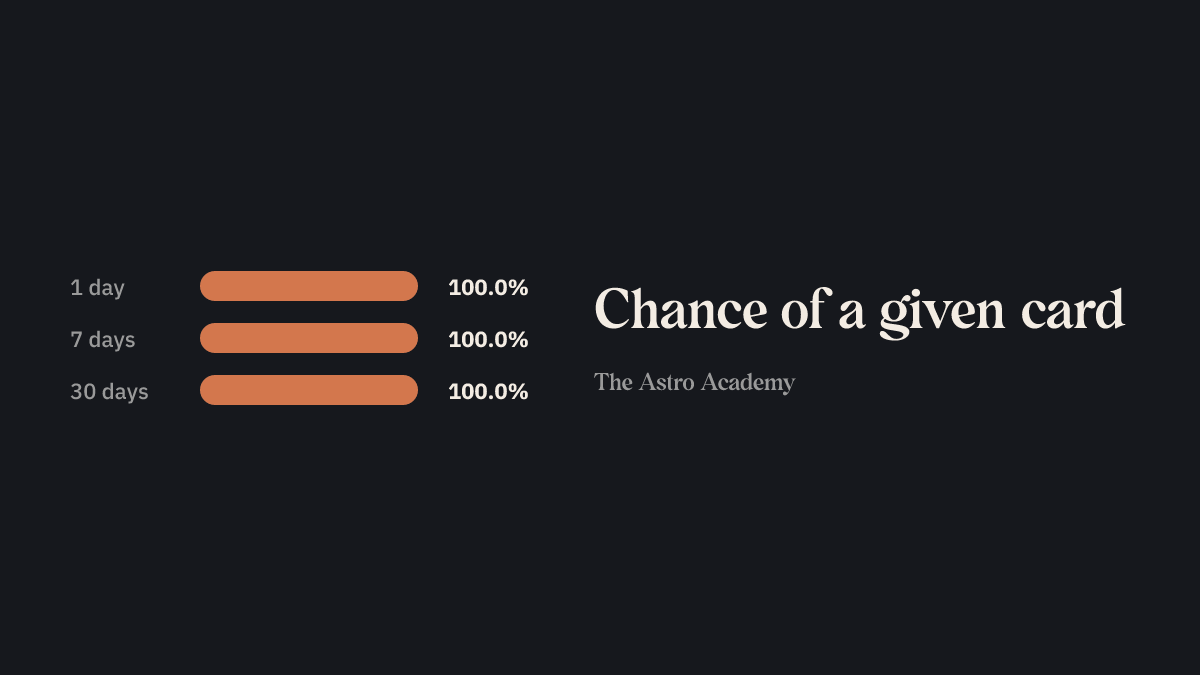
With 36 cards out of 36 Lenormand cards, every single card is in your spread with 100.0 %. Lay it every day for a week and a given card shows up at least once with 100.0 %, within a month with 100.0 %.
Until you have seen each of the 36 cards at least once takes 1 days on average. The last missing cards take the longest, because fewer new ones are left each day.
| Case | Value |
|---|---|
| Cards in the deck | 36 |
| Cards in the spread | 36 |
| Chance per card and spread | 100.0 % |
| At least once in 7 days | 100.0 % |
| At least once in 30 days | 100.0 % |
| Two given cards on consecutive places | 5.56 % |
| Days until every card was laid once (mean) | 1 |
Pure probability: every card equally likely, every spread freshly shuffled, no card twice in one spread. The mean until every card was laid is computed exactly over all intermediate states.
Frequently asked questions
- What is a grand tableau in Lenormand?
- The grand tableau is the biggest Lenormand spread, using all 36 cards. The cards are laid out in a grid, usually four rows of nine, to give a detailed overview of someone's life and how different areas connect.
- What are houses in the grand tableau?
- In the grand tableau, each of the 36 card spots is called a house. The house number matches a Lenormand card; for example, position 2 is the House of the Clover. You read the card that lands in a house together with that house's theme.
- How do you find your card in a grand tableau?
- You look for the person card that stands for you, either the Man (card 28) or the Woman (card 29). Where this card is becomes the main point of the reading. What's near, far, above, or below it gives clues about your current situation.
- What does mirroring mean in a Lenormand spread?
- Mirroring is a technique in the grand tableau where you pair cards that are in symmetrical spots. For instance, in a 4x9 layout, the card in the top left corner mirrors the card in the top right corner. These pairs can show hidden or complementary themes.
- Can I use the grand tableau for a simple yes or no question?
- The grand tableau isn't great for a simple yes or no question. Its strength is giving a complex, detailed overview of a situation. For a direct question, smaller spreads like a three-card draw would work better.