
Yes or no oracle: getting a quick answer

First, think of a clear question you can answer with just a yes or no. The yes or no oracle here will then give you one of three random answers: yes, no, or maybe. Think of this as a spark for your own thoughts, not a peek into the future.

The crystal ball

Ask your yes or no question and tap the ball.

Optional. Same question on the same day, same answer.

Contents

Video · 34 seconds

Your real answer

A yes-no oracle gives you a random answer. The real value is in your reaction to it. It acts as a mirror for your true feelings. Calculate it for free: theastroacademy.com

Read along

You toss a coin. What are you secretly hoping for before it even lands? A yes or no oracle works just like that. It is simply a digital coin flip. The answer is random, but your reaction is not. Your gut feeling is the real answer. Do you feel a sense of relief when it says no? That is the real information. This is an invitation to listen more closely to what you already know inside. Find out what you truly want at theastroacademy.com.

Random answer

How this yes no oraclefunctions

This yes no oracle works like a digital coin flip with three possible results. You ask your question, click the button, and the tool picks one answer at random from yes, no, and maybe.

The result is pure chance; it's not connected to any outside force or deeper system. The whole point is to give you a clear, simple nudge. Seeing one of these words can help you notice your first reaction.

That feeling often tells you more than the random answer itself. The tool is kept simple on purpose, so you focus on your inner feelings, not on trying to figure out a complex meaning.

The crystal ball’s five answers
AnswerLeaningQuestion for you
YesYes sideIf this yes holds, what would you do first tomorrow?
Probably yesYes sideWhat would it take to turn this probably into a clear yes?
OpenopenHow would you ask if you only wanted to know the next step?
Probably notNo sideWhat would have to change for this to become a yes?
NoNo sideWhat do you gain if you take this no seriously?
Inner response

What a random answercan show you

A random answer acts like a mirror for your own feelings. Pay attention to your immediate, gut reaction when you see the result.

Do you feel a sense of relief, or does your stomach tighten with disappointment? That first feeling is where the real information hides. For instance, if you ask, “Should I move to the new city?” and the oracle says “No,” how does that hit you?

  • secretly pleased: If you feel secretly pleased, you might have already had doubts about leaving your friends.
  • rush of frustration: If you feel a rush of frustration, you might want that change more than you thought. This is the same idea that makes a coin toss useful for clarifying what you truly hope for.
Clear questions

How to frame yourquestion

The best questions for a yes or no oracle are focused and specific. They should be answerable with a simple yes or no, without needing extra details or explanations.

Open questions like “What should I do about my career?” work better with other methods, like a three-card reading that looks at all the layers of a situation. Asking your question this way helps you focus on one clear step you can take yourself.

This makes the simple yes or no answer useful feedback for that specific choice, instead of a confusing response to a big, general worry. Always bring the question back to your own actions and decisions.

  • Good: Should I call my friend today?
  • Needs work: What does my friend think of me?
  • Good: Is it a good idea to repaint the living room this weekend?
  • Needs work: How can I improve my home?
  • Good: Should I focus on finishing my project this week?
  • Needs work: Will my project be successful?
Different tools

Oracle, pendulum, andcoin toss

A yes or no oracle, a pendulum, and a coin all do a similar job for simple questions. The main difference is how they work.

This online oracle and the coin flip tool both use a digital random number generator to create a result that doesn't depend on your thoughts at all. A physical pendulum, though, responds to tiny, unconscious muscle movements in your hand. This is called the ideomotor effect. Its answer reflects your own subtle, physical leanings.

All three methods are meant to help you check in with yourself, just in different ways. Asking the same question over and over until you get the answer you want defeats the whole point of these tools. The first answer and your reaction to it are the most insightful part of the process. Sticking with that initial response encourages you to sit with your feelings instead of just looking for outside approval for what you want to hear.
Statistics

How often does the crystal ball say yes?

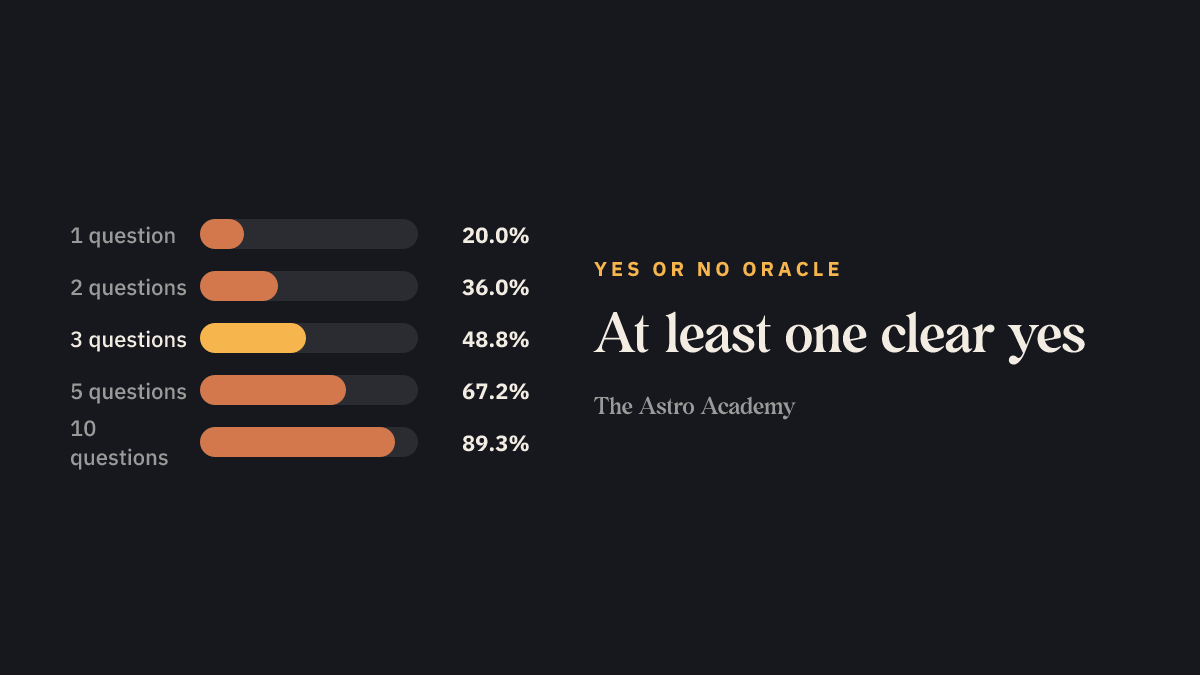
With one question in five: each of the five answers comes up 20% of the time. Count probably yes as well and the ball leans toward yes 40% of the time, and just as often toward no. It stays open 20% of the time.

Ask three different questions and at least one clear yes turns up 48.8% of the time. All three leaning toward yes happens only 6.4% of the time. On average you wait 5 questions for the first clear yes, because every new question has the same 1 in 5 chance.

Bar chart: chance of at least one clear yes from the crystal ball in 1, 2, 3, 5 and 10 questions, from 20% to 89.3%.
The crystal ball’s answers
ResultProbability
Yes20%
Probably yes20%
Open20%
Probably not20%
No20%
Yes side (yes or probably yes)40%
No side (no or probably not)40%
At least one yes in 3 questions48.8%
All 3 questions on the yes side6.4%
Questions until the first yes, on average5

Method: pure probability over our ball. It picks each of the five answers with a 1 in 5 chance, from a random number tied to your question, the date and your device. Different questions count as independent. No usage data.

FAQ

Yes or no oracle FAQ

Is a yes or no oracle always right?
A yes or no oracle doesn't predict the future, so its “rightness” isn't about being accurate. Treat it as a prompt to look at your own wishes. The result is random, but your emotional response to that answer can give you real insight into what you truly desire.
What does it mean if I get “maybe”?
A “maybe” answer suggests the situation isn't clear yet, or that the question can't be answered with a simple yes or no. It could mean you need more information, or it might be a nudge to rephrase your question to be more specific. “Maybe” can also point to a situation where you have more influence than you realize.
Can I ask about other people?
It's best to keep your questions focused on yourself and what you can do. An oracle can't tell you what another person thinks or feels. Instead of asking “Does Alex miss me?”, you could ask about your own path, like “Should I focus my energy on my own projects right now?”.
How is this different from a yes no tarot reading?
This online tool gives a direct, random answer of yes, no, or maybe. A yes no tarot reading involves pulling one or more cards from a tarot deck. Then, a reader interprets the card's traditional meaning, position, and imagery to form a detailed yes or no-style answer.
How many times should I ask the yes no oracle a question?
You can use the tool as often as you like, but it's most helpful to ask a single question only once. The idea is to watch your reaction to the very first answer you get. Asking again and again for a different result can just cloud your own intuition.