
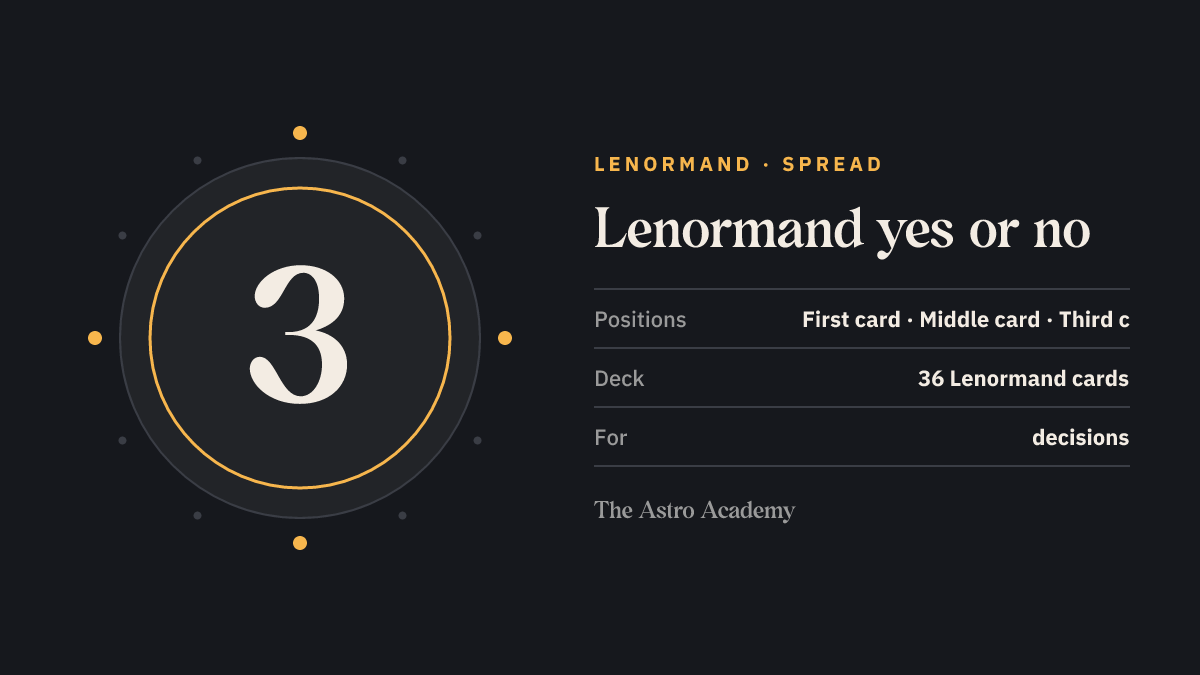
Lenormand spread · 3 positions
Lenormand yes or no: a quick guide
Lenormand yes or no
Focus on your question and draw all three cards.
3 cards to go.

Video · 36 seconds
Three Cards, One Answer
In a three-card yes or no reading, one card carries the most weight. Here's how to spot the tendency for your question. Calculate it for free: theastroacademy.com
Read along
For a quick answer, you draw three cards. Only one really sets the direction. The key card is the one in the middle. It shows the core of the answer. Some cards suggest a yes, like the Sun. Others suggest a no, like the Mountain. A third group is neutral. They might mean the outcome isn't decided yet. Think of the middle card as a sentence's subject. The other cards just add detail. This is an invitation to see your situation in a new light. Draw your cards for free at theastroacademy.com.
Contents
A Lenormand yes or no reading uses three cards to give you a quick take on a specific question. The answer comes from how the cards typically fall into positive, negative, and neutral groups. The middle card of the three carries the most weight for the final answer.
Sorting cards into yes, no, and maybe
Many Lenormand cards feel clearly positive or negative, which helps a lot in a yes or no reading. Cards like the Sun, Clover, Key, and Stars usually mean "yes."
They suggest things like success, good luck, and new opportunities. Then there are the "no" cards, which often stand for roadblocks or endings. The Mountain, Coffin, Cross, and Clouds are classic examples. When these show up, especially in the middle, the answer leans toward "no."
They can signal delays, tough spots, or a need to stop. Lots of cards are neutral, or they depend on the cards around them to show a direction. Cards like the Rider, Ship, or Book aren't a definite yes or no on their own. Their meaning gets colored by their neighbors, making them "maybe" cards that ask you to look closer at the whole picture.
| Card type | Examples | Meaning |
|---|---|---|
| Yes | Sun, Clover, Key, Stars | success, good luck, new opportunities |
| No | Mountain, Coffin, Cross, Clouds | roadblocks, endings, delays, tough spots |
| Maybe | Rider, Ship, Book | neutral, depend on neighbors, look closer |
Why the middle card weighs the most
In a three-card yes or no spread, the center card shows you the heart of the matter. It's the main answer to your question.
The cards on either side add details and context, but they don't override what the middle card says. For instance, a Sun in the middle clearly points to yes. If the card before it is the Clouds, it might mean the "yes" comes after some confusion. If the card after is the Clover, it suggests a happy and lucky outcome.
But the "yes" from the Sun is still the main point. Think of it like a simple sentence. The middle card is the main subject, and the outer cards are like adjectives. Always read the center card first to get the main answer before you consider the details from the cards on the left and right.
How to phrase a good yes or no question
How good your answer is often comes down to how good your question is. For a helpful Lenormand yes or no reading, your question should be closed, specific, and about just one thing.
A closed question is one you can answer with a simple yes or no, not an open one like "What about my job?" Instead of asking "Will I be happy?" (which is super broad), try something more concrete like "Is taking this new apartment a good step for me right now?" This gives the cards a clear topic to address.
Don't ask two questions at once, like "Should I apply for the promotion or look for a new job?" Ask about each choice separately.
- Ask about yourself: Frame questions around your own actions and perspectives.
- Be specific: “Is this a good week to start the garden project?” is better than “Will things work out?”.
- Focus on one topic: Address one single issue per reading.
- Set a timeframe: Adding “this month” or “soon” can provide more clarity.
When the choice remains with you
The cards are a tool for thinking things through, not a machine that makes your decisions. A "yes" doesn't promise success without effort, and a "no" isn't a command to give up.
The reading just gives you a snapshot of the current energy around your question. Sometimes, the most honest answer is "maybe." This can happen when things are still developing or when you have more say in the outcome than you realize. A spread with neutral cards might be a nudge to check in with yourself about what you really want or what info you're still missing.
Use the reading as a new way to look at things. The final choice and what you do next are always up to you. The cards can offer some clarity, but you're the one living your life and making the calls.
The positions at a glance
“Lenormand yes or no” has 3 positions. Each one asks the card lying there its own question.
| No. | Position | Guiding question |
|---|---|---|
| 1 | First card | What speaks for or against it? |
| 2 | Middle card | What weighs the most? |
| 3 | Third card | Which way do the scales tip? |
How often does a given card turn up in “Lenormand yes or no”?
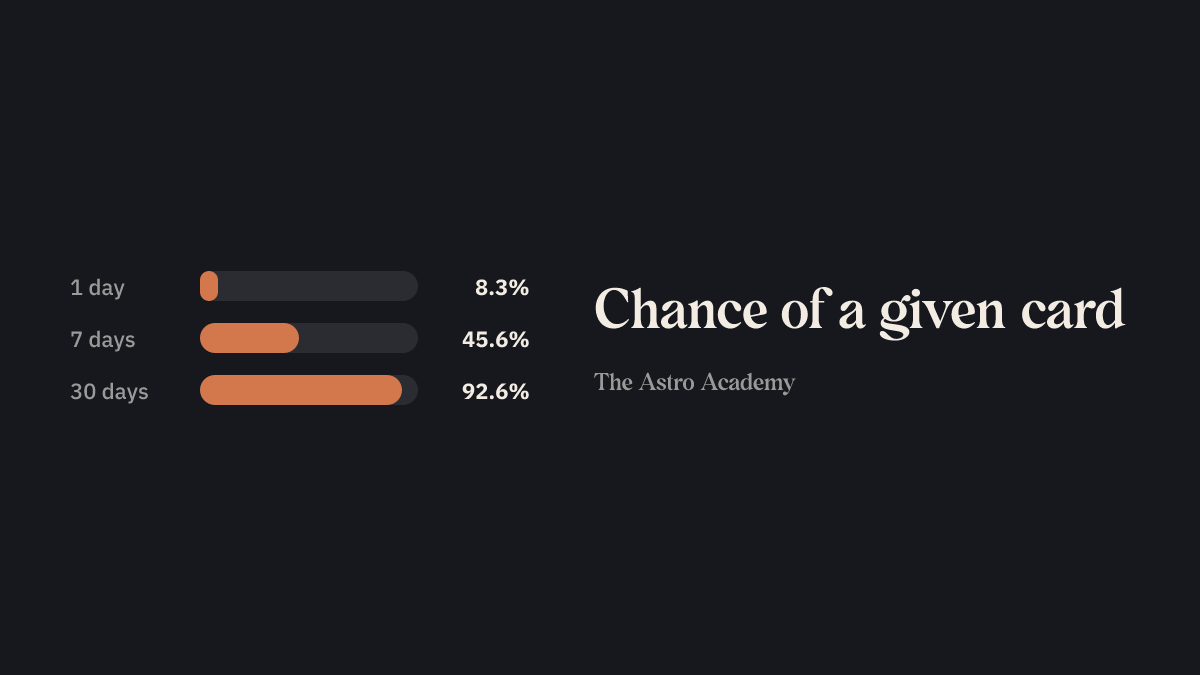
With 3 cards out of 36 Lenormand cards, every single card is in your spread with 8.3 %. Lay it every day for a week and a given card shows up at least once with 45.6 %, within a month with 92.6 %.
Until you have seen each of the 36 cards at least once takes 49 days on average. The last missing cards take the longest, because fewer new ones are left each day.
| Case | Value |
|---|---|
| Cards in the deck | 36 |
| Cards in the spread | 3 |
| Chance per card and spread | 8.3 % |
| At least once in 7 days | 45.6 % |
| At least once in 30 days | 92.6 % |
| Two given cards on consecutive places | 0.32 % |
| Days until every card was laid once (mean) | 49 |
Pure probability: every card equally likely, every spread freshly shuffled, no card twice in one spread. The mean until every card was laid is computed exactly over all intermediate states.
Frequently asked questions
- Which Lenormand cards mean yes?
- Cards that strongly mean yes include the Sun, Clover, Key, Stars, and Heart. These generally point to positive results, luck, clarity, and success. The Bouquet and the Ring can also lean toward yes, especially for relationship questions.
- Which Lenormand cards mean no?
- The most definite no cards are the Coffin, Mountain, and Cross. They often mean endings, blockages, and burdens. The Clouds and the Mice can also suggest a "no" by pointing to confusion, delays, or things getting smaller.
- What does a maybe answer mean in a Lenormand reading?
- A "maybe" answer suggests the situation isn't set in stone yet. It could mean the outcome really depends on what you do, or that key things are still changing. This result encourages you to get more info or rethink your approach.
- Can Lenormand tell me what to do?
- Lenormand cards don't tell you what to do. They just offer a way to look at your situation based on your question. Think of them as a mirror showing you the current circumstances, helping you make your own decision with more awareness.
- How do I read a three card Lenormand yes no spread?
- First, look at the middle card for the main answer: Is it a yes, no, or maybe card? Then, read the card on the left for context about the past or the base of the question. Finally, read the card on the right for what might come next or how the situation could unfold.