
Kipper cards spread · 3 positions
3 card Kipper spread: a simple overview
Three-card Kipper reading
Focus on your question and draw all three cards.
3 cards to go.

Video · 39 seconds
Three Cards, One Story
With just three Kipper cards, you can quickly understand a situation. They form a small picture story, showing where something started and where it might be heading. Calculate it for free: theastroacademy.com
Read along
You draw three cards. And they tell you a short, direct story from your life. Each card has its own fixed spot. Think of it as a simple timeline, from left to right. The first card shows what the situation is built on. This is the foundation. The middle one is about where you are right now. This is the point you're acting from. And the third card is an invitation to see how things might develop from here. Check for yourself what these pictures mean to you. It is your story. Lay your own three cards. Work it out for free at theastroacademy.com.
Contents
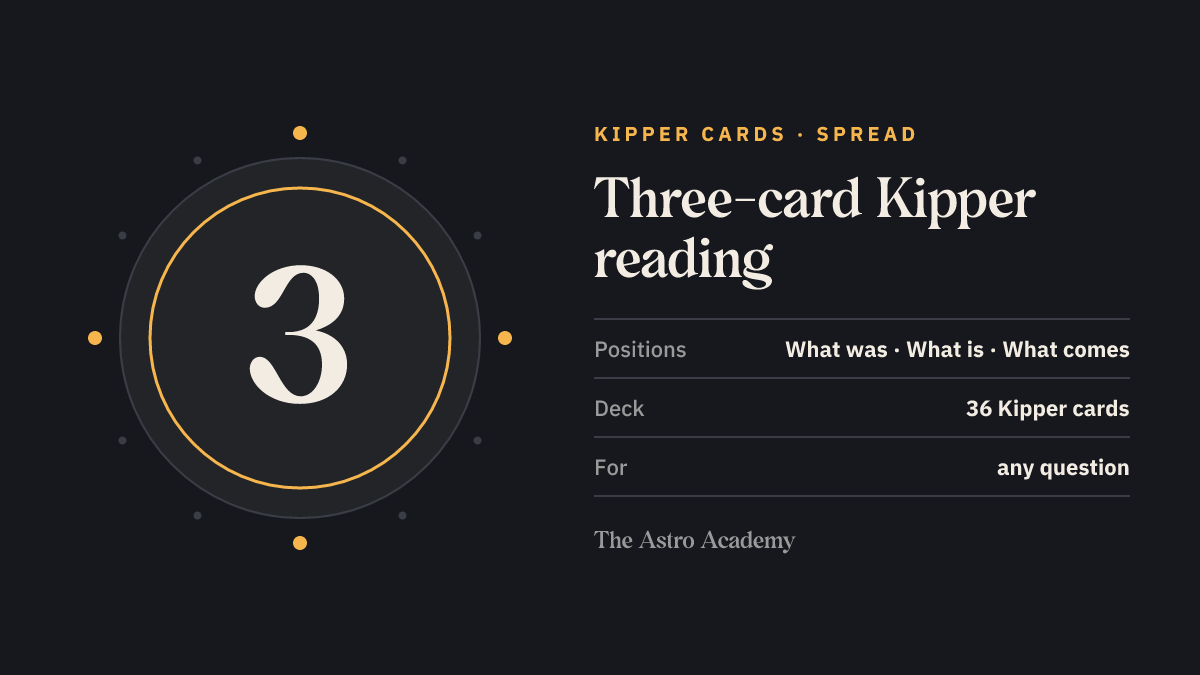
The 3 card Kipper spread is a direct way to get a quick look at a situation. You lay out the cards in a simple timeline: one for the past, one for the present, and one for what's coming next. This setup helps you understand what's behind your question and see where things might be headed.
Reading the positions: past, present, future
The three spots in this spread show a simple flow of time, read from left to right. The first card is for the past, showing what led up to now or what the situation is built on.
The middle card shows the present moment, the main thing you're looking at right now. The third card on the right points to the near future, suggesting how things might develop or what could happen next. Since Kipper cards often show clear scenes and people, this timeline can read like a short, direct story.
For instance, a card about news followed by a card showing a person might mean a message from someone is key to your question. Your own life knowledge is what helps you connect these images to your actual circumstances.
| Position | Time | Meaning |
|---|---|---|
| First card | Past | what led up to now |
| Middle card | Present | main thing you're looking at |
| Third card | Near future | how things might develop |
A sample spread: three real cards
Let's take an example for a three card Kipper reading about a work situation: Work, Change, and the Journey card.
- First card Work: The first card, Work, clearly sets the topic. The past and basis of your question are in your job or a main task you're focused on. This starts the story, setting the scene.
- Middle card Change: The middle card, Change, shows that the present is in motion. This card points to a transition, so you might want to check if things at work are currently shifting. This could be a new project, a team reorganization, or even moving to a different spot in the same building. It marks the current moment as a time of adjustment.
- Third card Journey: The third card, the Journey card, suggests this change involves moving. This often means physical travel, like a new commute, a business trip, or even relocating for the job.
The whole sequence suggests your work situation has entered a phase of transition that seems to be leading toward some kind of tangible move.
What to ask a three card spread
This spread works best with a focused question about how a specific topic is developing. Questions about 'why' something happened or 'how' a situation is unfolding fit well with this past, present, future layout.
It's not as good for big, general questions like 'what will my life be like?' because the three cards give you a narrow snapshot, not the whole picture. Clear questions usually lead to clearer insights.
Before you draw the cards, take a moment to think about what you really want to know about the situation. Asking a precise question helps you interpret the cards more meaningfully, connecting them directly to the issue at hand and avoiding vague readings.
- What is the context around this upcoming meeting?
- Show me the development of my creative project.
- What led to this disagreement, and what comes next?
- What should I be aware of regarding my new apartment?
- Give me an overview of this job opportunity.
When your card is not in the spread
It's very common for a Main Person card not to show up in a small spread of just three cards. This doesn't mean the reading is wrong or not about you.
It simply means the reading focuses on the events, actions, or other people involved in the situation you're asking about. Think of it like a story where you're the narrator instead of the main character.
The cards describe what's happening around you or how the situation itself works. If other person cards appear, like the Good Lady or Rich Man, they might represent key figures whose actions are important to the story the cards are telling.
The positions at a glance
“Three-card Kipper reading” has 3 positions. Each one asks the card lying there its own question.
| No. | Position | Guiding question |
|---|---|---|
| 1 | What was | What lies behind you? |
| 2 | What is | Where do you stand now? |
| 3 | What comes | What shows next? |
How often does a given card turn up in “Three-card Kipper reading”?
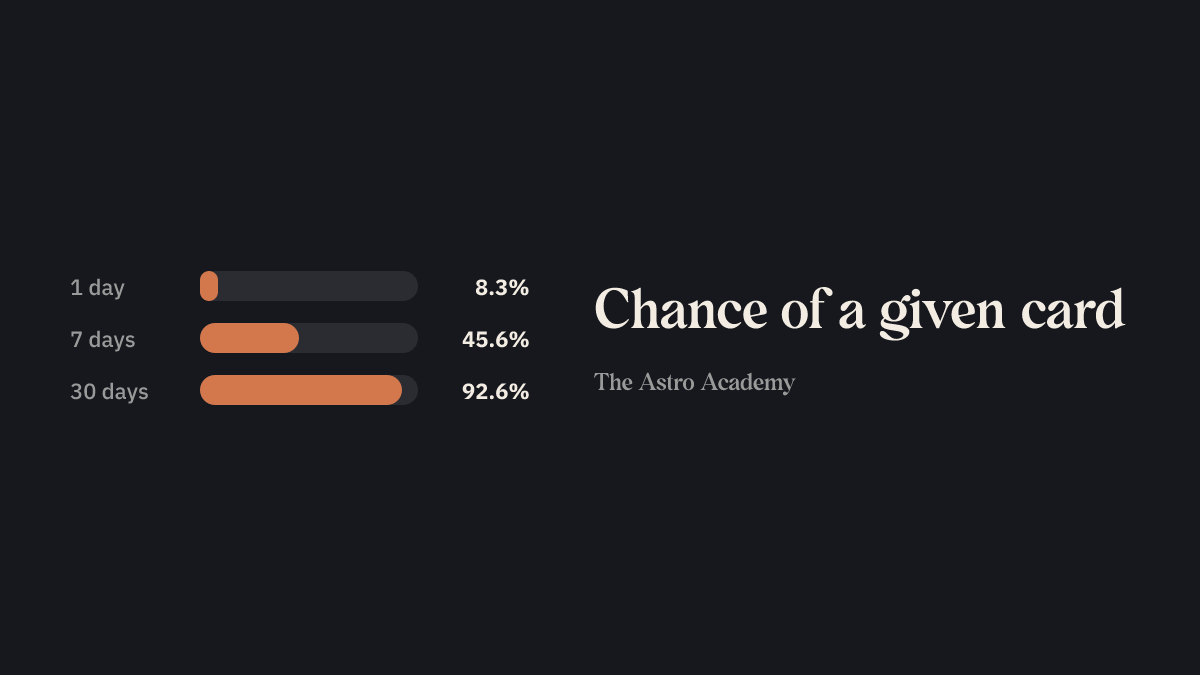
With 3 cards out of 36 Kipper cards cards, every single card is in your spread with 8.3 %. Lay it every day for a week and a given card shows up at least once with 45.6 %, within a month with 92.6 %.
Until you have seen each of the 36 cards at least once takes 49 days on average. The last missing cards take the longest, because fewer new ones are left each day.
| Case | Value |
|---|---|
| Cards in the deck | 36 |
| Cards in the spread | 3 |
| Chance per card and spread | 8.3 % |
| At least once in 7 days | 45.6 % |
| At least once in 30 days | 92.6 % |
| Two given cards on consecutive places | 0.32 % |
| Days until every card was laid once (mean) | 49 |
Pure probability: every card equally likely, every spread freshly shuffled, no card twice in one spread. The mean until every card was laid is computed exactly over all intermediate states.
Frequently asked questions
- What does a 3 card Kipper spread tell you?
- A three card Kipper reading gives a clear snapshot of a situation's timeline. It usually shows a past influence, the current circumstances, and what might develop next. This flow helps you see the context of your question and understand how events are progressing.
- Is the three card Kipper spread good for beginners?
- Yes, it's a great spread for anyone just starting with Kipper cards. With only three positions, it lets you focus on how the cards connect in a simple sequence. It builds a good base for understanding the deck's literal storytelling style before you move to bigger layouts.
- What if I don't get a Main Person card in my reading?
- That's perfectly normal and happens often in smaller spreads. It just means the reading focuses on the events, situations, or other people shown in the cards. The story is more about what's happening around you than about you as the central figure.
- How often can I do a three card Kipper reading?
- You can use this spread whenever you need clarity on a specific, developing situation. However, it helps to give some time between readings on the exact same topic. This lets events unfold and gives you space to think about the previous reading's perspective.
- Can this spread answer yes or no questions?
- The 3 card Kipper spread isn't designed for simple yes or no answers. Instead, it tells a short story about how a situation is developing. Rather than asking a question with a binary answer, try asking 'what is the outlook for…' to get a more nuanced view.