
Kipper cards spread · 5 positions
Kipper cards love: reading relationships
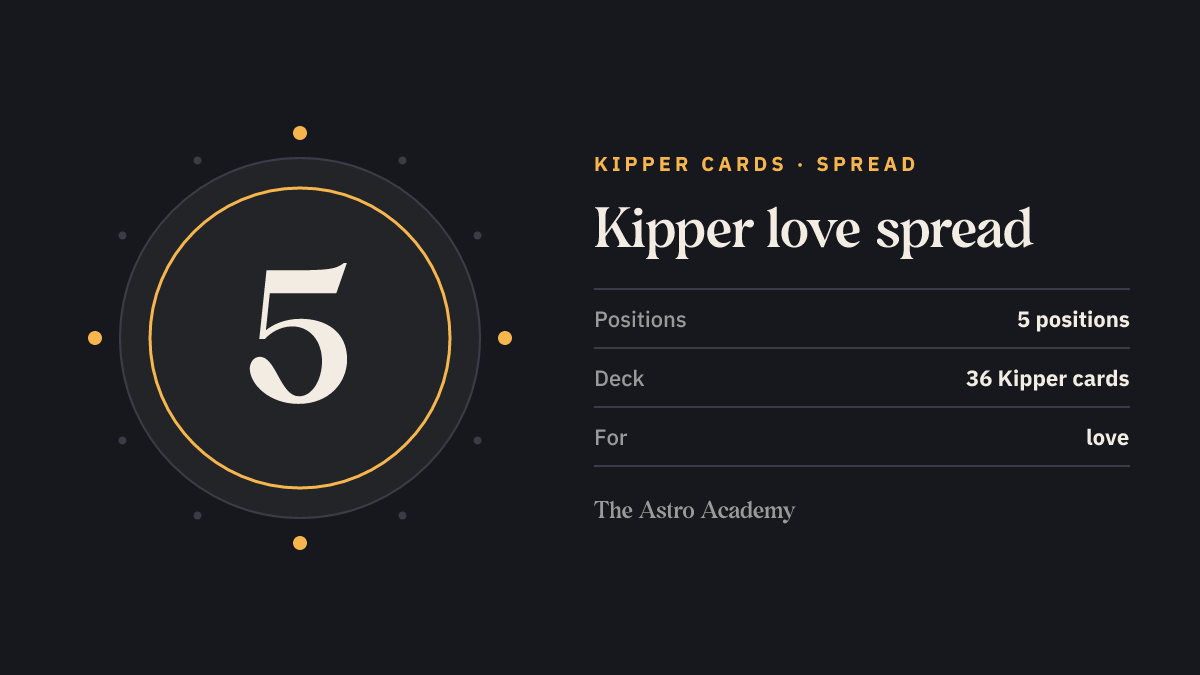
Kipper love spread
Focus on your question and draw all 5 cards.
5 cards to go.

Video · 34 seconds
Mind Reading?
A five-card spread can help you see your relationship more clearly. It's not about predicting the future, but about understanding the present. Calculate it for free: theastroacademy.com
Read along
Kipper cards can't read someone's mind. They show you something much more useful. Think of the cards as a snapshot of your relationship. A clear look at the present moment. One card represents you and your role. Another one shows the other person. The cards in between point to your bond. They highlight what helps and what's a challenge. This isn't about predicting outcomes. It's a chance to get clear on your own part in the connection. Do your own love reading for free at theastroacademy.com.
Contents
Kipper cards give you a practical, down-to-earth look at relationships. They show people and everyday stuff, so a Kipper cards love reading usually feels really direct. This way, you can think about your own feelings and actions in a connection. It gives you clarity, not predictions.
Understanding the five positions
Each of the five spots in this spread focuses on a specific part of your connection. “You” shows your current role, “The other person” covers their side of things, and “Your bond” describes what the relationship is really about.
The spots “What disturbs” and “What helps” point to a main challenge and a good way forward. Don't see the cards as separate answers. Think of them as parts of one big picture. “You” and “The other person” are like the two main characters. “Your bond” is the stage they're on, and “What disturbs” and “What helps” are like the story's problem and solution.
This setup helps you see how everything connects. Say the Meeting card shows up under “What helps”. You might ask yourself where open talks or a fresh start could make things better. It points to a chance for connection, not a guaranteed event. The cards give you a map of the current situation for you to use.
| Position | Focus |
|---|---|
| You | your current role |
| The other person | their side of things |
| Your bond | what the relationship is really about |
| What disturbs | a main challenge |
| What helps | a good way forward |
Important cards for love themes
A few Kipper cards speak directly to love and partnership, so they're important in a relationship reading.
- Luck in love and Marriage: Luck in love and Marriage are pretty clear, often meaning happiness and deep commitment.
- Meeting card: The Meeting card can mean a new connection, getting back together, or just an important encounter that changes things.
- Main Person cards: The Main Person cards are key in any reading about people. Depending on who's asking, one card is you and the other can be a significant partner. Where they are compared to each other, and the cards between them, tell you a lot in a bigger spread. They show how close or distant things feel.
- His thoughts: The card His thoughts doesn't literally show what someone else is thinking. Instead, it can stand for the thinking or planning side of a situation. It might point to what you're thinking about, the general mental vibe around the relationship, or a need to think things through more logically.
When difficult cards show up
Tough cards in a love reading aren't bad omens. They often point to areas that need your attention or honesty.
Cards like Falseness, Sorrow, or Gloomy thoughts can highlight misunderstandings, sadness, or worries in the connection. Seeing them is a chance to look closer. For example, if Falseness shows up in the “What disturbs” spot, it doesn't automatically mean someone's being sneaky. It can suggest things aren't clear, something feels off, or you need to be more honest with yourself.
Ask yourself what part of this you see in your current situation. These cards encourage you to really look at what isn't working. They can prompt you to think about your own feelings or to have a necessary talk. By bringing hidden issues to the surface, they make it possible to deal with them.
How to ask helpful questions
The best questions for Kipper are open-ended and focus on your own role in a situation. This gives you helpful insights you can act on.
Instead of asking “Will we get back together?”, which asks for a prediction, a better question might be “What can I do to improve communication in my relationship?” When you focus your questions on what you can see and influence, you'll always get more helpful insights. Here are some examples of questions that work well with the Kipper system.
- What is my role in this connection right now?
- What aspect of our bond needs more attention?
- How can I best contribute to a positive dynamic?
- What should I be aware of regarding my own feelings?
- What is a helpful next step for me to consider?
The positions at a glance
“Kipper love spread” has 5 positions. Each one asks the card lying there its own question.
| No. | Position | Guiding question |
|---|---|---|
| 1 | You | What do you feel? |
| 2 | Your bond | What connects you? |
| 3 | The other person | What moves the other person? |
| 4 | What disturbs | What stands between you? |
| 5 | What helps | What brings you closer? |
How often does a given card turn up in “Kipper love spread”?
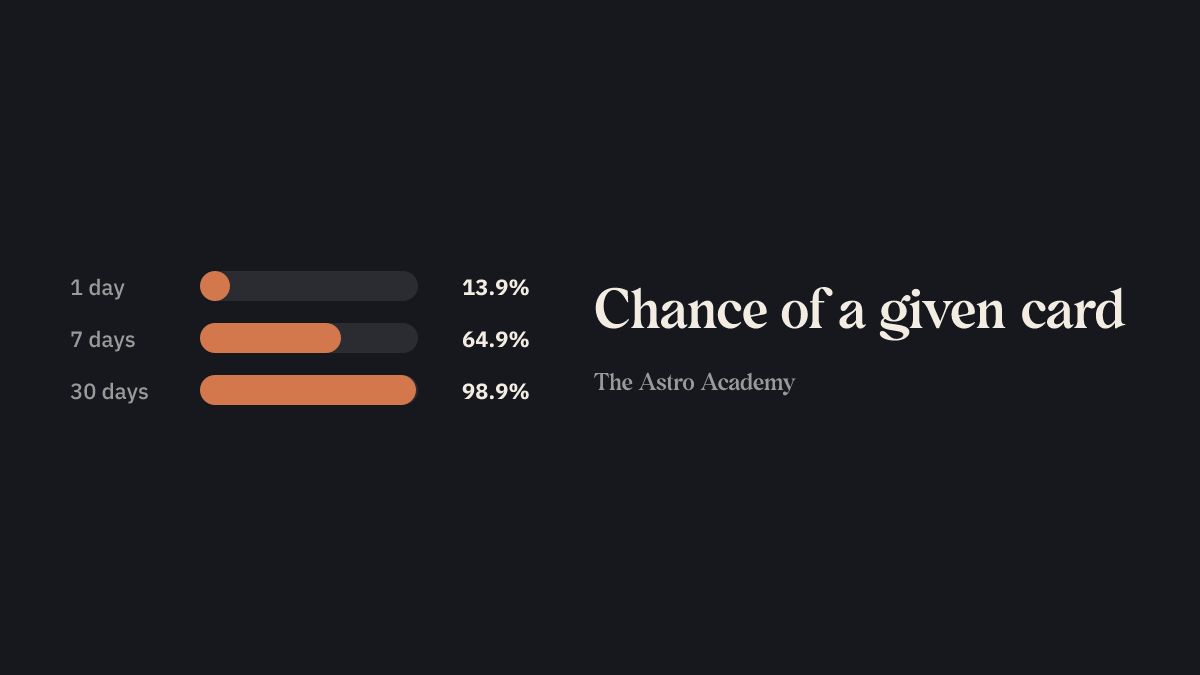
With 5 cards out of 36 Kipper cards cards, every single card is in your spread with 13.9 %. Lay it every day for a week and a given card shows up at least once with 64.9 %, within a month with 98.9 %.
Until you have seen each of the 36 cards at least once takes 28.7 days on average. The last missing cards take the longest, because fewer new ones are left each day.
| Case | Value |
|---|---|
| Cards in the deck | 36 |
| Cards in the spread | 5 |
| Chance per card and spread | 13.9 % |
| At least once in 7 days | 64.9 % |
| At least once in 30 days | 98.9 % |
| Two given cards on consecutive places | 0.63 % |
| Days until every card was laid once (mean) | 28.7 |
Pure probability: every card equally likely, every spread freshly shuffled, no card twice in one spread. The mean until every card was laid is computed exactly over all intermediate states.
Frequently asked questions
- Can Kipper cards predict if I will find love?
- Kipper cards don't predict the future or guarantee specific events like finding love. They can, however, highlight your current mindset about relationships and what you might be open to. For instance, the Meeting card could suggest you're in a phase where new people are entering your life.
- What does the Main Person card mean if I am single?
- When you're single, the other Main Person card can represent a type of person you're looking for, a close friend, or even a part of yourself you want to develop. Its placement in a spread shows your relationship to that idea or person. It doesn't always mean a future partner.
- How do I read what another person feels about me in Kipper?
- Kipper cards can't reveal another person's private thoughts or feelings. Cards that seem to relate to the other person reflect how you see them or their role in the connection you share. They're a mirror for the relationship, not a window into someone else's mind.
- Are there specific “yes or no” love cards in Kipper?
- Kipper isn't made for simple yes or no answers, since the cards describe complex situations and people. Cards like Luck in love can show a positive mood, while Sorrow suggests difficulties. You should always read these in the context of the whole spread to get the full picture.
- What if I get a card like Coffin in a love reading?
- Cards that seem negative, like Coffin, often mean an ending, which can be necessary for something new to start. In a love reading, this could point to the end of a specific phase, an unhelpful behavior pattern, or a period where nothing's happening. It's a symbol of closure, not a literal warning.