
Rauhnacht 1: looking back at the year
Rauhnacht 1 · 2026/27
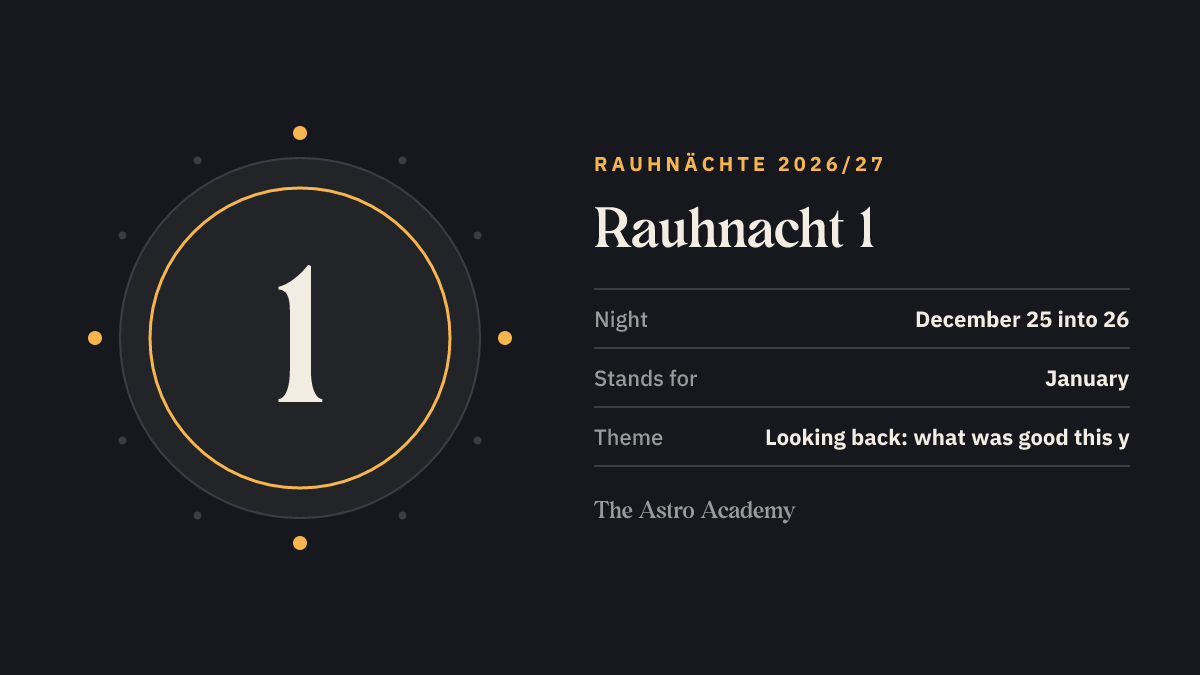
Night of December 25 into 26, stands for January
Theme of the evening: Looking back: what was good this year
Rauhnacht 1: card of the night
Focus on your question and draw the card.
1 card to go.

Video · 35 seconds
Your January starts now
The first of the twelve holy nights begins on the evening of December 25. It stands for January and invites you to reflect. Find out what this means for you. Calculate it for free: theastroacademy.com
Read along
The night of December 25th into 26th offers a theme for your January. This is the first of the twelve holy nights. Each night is traditionally linked to one month of the year. It's like flipping through a photo album. You look back before turning to a new page. This first night is an invitation to appreciate what went well for you this year. You could ask yourself what you are quietly proud of. Maybe write down three moments. Find your personal theme for January for free at theastroacademy.com.
Contents
The first Rauhnacht begins on the evening of December 25. This night, which leads into December 26, traditionally opens the period of the twelve nights and stands for the month of January. For Rauhnacht 1, our theme is a gentle look back at the year that is ending, focusing on what was good.
Rauhnacht 1 in brief
| What | This night |
|---|---|
| Date | Night of December 25 into 26 |
| Stands for | January |
| Theme | Looking back: what was good this year |
| Question for the evening | What are you quietly proud of this year? |
| Ritual | Write down three things that went well this year. |
| In the custom | Christmas Day. This night opens the time between the years. |
Your audio for tonight
The audio of the evening from the healing library. The preview is free.
What your chart shows for January
Rauhnacht 1 and its link to January
The twelve nights, or Rauhnächte as they are called in German, are a traditional period between the years. Here, we observe them from the night of December 25 into December 26 through the night of January 5 into January 6.
The very first Rauhnacht opens this special time, which many people use for quiet reflection. Old custom connects each of the twelve nights to one month of the coming year. Following this tradition, the first night offers a symbolic preview for January.
This is not a fixed prediction but rather a theme to consider for yourself as the month unfolds. While our calendar marks these specific dates, you may find other regional traditions that start the Rauhnächte on December 21. The core idea remains the same: it is a quiet time to reflect on the past and prepare for what lies ahead.
Taking stock of the good moments
The theme for this first evening is a review of your year, with a focus on what went well. Before looking forward, it can be helpful to acknowledge the positive experiences, big and small, that the past twelve months have held. This practice is not about ignoring difficulties but about consciously appreciating what brought you joy or taught you something valuable.
- Quiet afternoons that felt right: Consider the moments that made you smile, the challenges you successfully navigated, or the quiet afternoons that felt just right.
- High points of your year: What were the high points of your year? Bringing these memories to mind helps you close the year with a sense of gratitude and completeness.
- Three things most thankful for: For your reflection this evening, you might ask yourself: What three things from this past year am I most thankful for?
Let your mind wander through the seasons and see what memories surface for you.
How to capture your good memories
A small ritual can help you anchor your reflections for the evening. You do not need any special tools, just a pen and some paper or a notebook you might be using as a Rauhnacht journal. If it helps you feel settled, you could light a candle or make a cup of tea.
- Find a quiet moment: Find a quiet moment for yourself.
- Write down three things: Think about the question for the evening and write down three specific things that went well this year.
- Be concrete: Try to be concrete. Instead of writing 'a nice vacation,' you might recall 'watching the gray seals on the beach during our trip in March.' This simple act of writing things down gives them weight and makes them tangible. It is a way of honoring your own experience and setting a positive, thoughtful tone for the rest of the twelve nights.
Your dream as an image for the new year
Tradition holds that the dreams you have during the Rauhnächte carry a special significance. The dream during this first night is often seen as a symbolic image for the month of January. It can provide a theme, a question, or a feeling to carry with you into the start of the year.
- Recall your dream: When you wake up on the morning of December 26, take a moment before you get up to see if you can recall any part of your dream.
- Write down images or feelings: Write down any images, characters, or feelings that come to mind, without trying to analyze them right away.
- Simply record what is there: Simply record what is there.
If you do not remember a dream, that is completely normal. Instead, just notice your very first mood or feeling upon waking. Was it calm, hurried, cheerful, or something else?
This feeling can also serve as your personal theme for January. Check for yourself how this initial impression colors your view of the month as it begins.
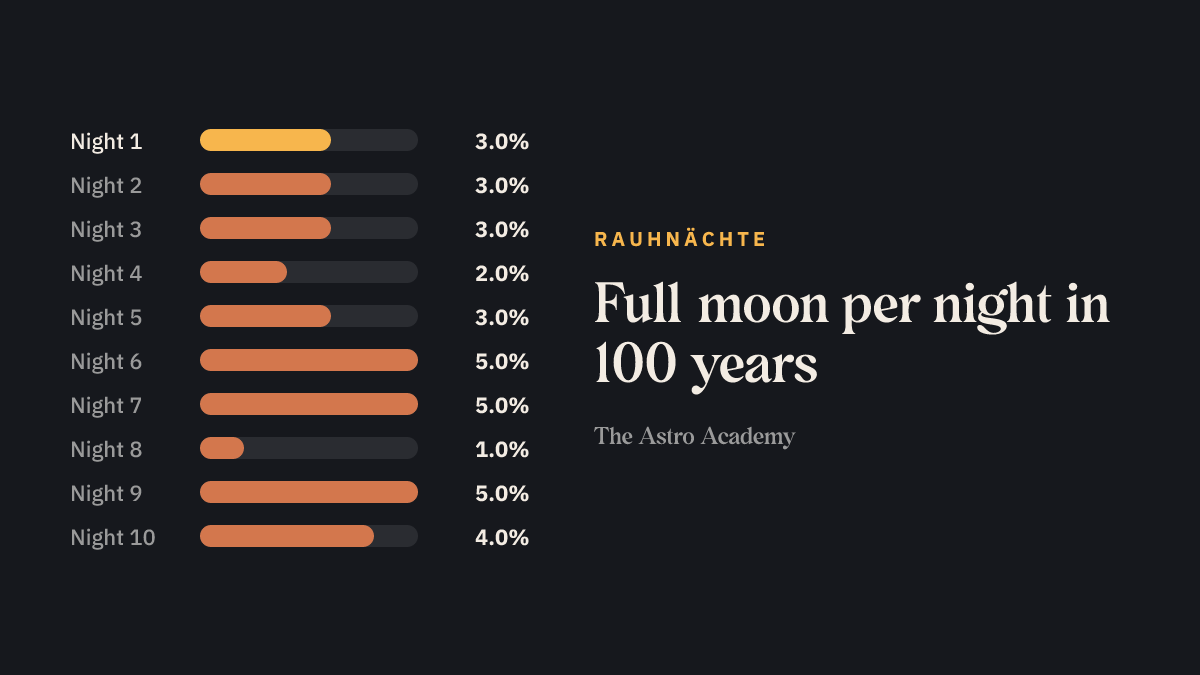
How often does the full moon fall on Rauhnacht 1?
A full moon fell on Rauhnacht 1 in 3 of 100 years, so about once every 33 years. A lunar cycle lasts about 29.5 days, which is why the full moon rarely hits any single night.
In the Rauhnächte 2026/27 neither a full moon nor a new moon falls into the twelve nights: the full moon comes just before, the new moon just after.
| Season | Moon in the nights |
|---|---|
| 2026/27 | none |
| 2027/28 | New moon, December 27, 2027, night 3 |
| 2028/29 | Full moon, December 31, 2028, night 7 |
| 2029/30 | New moon, January 4, 2030, night 11 |
| 2030/31 | none |
| 2031/32 | Full moon, December 28, 2031, night 4 |
| 2032/33 | New moon, January 1, 2033, night 8 |
| 2033/34 | Full moon, January 4, 2034, night 11 |
Calculated with the Swiss Ephemeris for the seasons 1950/51 to 2049/50. The day of the exact full or new moon in German time counts; the nights are the evenings from December 25 to January 5.
Frequently asked questions
- When is Rauhnacht 1?
- Rauhnacht 1 is the first of the twelve nights. It always begins on the evening of December 25 and lasts through the night into December 26. In this tradition, it marks the start of the special time between the years.
- Which month does the first Rauhnacht represent?
- The first Rauhnacht stands for the first month of the coming year, January. According to custom, each of the twelve nights offers a symbolic preview of one of the twelve months. This connection is a tool for reflection, not a definite forecast.
- What is a simple ritual for the first Rauhnacht?
- A fitting ritual for this night is to focus on gratitude. Find a calm moment in the evening and write down three specific things from the past year that you are thankful for. This helps you to close the old year on a positive note before looking ahead.
- What should I do if I can't remember my dream on Rauhnacht 1?
- If you don't remember a dream, that is perfectly fine. Simply notice your first feeling or mood when you wake up on the morning of December 26. Write that down instead, as it can also serve as a symbolic theme for January.
- Why is Rauhnacht 1 about looking back?
- We begin the twelve nights by looking back to consciously close the old year before we turn to the new one. Acknowledging the good experiences helps create a foundation of gratitude. The following nights will build on this, helping you let go of difficulties and form intentions for the future.