
Rauhnächte spread · 4 positions
Year review card spread: look back, look ahead
Look back, look ahead
Focus on your question and draw all 4 cards.
4 cards to go.

Video · 37 seconds
Look Back, Look Ahead
Before making plans for the new year, it helps to consciously close the last chapter. This four-card spread guides you to look back and find a clear direction. Calculate it for free: theastroacademy.com
Read along
Before you make plans for the new year, imagine you’re packing a suitcase. You decide what from the past year comes with you, and what stays behind. A simple four-card spread can be a mirror for your thoughts during this time. The first card reminds you of what was good. A success or a happy memory. The second card asks what you are ready to let go of. A habit, perhaps. The third shows what you take along. The fourth gives you a focus for what's next. Find your direction for the coming year. Do the reading for free at theastroacademy.com.
Contents
This four-card spread helps you reflect on the past year and set a direction for the new one. The Rauhnacht oracle's year review card spread offers a moment of quiet contemplation, using one card for what was good, one for what to let go of, one for what to take with you, and one for what you are turning towards. It is a simple way to look back and look ahead with clarity.
The four positions of this year review
The spread uses four cards to structure your thoughts about the turn of the year. The first card explores what was good, the second what you are ready to release, the third what you will carry forward, and the fourth what you will focus on next.
Position one, 'What was good', is about gratitude and recognizing success. The second, 'What you let go of', can point to habits or situations that no longer serve you.
The third, 'What you take along', often highlights a strength or a resource you already have. The final card, 'What you turn towards', gives you a theme or a focus for the coming year.
- What was good: A positive memory or a success from the past year.
- What you let go of: Something to release before the new year begins.
- What you take along: A quality or strength to keep with you.
- What you turn towards: A theme or direction for the coming year.
| Position | Meaning | Focus |
|---|---|---|
| Position one | gratitude and recognizing success | A positive memory or a success |
| The second | habits or situations that no longer serve you | Something to release |
| The third | strength or a resource you already have | A quality or strength |
| The final card | a theme or a focus for the coming year | A theme or direction |
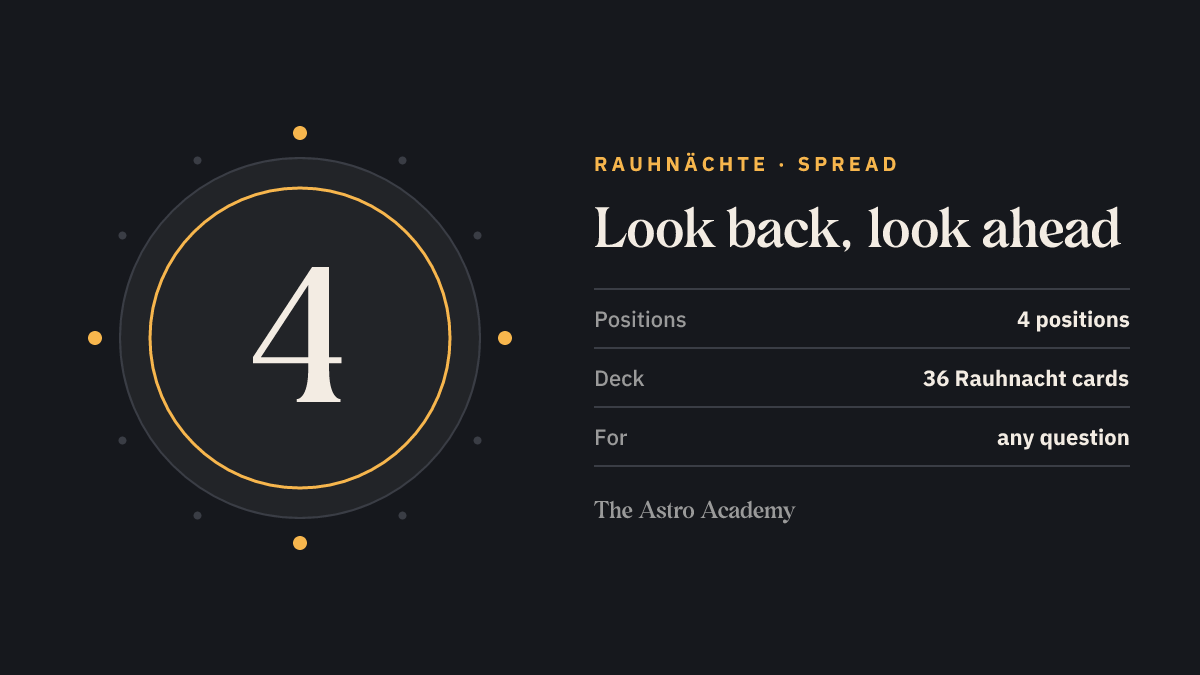
First look back, then look ahead
This spread intentionally guides you to look back before you look ahead. Acknowledging your experiences from the past twelve months, both the good and the challenging, creates a solid foundation for new intentions.
It helps you close one chapter consciously before starting the next. The days between Christmas and New Year's Eve are a traditional time for this kind of reflection.
This period falls within the Rauhnächte, the twelve nights of German-speaking folklore, which are seen as a quiet time outside the ordinary flow. You can use this spread on any evening that feels right to you for a moment of peace.
An example with four cards
Let’s see how a reading might look. Imagine you draw these four cards from the Rauhnacht oracle.
- What was good: 'What was good' is The Bread. This card often stands for simple joys, community, and feeling nourished. Perhaps you remember many shared meals with friends or a project that felt deeply satisfying.
- What you let go of: For 'What you let go of', you draw The Knot. This could suggest you are untangling a complicated situation or releasing a pattern of overthinking that kept you stuck.
- What you take along: The third card, 'What you take along', is The Key. This suggests you are carrying a solution, a special skill, or access to something important into the new year. Check for yourself where you feel you already hold the answer.
- What you turn towards: Finally, 'What you turn towards' is The Lantern. This card points toward seeking or providing guidance.
Your theme for the year ahead might be about finding your own way with quiet confidence or helping others see their path more clearly.
Your theme for the year ahead
The final card in the 'What you turn towards' position has a special significance. Think of it as a helpful companion or a guiding star for the next twelve months. It offers a theme to keep in mind as the year unfolds.
- If you drew The Lantern, for instance, you could place the card where you can see it.
- When you feel unsure during the year, you might look at it and ask yourself, 'What would help me see the next step?' or 'How can I be a light for someone else right now?' It becomes a personal symbol for your chosen direction.
The positions at a glance
“Look back, look ahead” has 4 positions. Each one asks the card lying there its own question.
| No. | Position | Guiding question |
|---|---|---|
| 1 | What was good | What carried you this year? |
| 2 | What you let go of | What do you leave in the old year? |
| 3 | What you take along | What do you take along? |
| 4 | What you turn towards | Where do you want to go in the new year? |
How often does a given card turn up in “Look back, look ahead”?
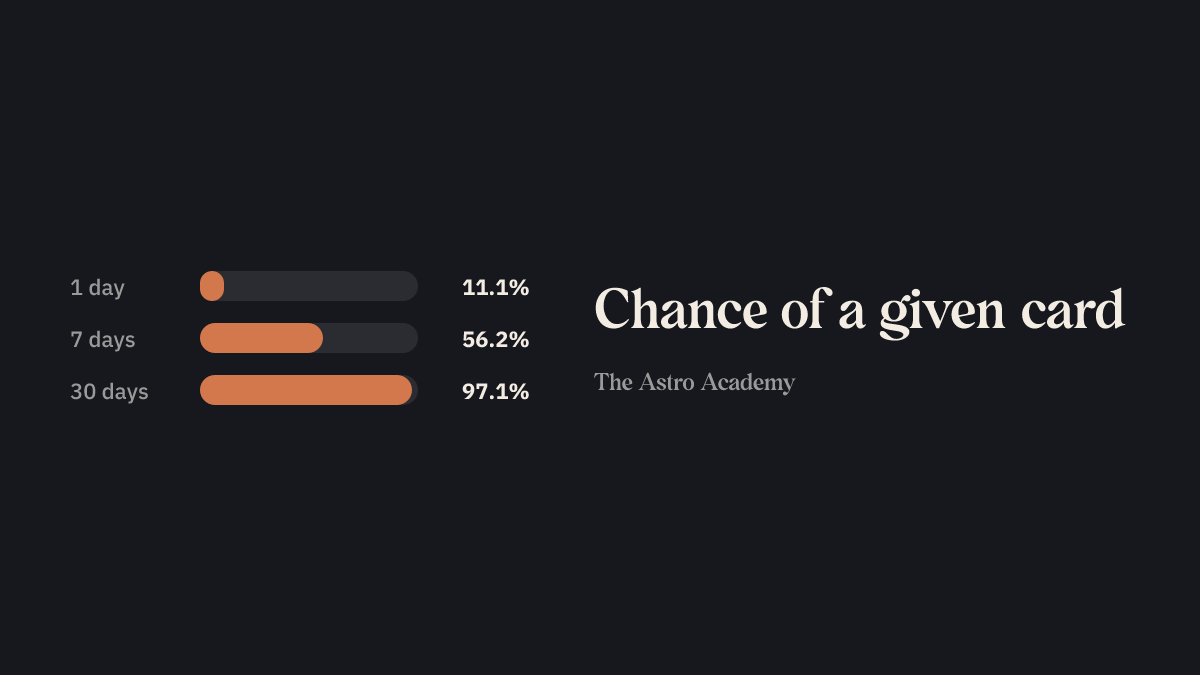
With 4 cards out of 36 Rauhnächte cards, every single card is in your spread with 11.1 %. Lay it every day for a week and a given card shows up at least once with 56.2 %, within a month with 97.1 %.
Until you have seen each of the 36 cards at least once takes 36.3 days on average. The last missing cards take the longest, because fewer new ones are left each day.
| Case | Value |
|---|---|
| Cards in the deck | 36 |
| Cards in the spread | 4 |
| Chance per card and spread | 11.1 % |
| At least once in 7 days | 56.2 % |
| At least once in 30 days | 97.1 % |
| Two given cards on consecutive places | 0.48 % |
| Days until every card was laid once (mean) | 36.3 |
Pure probability: every card equally likely, every spread freshly shuffled, no card twice in one spread. The mean until every card was laid is computed exactly over all intermediate states.
Frequently asked questions
- What is a year review card spread?
- A year review card spread is a specific layout of oracle or tarot cards used for personal reflection at the end of a year. It typically has positions that help you look back at your experiences and look forward to your intentions for the coming year.
- When is the best time to do a look back look ahead spread?
- Many people favor the quiet days between Christmas and New Year's Eve for a look back look ahead spread. This time aligns with the Rauhnächte tradition, which is seen as ideal for reflection. However, any day around the turn of the year that provides you with a peaceful moment will work.
- Can I use any oracle deck for this spread?
- Yes, you can use this four-position spread with any oracle or tarot deck you feel connected to. The positions ('What was good', 'What to let go of', 'What to take along', 'What to turn towards') are universal. This page uses the Rauhnacht oracle for its examples because its themes fit the winter season well.
- How is this different from a twelve-month spread?
- This spread gives you one central theme for the new year, while a twelve-month spread provides a specific theme for each month. The year review focuses on the big picture transition, making it a great starting point. You could do a twelve-month spread later for more detail.
- What if I draw a 'bad' card for the new year?
- The Rauhnacht oracle does not contain 'bad' cards, only themes for reflection. If a drawn card seems challenging, like The Wild Hunt or The Long Night, see it as a prompt. It might point to a need for more rest, a challenge to face with courage, or an area of life that requires your attention.