
Lenormand spread · 5 positions
Lenormand career spread: work and money
Lenormand spread for work and money
Focus on your question and draw all 5 cards.
5 cards to go.

Video · 33 seconds
Clarity at Work
This simple 5-card Lenormand spread helps you understand your professional situation better. It shows you where you stand, what supports you, and what a good next step could be. Calculate it for free: theastroacademy.com
Read along
Lenormand cards don't predict your future. They simply show you your next step. Think of a 5-card career spread as a small map for your professional life. Each card has a clear job. The first one shows where you currently stand. The next card points to a strength you have. See if that feels right to you. And the final card suggests a concrete action you could take. It's an invitation to see your work situation from a new angle. Try the five-card career spread for free at theastroacademy.com.
Contents
This five-card Lenormand career spread gives you a clear look at your current work situation. It helps you see where you stand, what supports you, and what your next practical step might be. Use it to check in on your professional life or to get ideas for a specific money question.
The five positions and what they represent
Each of the five cards in this spread has a specific job that builds on the others. Together, they give you a quick picture of your work life right now, showing the main theme and what's going on around it.
You read them from one to five to follow the story they tell. The first three cards map out your situation. “Where you stand” is the main topic. “What helps” points to a resource or advantage you might have. “What slows you” can show a challenge or something you might need to deal with before you can move forward.
The last two cards look at specific areas. The “Money” card gives you a hint about your financial situation connected to your work. Finally, the “Next step” card suggests a concrete action you could take. It's a prompt for what to do next, not a prediction.
| Position | Meaning |
|---|---|
| Where you stand | main topic |
| What helps | resource or advantage |
| What slows you | challenge to deal with |
| Money | financial situation connected to work |
| Next step | concrete action to take |
Common cards in a work context
While any card can show up in a career reading, some appear more often and have specific work-related meanings.
- The Anchor: The Anchor is the main card for your job, profession, and long-term stability.
- The Fish: The Fish points to money, business, and the flow of resources, making it an important part of a Lenormand money reading. Other cards give details about the work environment.
- The Tower: The Tower can mean a corporation, a big company, or feeling alone at work.
- The Fox: The Fox suggests you need to think smart and might point to a side job or a situation that needs a clever approach. Check if its appearance means you need to be cunning or if someone else is being sly.
- The Bear: The Bear often represents a boss, someone in power, or your own strength and influence.
- The Key: The Key means a solution, a breakthrough, or something important that opens doors.
When you see it, ask yourself what problem it might be solving or what opportunity it's presenting.
Phrasing questions about career and finance
The way you ask your question helps focus the reading. Instead of asking “Will I get the job?”, try something like 'What should I focus on to improve my chances with this application?'.
This changes the focus from a simple yes or no to advice you can use. Open questions often give you more to work with. If you're thinking about changing jobs or asking for a raise, your question could be 'What's a helpful perspective on my current salary situation?' or “Show me an overview of changing my job right now.” The cards can offer a fresh angle or highlight something you haven't thought about yet.
The card in the “Money” position gives you a view of your financial situation as it relates to your work. It shows the quality of your income. For instance, the Ship might suggest money from abroad or a long-term investment, while the Scythe could mean a sudden expense or a necessary cut.
From the last card to your next move
The fifth card, “Next step”, is probably the most practical one in the spread. It's a direct suggestion for what you can do.
It points to a real action, a change in attitude, or a conversation to have. Think of this card as a friendly prompt from a helpful colleague. For example, if the Letter appears as your next step, it might suggest sending that email you've been putting off or updating your resume. If you see the Crossroads, maybe the next step is to make a clear decision or to explore an alternative path you've been considering. The advice is usually simple and direct.
The idea is to turn the card’s symbol into a real-world task. If the Garden shows up, perhaps your next step involves networking or attending a work-related social event. Ask yourself: What's the most straightforward, practical action this card points to in my current situation? Then, you can decide if that action feels right for you.
| Card | Suggested action |
|---|---|
| The Letter | sending that email or updating resume |
| The Crossroads | make a clear decision or explore an alternative path |
| The Garden | networking or attending a work-related social event |
The positions at a glance
“Lenormand spread for work and money” has 5 positions. Each one asks the card lying there its own question.
| No. | Position | Guiding question |
|---|---|---|
| 1 | Where you stand | What is your situation at work? |
| 2 | What helps | What supports you? |
| 3 | What slows you | What holds you up? |
| 4 | Money | How does money look? |
| 5 | Next step | What is your next step? |
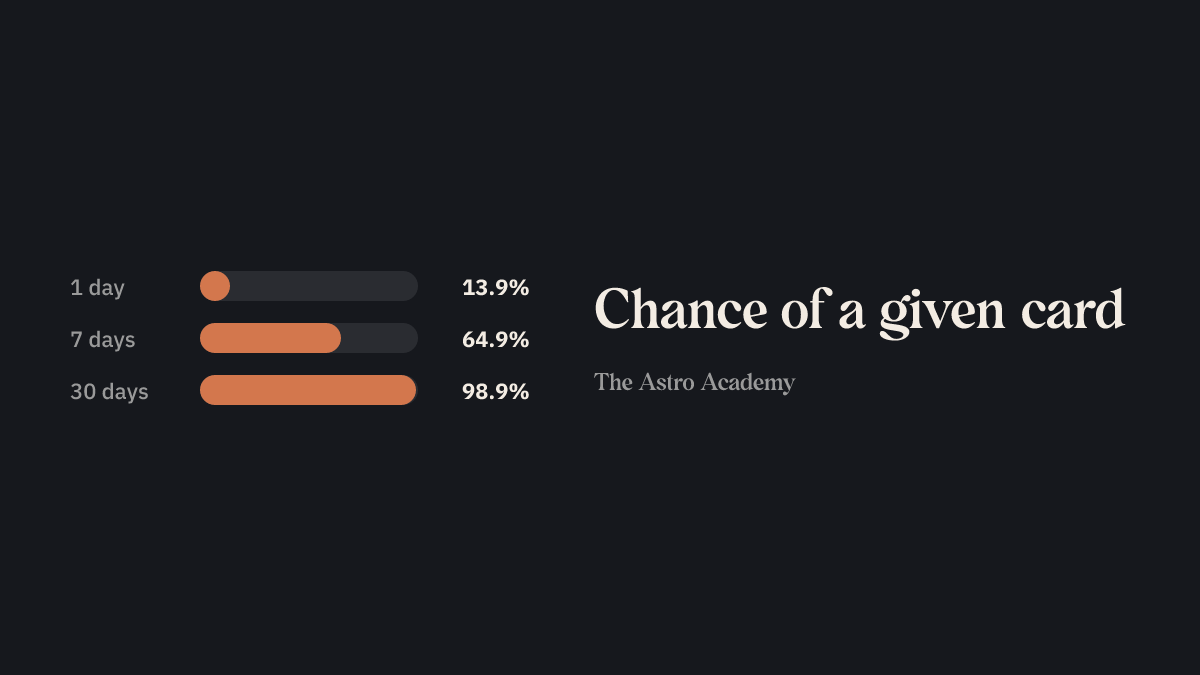
How often does a given card turn up in “Lenormand spread for work and money”?
With 5 cards out of 36 Lenormand cards, every single card is in your spread with 13.9 %. Lay it every day for a week and a given card shows up at least once with 64.9 %, within a month with 98.9 %.
Until you have seen each of the 36 cards at least once takes 28.7 days on average. The last missing cards take the longest, because fewer new ones are left each day.
| Case | Value |
|---|---|
| Cards in the deck | 36 |
| Cards in the spread | 5 |
| Chance per card and spread | 13.9 % |
| At least once in 7 days | 64.9 % |
| At least once in 30 days | 98.9 % |
| Two given cards on consecutive places | 0.63 % |
| Days until every card was laid once (mean) | 28.7 |
Pure probability: every card equally likely, every spread freshly shuffled, no card twice in one spread. The mean until every card was laid is computed exactly over all intermediate states.
Frequently asked questions
- How do I read a Lenormand career spread?
- Start by looking at each card in its position, from one to five. The first card sets the theme, cards two and three show supports and challenges, and the last two point to finances and your next action. Then, try reading them in pairs to see how they influence each other and tell a short story about your work.
- What if a difficult card appears in my Lenormand money reading?
- A card like Mountain or Mice in the money position isn't a prediction of doom. It can point to a temporary block, a slow cash flow, or small, persistent worries about finances. Use this information to check where you feel stuck or what small financial details might need your attention.
- Can Lenormand tell me if I will get the job?
- The cards are better at offering perspective than giving a definite “yes” or “no” about the future. Instead of predicting the outcome, a reading can show you your strengths in the situation and a good next step to take. It helps you focus on what you can control.
- Which Lenormand card is best for career?
- The Anchor is the classic card for work, employment, and stability. However, other cards can be very positive in a career context. The Sun can point to success and recognition, while the Key often means a solution or an important breakthrough.
- How specific should my question be for a work reading?
- A clear question leads to a clearer reading. It's helpful to be specific, for example, “What can I do to improve communication with my team?” is better than “Tell me about my job”. A focused question gives the cards a clear context to respond to.