

Sun
Conjunction Ascendant

With the Sun conjunct your Ascendant, your core identity and the way you show yourself to the world are closely woven together. The Sun is your inner light, the Ascendant your front window. This placement can shape how others see you and how you live your own life.

Step 1 of 2

Your birth data

When were you born?

The date sets the Sun, Moon and every planet.

Swiss-Ephemeris accurateResult in seconds

This aspect involves an angle, so we need your date, time and birthplace.

Contents
How it works

Three steps to Sun Conjunction Ascendant

  1. Enter your birth data

    This aspect involves an angle (Ascendant or MC). For that we need your date, time and birthplace.

  2. Calculate the aspect

    The math runs on the Swiss Ephemeris, the same base professional astrology software is built on. The result is accurate to the arc-second, and free.

  3. Read your result

    You see right away whether you have the aspect and how tight the orb is, along with a reading you can check against your own everyday life.

Video · 29 seconds

What You See

The Sun in your chart is your core identity. The Ascendant is how you appear. When they're aligned, you project your true self naturally.

Read along

Do people often say what they see is what they get with you? In astrology, the Sun is your core self, the real you. Your Ascendant is your public face, the first impression you make. Imagine your Ascendant is your front door. Your Sun is standing right in it. People with this often come across as very authentic. Check if that feels true for you. See if your Sun and Ascendant are aligned in your chart at theastroacademy.com.

Meaning

What Sun Conjunction Ascendant means

Think of your Ascendant as the front door of your personality: the first impression you make and the way you naturally come across. The Sun stands for your essential self, your vitality and what makes you you. In this conjunction the two are practically fused. Often that means your true self shines through quickly and brightly in the way you present yourself, with very little filter between who you are inside and who people meet. Many with this placement come across as authentic and genuine, with a strong presence in the room. Do you recognize yourself in that? It often hints at a life path that asks you to explore your own identity in depth and to show it.
In daily life

How it shows up day to day

Day to day, this conjunction can show up in several ways. People may say you have a clear identity or a personal style all your own, even when you are not trying to build one. See whether these fit:

  • Your energy rises and falls with how freely you can be yourself.
  • You stand out in a crowd, less through volume than through a presence people notice.
  • Pretending to be someone else is hard for you, and faking it feels uncomfortable.
  • Others may see you as a natural leader or as someone who takes the first step.
  • The first impression you make is usually a fairly accurate picture of your whole personality.

Others tend to pick up the directness in how you come across right away, like a handshake that tells them who you are.

Light and shadow

Strengths and tensions

A real gift of this aspect can be a strong sense of self-awareness and authenticity. Many people with it know who they are and show it with confidence. Does that make you effective when you lead, or wherever clear self-expression is valued? People often trust you because what they see is what they get. One thing to consider: this strong presence can sometimes feel like a lot to others, and you might find it hard to adjust when a situation calls for a different approach. It helps to grow more flexible here and to remember that giving others room to shine is a strength too. At times your identity may feel so solid that you miss the finer points of someone else's view.

In practice

How to work with it

To get the most out of this conjunction, focus on expressing yourself on purpose. Lean into your natural authenticity, and also watch how your strong presence affects the people around you. Some ideas:

  • Let your individuality show fully, and do not hide from being seen.
  • Build your leadership skills, since guiding and inspiring others may come naturally.
  • Practice active listening, so your strong self-expression is balanced by understanding.
  • Find creative outlets where you can show who you are without holding back.
  • Take care not to dominate conversations or situations, and leave space for other voices.

This path asks you to be fully yourself while you get better at the art of graceful give-and-take.

Going deeper

Sun Conjunction Ascendant as a transit

Sun Conjunction Ascendant also happens as a transit: the currently moving Sun forms this angle to the Ascendant in your birth chart. While it lasts, the focus is on will and on what your Ascendant stands for, and the two themes briefly merge into one shared note. With the fast Moon it passes within hours. Slow planets like Saturn or Pluto can stay with you for months.

Fact sheet

Sun Conjunction Ascendant at a glance

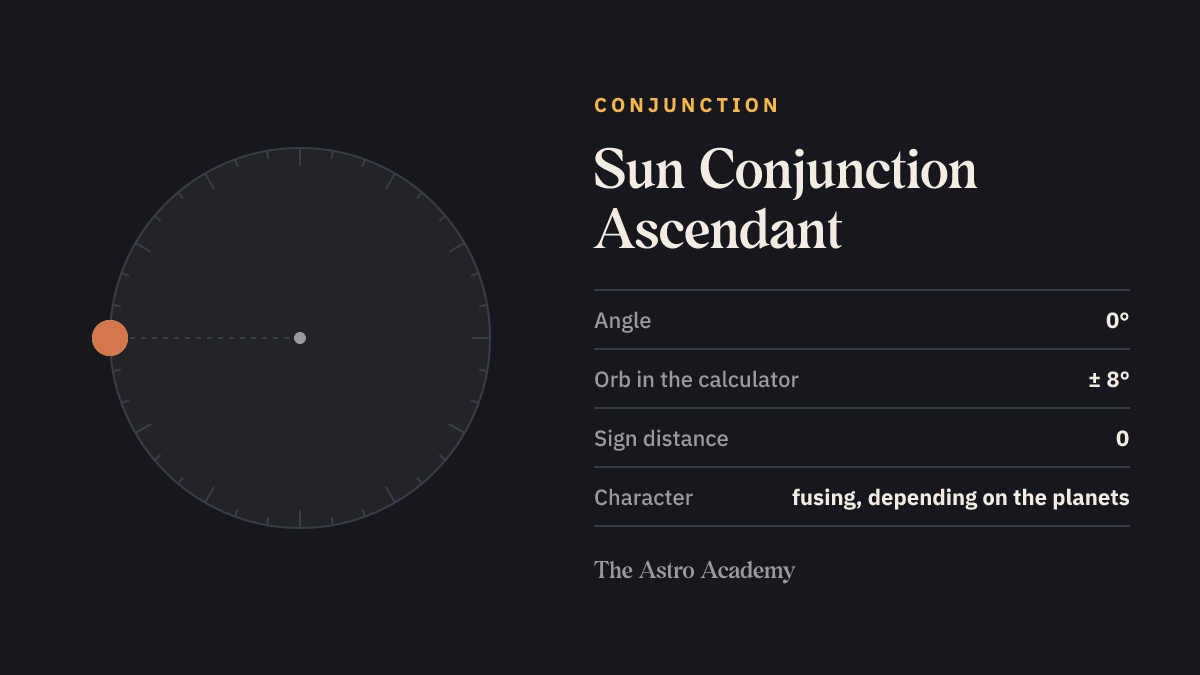
Between Sun (your core self) and Ascendant (how you come across to others) this aspect leaves about 0°. As a conjunction, that means: both sit in the same spot and act as one force.

Circle with two points for Sun and Ascendant set 0 degrees apart, showing the shape of Sun Conjunction Ascendant
Sun Conjunction Ascendant: 0° with up to 8° of leeway. Under 1° it counts as exact.
Profile: Sun Conjunction Ascendant
FeatureValue
AspectConjunction (0°)
Orb in the calculator± 8°
Typical sign distancesame sign
Characterfusing, depending on the planets
Sunyour core self
Ascendanthow you come across to others
Needs birth timeyes, because an angle is involved
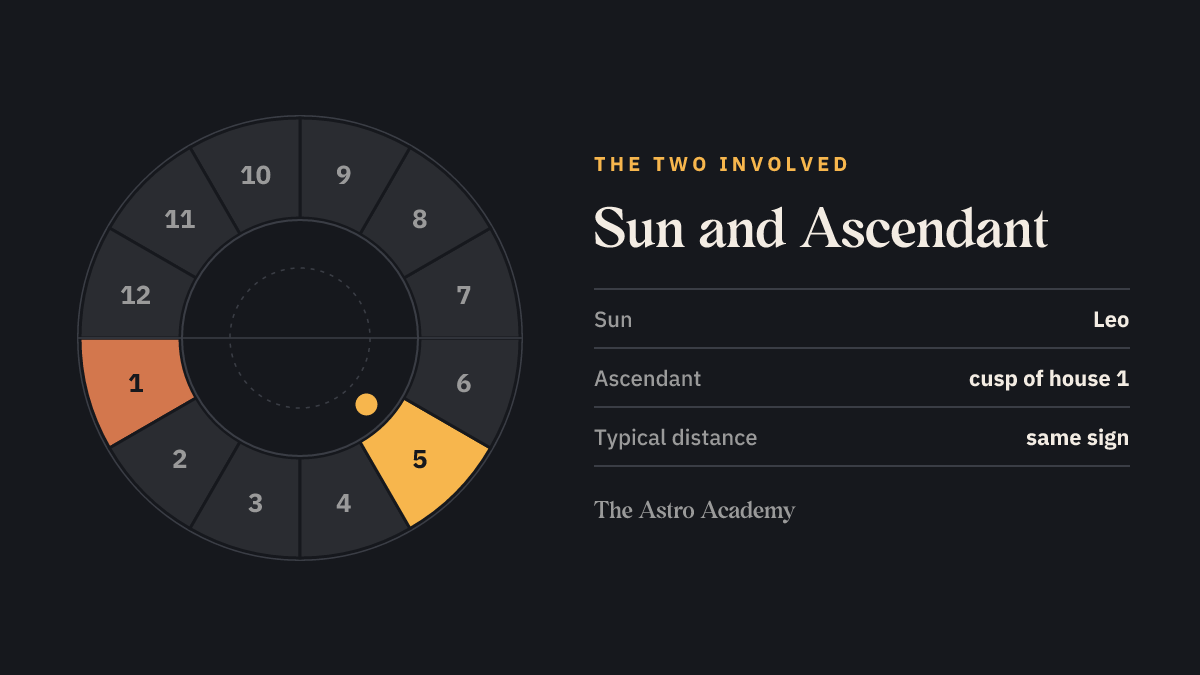
House wheel showing the home fields of Sun (Leo) and Ascendant (cusp of house 1)
This is where Sun and Ascendant are at home in the natural zodiac. In your own chart they can sit in any sign.

Check it against yourself

  • Are there moments when both themes are called on at once? One: your core self. The other: how you come across to others. How do you react then?
  • Is the orb in your chart tight (under 2°)? Then you usually feel the aspect more clearly.
  • Tonight, write down one situation that might fit, and read it again in a week.

Continue with the overview of all astrology aspects, with all five angles between the two on the Sun–Ascendant aspects page and with Sun Sextile Ascendant. Which life areas the aspect connects is shown by the house calculator. When a moving planet forms this angle to your chart, it appears in your personalized daily horoscope. The planets themselves are explained in the planets overview, and between two people the compatibility chart compares the same angles.

Statistics 1940–2010

How rare is Sun Conjunction Ascendant?

4.4 % of people born between 1940 and 2010 have Sun Conjunction Ascendant in their birth chart, within an orb of up to 8°. Among 711 aspect combinations that occur at all, that is number 599 by frequency. The most common aspect between Sun and Ascendant is the square (7.9 %).

Here the birth time decides: the Ascendant turns through all twelve signs in 24 hours as the Earth rotates. Two people born on the same day can have quite different aspects here, depending on whether they arrived in the morning or the evening.

Bar chart: share of births 1940 to 2010 with a conjunction, opposition, square, trine, sextile or no aspect between Sun and Ascendant, conjunction highlighted
Sun Conjunction Ascendant in numbers
ItemValue
Share of births4.4 %
Rank among all combinations599 / 711
Orb8°
No aspect between Sun and Ascendant69.4 %

Counted with the Swiss Ephemeris: 25,933 birth charts, one for every day from 1940 to 2010, each day at a different hour, born in Frankfurt am Main. Orbs as in the calculator on this page.

FAQ

Sun Conjunction Ascendant: frequently asked questions

What does 'conjunction' mean in astrology?
A conjunction forms when two planets or points sit very close together in the zodiac, usually within 0 to 10 degrees. Being that close, their energies blend and act as one strong force in your chart, each one making the other louder.
Do I need my exact birth time to know if I have Sun Conjunction Ascendant?
Yes. For aspects that involve the Ascendant (or the Midheaven), you need your precise birth time. The Ascendant changes sign about every two hours, so even a small shift in birth time can move it and change the aspects it forms.
Is Sun Conjunction Ascendant a good or bad aspect?
Astrology does not have 'good' or 'bad' aspects. Each placement brings its own mix of strengths and chances to grow. Sun conjunct the Ascendant is strong, and it can bring real authenticity and presence, along with the task of steering that personal energy well.
Next step

See your whole chart

One aspect is only the start. Build your full birth chart for free, with every aspect, house and planet.

Build my birth chart

Free, no sign-up.