
Sun–Moon aspects
Are you at peace with yourself? Sun and Moon may hold the answer. Your Sun stands for the person you're trying to become, your conscious will and the way you grow. Your Moon is about safety: feelings, habits, the thing you reach for when you're alone, like the old sweater or the late-night snack. If both agree, what you want and what you need point in one direction. If they clash, you might keep tripping over yourself, chasing one thing and quietly longing for the opposite. More than your outward behavior, this aspect shows the weather inside you.
Enter your birth details. We use the Swiss Ephemeris to work out which angle actually stands between Sun and Moon in your chart.
Your birth data
Do you have one of these aspects?
The date sets the Sun, Moon and every planet.
Contents5 sections
Sun Conjunction Moon
Fusion: the two act as a single force.
With Sun conjunct Moon, your core self and your feelings and instincts are hard to tell apart. Wanting and doing often come from the same impulse, so both feel like one movement. That gives you strength, but stepping back from it is hard.
A conjunction puts both factors on the same spot in your chart. You can't feel them separately, because whatever the first wants tints the second. Astrologers call it the strongest connection of all: intense rather than easy or hard. With a tight conjunction, check whether the theme feels like part of who you are instead of something that happens to you. The catch is that you rarely see it from outside. It's as obvious as your own voice, which only sounds strange on a recording.
Sun Opposition Moon
Tension: two poles facing each other.
With Sun opposite Moon, your core self and your feelings and instincts pull against each other. Many people live one side themselves and meet the other in someone close to them. See whether your relationships hold up a mirror to this theme.
With an opposition, the two factors face each other from opposite sides of your chart. It often feels like either/or, seldom both at once. Many people live one side and meet the other in those around them, like the partner who plans every detail while you improvise. That's why oppositions so often read as relationship themes. The aspect tends to mature once you stop picking a side and move between the two poles.
Sun Square Moon
Friction: the aspect that forces you to act.
With Sun square Moon, your core self and your feelings and instincts keep getting in each other's way. Choosing one often costs you something in the other. Over time that pressure tends to build real skill in this area of life.
A square sets two factors at an angle where they trip over each other. It tends to feel like resistance: follow one, and the other pipes up, like a coworker who objects the moment you start. That friction is why squares turn up so often in the charts of people who get things done. Pressure builds, and pressure moves you. A trine lets you be good at something, while a square makes you earn it. Rather than settling the conflict, see whether you can put it to work.
Sun Trine Moon
Flow: talent that comes for free.
With Sun trine Moon, your core self and your feelings and instincts work together with ease. Other people read it as a gift. To you it often feels ordinary, so it is easy to overlook.
In a trine, two factors cooperate effortlessly. What's linked here runs without you thinking about it, and that ease is the trap. Because it comes easily, you may take it for granted and never build it up, like a friend who can sing but never joins a choir. Trines tend to be your reserve rather than your engine. They show what you can lean on in hard times and reach full strength once you use them deliberately.
Sun Sextile Moon
Opportunity: talent you have to call on.
With Sun sextile Moon, the link between your core self and your feelings and instincts is ready but does not start on its own. Use it deliberately and it carries you reliably.
Think of the sextile as the trine's smaller sibling. The link is there, but it won't get going on its own. Use it on purpose and it tends to carry you well. People often describe sextiles as "doors that open when I knock." The chance exists, and the knocking is your job. So in a life story this aspect can look unremarkable until someone practices it deliberately.
Combine two planets.
Choose two factors and an angle. The meaning of that pairing appears right below, in a single line.
Sun Square Moon
With Sun square Moon, your core self and your feelings and instincts keep getting in each other's way. Choosing one often costs you something in the other. Over time that pressure tends to build real skill in this area of life.
Sun and Moon: the five angles in numbers
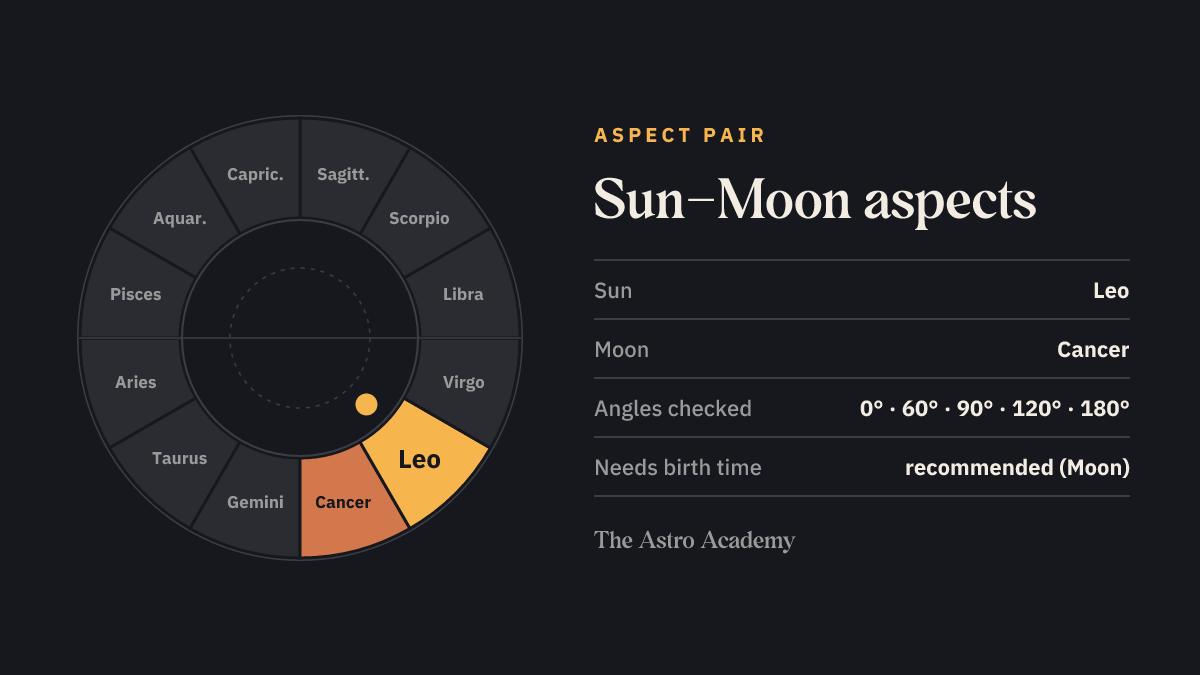
Between Sun (your core self) and Moon (your feelings and instincts) the calculator checks five angles. Each has its own leeway; the date is a start, your time makes it certain, because the Moon moves about 13° a day.
| Aspect | Angle | Orb | Character |
|---|---|---|---|
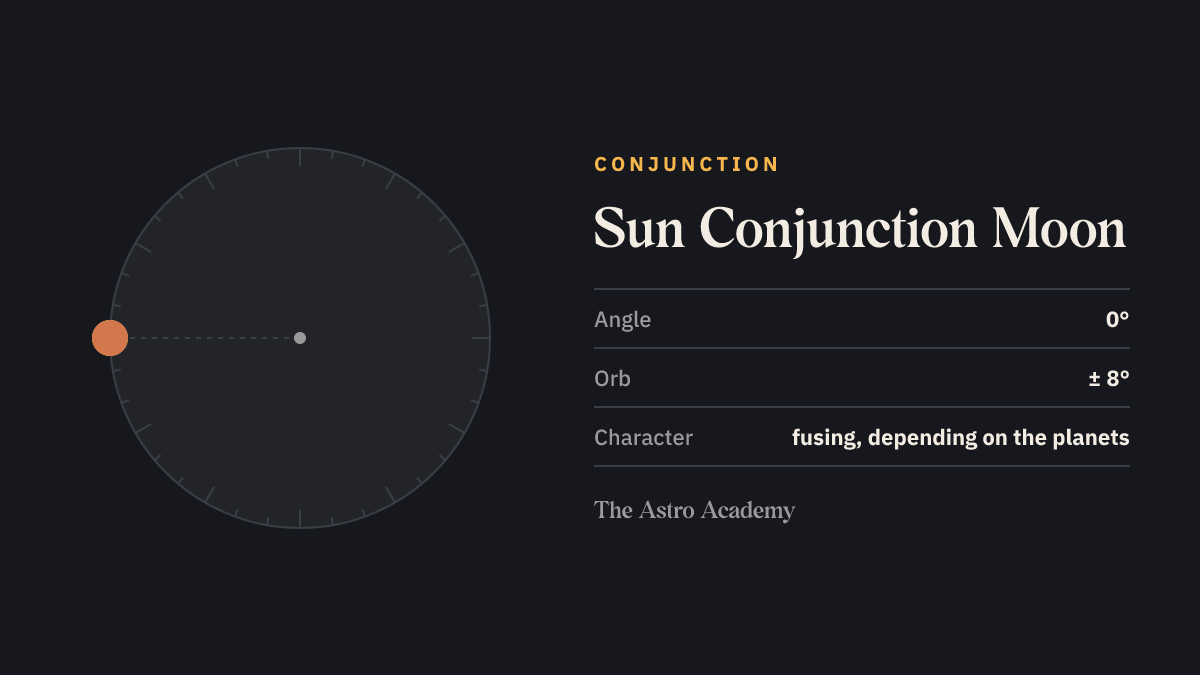
| Sun Conjunction Moon | 0° | ± 8° | fusing, depending on the planets |
| Sun Sextile Moon | 60° | ± 5° | flowing, harmonious |
| Sun Square Moon | 90° | ± 7° | tense, demanding |
| Sun Trine Moon | 120° | ± 7° | flowing, harmonious |
| Sun Opposition Moon | 180° | ± 8° | tense, demanding |
- Use the calculator above to find which of the five angles you have.
- Then read just that one section and test it against something that happened this week.
- No hit? Then Sun and Moon work independently for you.
Related pairs: Sun–Mercury aspects, Sun–Venus aspects, Sun–Mars aspects. All aspects of your chart at once are in the aspects calculator, the life areas in the house calculator, and today’s angles to your chart in your personalized daily horoscope.
Which aspect between Sun and Moon is the most common?
29.7 % of everyone born 1940 to 2010 has one of the five major aspects between Sun and Moon; 70.3 % have none. The most common is the square (7.8 %), the rarest the opposition (4.3 %).
This is plain geometry: Sun and Moon move through the zodiac independently. A square exists twice on the circle, once on each side. With an orb of up to 7° it covers 28° in total, which is 7.8 % of 360°. The conjunction and opposition exist only once, so they are rarer.
In the sky the two form 99 exact major aspects a year, because the Moon runs through the whole zodiac in under a month.

| Aspect | Share of births |
|---|---|
| Conjunction | 4.3 % · 12.37× a year exact |
| Opposition | 4.3 % · 12.37× a year exact |
| Square | 7.8 % · 24.74× a year exact |
| Trine | 7.8 % · 24.74× a year exact |
| Sextile | 5.6 % · 24.74× a year exact |
| No major aspect | 70.3 % |
Counted with the Swiss Ephemeris: 25,933 birth charts, one for every day from 1940 to 2010 at 12:00 UT, orbs as in the calculator. Sky: every day 1900–2100. Famous people: Wikidata, only where the aspect holds for the whole birth day.