
Astrology · Basics
Astrology terms, explained fast
Ascendant, aspect, transit, retrograde? Every key term is here — in one sentence, no jargon.
The chart
- Natal chart
- A snapshot of the sky at the moment you were born — the map everything else is read from.
- House
- One of twelve life areas in the chart (home, career, relationship …). It shows where something plays out.
- Ascendant (Rising)
- The sign rising on the eastern horizon at your birth. Your first impression — it needs your exact birth time.
- Descendant
- The point opposite the Ascendant. It stands for partnership and what you seek in others.
- Midheaven (MC)
- The highest point of the chart. It stands for career, reputation and public role.
- Cusp
- The boundary line where a house begins. The changeover between two signs is also called a cusp.
- Lunar Nodes
- Two opposite points (North and South Node). The North Node shows your direction of growth, the South Node what’s familiar.
Signs & building blocks
- Zodiac sign
- One of twelve 30° slices of the zodiac (Aries to Pisces). It describes the "how" of an energy.
- Element
- Fire, earth, air or water — a sign’s basic nature. Three signs share each element.
- Modality (Quality)
- Cardinal, fixed or mutable — whether a sign starts, sustains or adapts.
- Polarity
- Active (yang, fire & air) or receptive (yin, earth & water) — a sign’s basic orientation.
- Ruler
- The planet that governs a sign (e.g. Venus for Libra) and gives it its core tone.
- Benefics & malefics
- A traditional split of the planets: Venus and Jupiter as "benefics" (easy, kindly), Mars and Saturn as "malefics" (demanding). Not good vs evil — the malefics are teachers, not demons.
- Essential dignity
- How strong a planet is by sign. Strongest in its own sign (domicile) or its exaltation; weakened in the opposite sign (detriment) or its fall.
- Exaltation
- The sign where a planet works especially well — almost like a welcome guest. The Sun, for example, is exalted in Aries.
- Luminaries
- The Sun and Moon — the chart’s most important pair: who you are and how you feel.
- The Big Three
- Sun, Moon and Rising together — the quickest shorthand for your personality.
Aspects
- Aspect
- The angle between two planets. It tells you whether they cooperate or clash.
- Conjunction (0°)
- Two planets at the same point. Their forces merge and amplify each other.
- Opposition (180°)
- Planets exactly across from each other. A tug-of-war asking for balance between two poles.
- Trine (120°)
- An easy, flowing angle. Talents that come to you effortlessly.
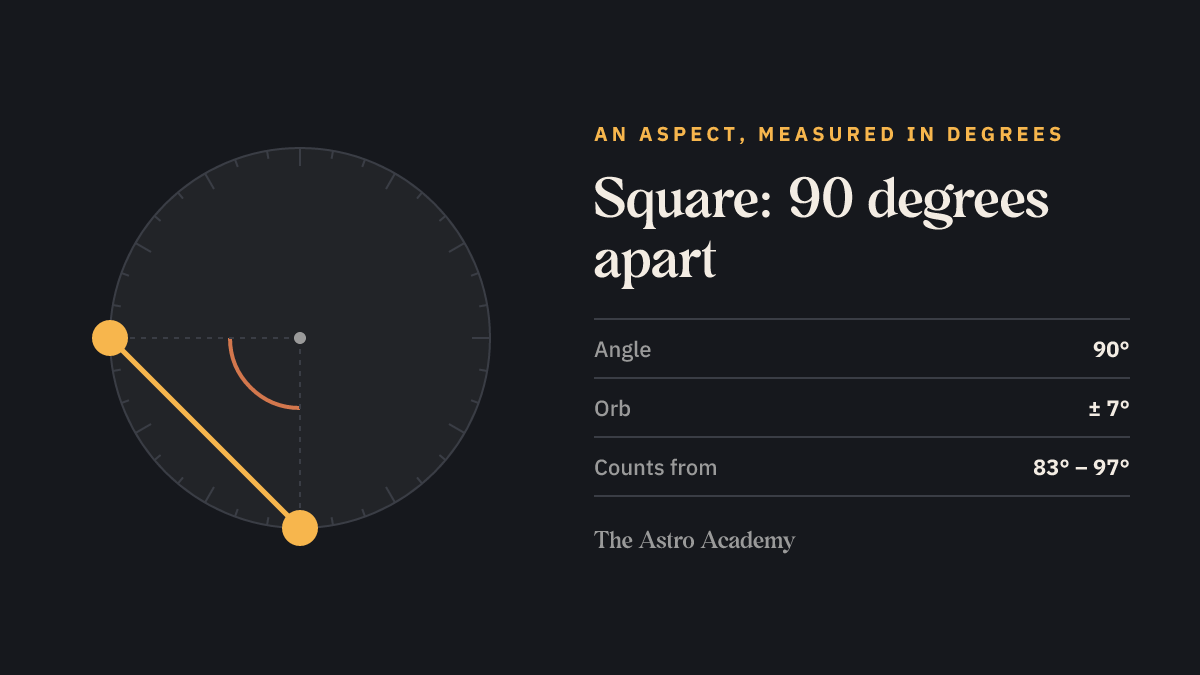
- Square (90°)
- A tension angle. Friction that challenges you — and drives growth.
- Sextile (60°)
- A friendly angle full of opportunity — easy if you reach for it.
- Orb
- The allowed leeway around an exact aspect. The tighter the orb, the stronger the aspect.
Timing & movement
- Transit
- Where a planet is today — and how it touches your natal chart. The basis of a daily horoscope.
- Retrograde
- When a planet appears to move backward from Earth. A time to revisit, not to launch.
- Ingress
- The moment a planet moves into a new zodiac sign — often a felt shift in mood. The Sun’s ingresses mark the start of each season.
- Lunation
- A full lunar cycle from new moon to new moon (about 29.5 days). Loosely, "lunation" often means the new moon itself as the starting point.
- Solar Return
- The moment the Sun returns to its birth position each year — your "chart for the year ahead".
- Moon phase
- The cycle from new moon to full moon and back — a natural rhythm for starting and releasing.
- Synastry
- Comparing two charts to see how well two people fit together.
- Ephemeris
- The astronomical table of planet positions. We compute with the Swiss Ephemeris — accurate to the second.
The aspects in numbers
Aspects and orbs: the angles at a glance
Many terms in this glossary describe angles. An aspect is the distance between two planets on the zodiac, measured in degrees. It does not have to be exact to count: the orb says how many degrees of leeway are allowed. The table shows the angles and the orbs our chart calculators use.
| Aspect | Angle | Orb | In plain words |
|---|---|---|---|
| ☌ Conjunction | 0° | ± 8° | merge and act as one |
| ⚹ Sextile | 60° | ± 5° | an opening you have to take |
| □ Square | 90° | ± 7° | friction that pushes you to act |
| △ Trine | 120° | ± 7° | flows easily, almost by itself |
| ⚻ Quincunx | 150° | ± 3° | doesn’t quite fit, needs adjusting |
| ☍ Opposition | 180° | ± 8° | opposite poles seeking balance |
Terms beginners often mix up
- Zodiac sign and constellation: signs are equal 30-degree sections, constellations are actual star groups. More on the page The 12 zodiac signs.
- Moon sign and moon phase: the sign the Moon was in, versus the shape of the lit Moon. Your phase is shown by the moon phase calculator.
- House and sign: both split the circle into twelve, but houses depend on birth time and place. Explained in The 12 houses.
- Lunar nodes and the Moon: the nodes are not bodies but points where the Moon’s path crosses the Sun’s. Your nodes are calculated by the lunar nodes calculator.
To see the angles in your own chart, open the free birth chart or look them up one by one under aspects. The groundwork behind them is in astrology basics.
Frequently asked questions
What is the difference between zodiac sign and Ascendant?
Your zodiac sign is the sign the Sun was in when you were born. The Ascendant is the sign rising in the east at that moment — it depends on your birth time and place and describes how you come across.
What does orb mean in astrology?
The orb is the margin within which an aspect still counts. If the Sun and Moon are 115 instead of exactly 120 degrees apart, that is still a trine with a 7-degree orb. The tighter the angle, the stronger the aspect.
What does radix mean?
Radix is another word for the natal chart — the position of every planet at the moment of your birth. Everything else, such as transits or the solar return, is compared against the radix.
Which terms should a beginner learn first?
Start with four: sign, planet, house and aspect. Then Ascendant and transit. With those six terms you can already follow most readings.
 Reviewed by Theresa Touhey · Astrologer & Tarot Reader