
Astrology · Basics
Astrology basics, made clear
No jargon, no prior knowledge. Here you’ll learn what a birth chart is made of — and how to read it yourself, step by step.
Astrology is the craft of reading the sky: where the Sun, Moon and planets stood at the moment you were born forms a map of your make-up — your birth chart. It doesn’t predict the future. It’s a language for understanding yourself and your patterns more clearly.
The four building blocks
What a birth chart is made of
Every chart comes down to four parts. Understand these four and you can read any chart.
Zodiac signs
The twelve signs describe the "how" of an energy — through element, modality and polarity.
The 12 signsPlanets
The planets are the "what" — which force is at play, from the Sun to Pluto.
Planets & pointsHouses
The twelve houses are the "where" — the life area an energy shows up in.
The 12 housesAspects
Aspects are the angles between planets — whether they cooperate or clash.
Understand aspectsExplore the 12 signs.
Tap a sign — its polarity, element, modality and ruler, each explained in one line.
How to start
Read your chart in three steps
Find your Big Three
Sun, Moon and Rising together are the quickest shorthand for your personality.
Read sign + house together
A planet is the "what", its sign the "how", its house the "where". Those three make a sentence.
Look at the aspects
Finally, aspects connect the dots — showing what in you plays together or wrestles.
From jargon to a sentence
How to read a placement — one example
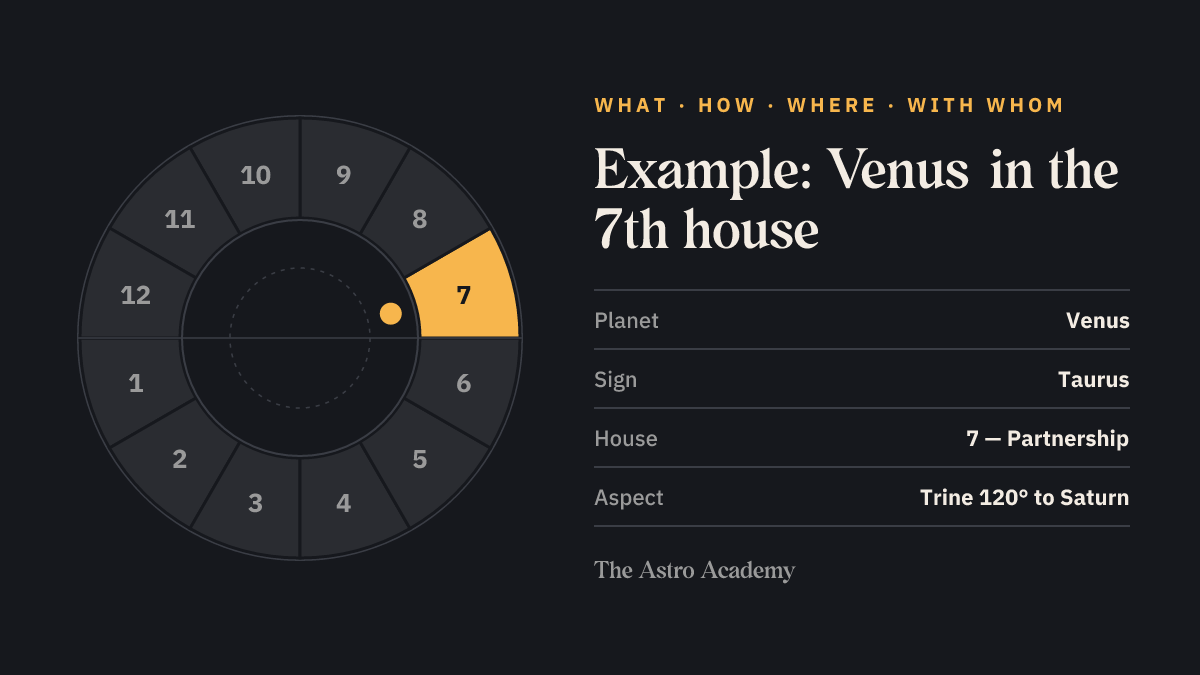
A chart might say: "Venus in Taurus in the 7th house, trine Saturn." For beginners that sounds like code. It is really just four questions in a row — what, how, where and with whom. The table shows how each technical word turns into everyday language.
| Building block | Question | In the example | In plain words |
|---|---|---|---|
| Planet | What? | Venus | how you love and what you value |
| Sign | How? | Taurus | calm, sensual, built to last |
| House | Where? | 7th house | in committed partnership |
| Aspect | With whom? | Trine (120°) to Saturn | reliability supports affection |
Put together, that becomes a sentence you will soon be able to form yourself: "In relationships you may look for calm and constancy — does loyalty feel more like safety to you than duty?" That is how a reading sounds when it stays a question for you rather than a verdict about you.
What you need to start
- Birth date: is enough for your Sun sign, moon phase, lunar nodes and the signs of almost every planet. Only the Moon can change sign within a day, since it spends about two and a half days in each.
- Birth time: sets your Ascendant and houses. The Ascendant changes sign about every two hours on average — some signs pass faster than others, as the rising-sign frequency study shows.
- Birth place: gives latitude and longitude. Without it the houses cannot be calculated, because the horizon lies differently everywhere on Earth.
Three beginner mistakes almost everyone makes
- Looking only at the Sun sign. The Moon and Rising matter at least as much. The Big Three calculator shows all three at once.
- Sorting aspects into good and bad. A square (90 degrees) brings friction, but often also the push to change something. What the angles really mean is explained under aspects.
- Retrograde means bad luck. A retrograde planet only appears to move backwards as seen from Earth. What the best-known case means is explained on the page about Mercury retrograde.
Ready for your own birth chart?
Build it free in seconds — or learn to read it yourself with our 30-day course. New words? The glossary explains each in one line.
Or: learn astrology in 30 days →Frequently asked questions
What do you need to learn astrology?
Your birth date is enough to start. Add your birth time and place and you unlock the Ascendant and houses — that’s when the chart gets personal.
What are the four building blocks of a chart?
Signs (the how), planets (the what), houses (the where) and aspects (how the parts interact). Understand those four and you can read any chart.
How long does it take to learn astrology?
The basics land in a few weeks if you keep at it a few minutes a day. Our 30-day course takes you step by step from zero to reading your own chart.
Can you teach yourself astrology?
Yes. Astrology is very learnable on your own — free calculators and guides show you the what. The jump from looking things up to actually interpreting comes easiest with a little structure: short lessons that build on each other and daily practice on your own chart rather than dry theory.
What is the best way to learn astrology online?
Start with the four building blocks (signs, planets, houses, aspects), practise on your own chart rather than abstract theory, and keep it to small daily steps instead of long sessions. That is exactly how our 30-day course is built — 5 minutes a day, with a personal daily quest drawn from your chart.
 Reviewed by Stina Garbis · Tarot & Astrology Reader