
Free · no sign-up · in seconds
Human Design centers: open or defined
Enter your birth data and see right away which of your centers are open.
Your Human Design centers are the nine special points you find in your chart. Each one is either clearly defined, so it's colored and active, or it's open and empty. Just put in your birth details, and we'll first show you which of your centers hold their own energy and which ones tend to pick up on what's around you. Then we'll explain all nine to you in plain words. For the open centers, you'll also find the question you might have often wondered about yourself.
Contents
Your result in three steps
Enter your birth data
Your date is enough to start; time and place make it exact.
Two moments
Your birth and the moment 88 degrees of the Sun’s path before.
Look at the centers
Which of the nine centers are defined in you and which are open.


Video · 40 seconds
Your two sides
In Human Design, there are defined (colored) and open (white) centers. The defined ones are your consistent nature, the open ones take in from the outside. Understand the difference in 60 seconds.
Read along
Some parts of your personality are yours. Others are just visiting. In your Human Design chart, you see this as colored and white shapes. The colored ones are called defined centers. A defined center is like your own personal library. You know the books well, they belong to you. The white, open centers are like a public library. You can read anything, but the books are not yours to keep. Your open centers are an invitation to absorb wisdom from others. Without having to make it your own. You can see which of your centers are open right away. Work it out for free at theastroacademy.com.
What are the centers in Human Design?
Your Human Design chart shows you nine centers. Think of them as small energy stations that handle all sorts of life topics, from your feelings to your willpower. When a center is connected by a full channel, it’s “defined” and has a consistent quality. If that connection is missing, it’s open and more sensitive to the world around you.
The 64 gates from your chart are spread across these nine centers, like little doors to different qualities. If both gates of a channel are activated by planets, either from your birth chart or your Design, then that channel is defined. And that's exactly how the two centers it connects become defined. In our count, on average across all charts, about 4.2 of these nine centers are open. Only for Reflectors are all centers undefined, which gives them a very special role.
| Center | Kind | Theme | Defined in |
|---|---|---|---|
| Head center | Pressure | Questions and inspiration | 27.8% |
| Ajna center | Awareness | Thinking and making sense | 48.2% |
| Throat center | Expression | Speaking and doing | 70.1% |
| G center | Identity | Direction and sense of self | 57% |
| Heart center (Ego) | Motor | Willpower and self-worth | 37.4% |
| Sacral center | Motor | Life force and work energy | 67.1% |
| Spleen center | Awareness | Gut instinct and wellbeing | 58% |
| Solar Plexus center | Motor and awareness | Feelings and moods | 52.9% |
| Root center | Pressure and motor | Pressure and drive | 61.4% |
The difference: defined or open
When a center in your chart is defined, you get a really steady energy from it. An open center, though? That takes in all the vibes from your environment. Both are valuable. They show you two different ways you might handle certain life topics.
- Defined (colored in): When a center in your chart is defined, you have a very consistent way of approaching its themes. Many with a defined center feel very reliable in this area, no matter who they are with or where they are.
- Open (white): Here, you're like an antenna: you strongly pick up on others' energies and feelings related to this theme. It can even feel quite different for you depending on the company you keep.
- Undefined: Some Human Design texts look at this more closely: An undefined center is white in your Human Design chart, but it has individual active gates. A completely open center, however, shows none at all. Here on this page, "open" refers to both, meaning any center that doesn't have a continuous channel.
What open really means
Open areas in your Human Design chart pick up on other people's energies. You often feel them much more strongly inside you. This influence is called conditioning, and it's not good or bad, but simply a part of how you experience the world.
An open center acts like a loudspeaker. It doesn't have its own sound, but it amplifies every sound that comes in. Sometimes it even sounds louder than the original music. Things often get tricky when you make decisions from this open area, perhaps to get rid of a pressure that isn't even yours.
- Use the calculator above to see which of your centers are white.
- Further down, read the question for each open center.
- For one week, notice the moments when that question comes up for you.
- After an hour by yourself, see which thoughts or feelings are still around.
The pressure centers: Head and Root
Your Head and Root centers are sources of inner pressure in Human Design. They make you feel like you just have to do something. Your Head pushes you to understand things, while your Root drives you to get moving.
Head center
The Head center is defined in 27.8% of all charts, which is about a quarter. If your Head center is defined, ideas and questions often flow out of you quite naturally. If your Head center is open, you might pick up on other people's questions and rack your brain over things that don't directly concern you. Then it helps to briefly ask yourself: "Does this thought really belong to me?"
Root center
If your Root center is defined, it gives you a very specific rhythm for handling pressure and stress; this energy comes and goes in bursts. An open Root, however, picks up on the hurried energy of your surroundings very intensely. Many people then rush through their tasks just to make that external pressure finally ease up. A helpful question for you then is: Does this really have to be finished today?
The awareness centers: Ajna, Spleen, Solar Plexus
The Ajna Center, the Spleen Center, and the Solar Plexus Center are your three awareness centers. They're where you take in the world and organize it for yourself. Each of these centers has a way that’s all its own, as you'll soon see.
- Ajna center: If your Ajna center is defined, as it is in 48.2% of all charts, your thinking has its own steady structure. This can be a great guide for others. If it's open, you're good at understanding many points of view and don't like to be pinned down. Take a moment to check in with yourself: Are you claiming to know something for sure, even if you feel unsure inside?
- Spleen center: A defined Spleen center usually gives you a solid feeling of well-being and an instinct that reacts lightning-fast in the moment. However, if your Spleen center is open, you pick up on discomfort and the worries around you very intensely. Then it's good to take a moment for yourself: Are you holding onto something that secretly isn't good for you at all? Remember, this refers to your feelings and isn't a medical statement. For physical complaints, always consult a doctor.
- Solar Plexus center: A defined Solar plexus center gives you your own distinct emotional wave and with it, emotional authority. As someone with an open Solar plexus, you often pick up on other people's moods much more strongly than they do themselves. So, ask yourself: Do you prefer to avoid conflict or uncomfortable truths?
The motors: Sacral and Heart
Four centers in your chart are your motors; they give you drive: the Sacral, Heart, Solar Plexus, and Root centers. When the energy from one of these motors reaches your Throat via channels, it turns into action. And that also shapes your Type.
Sacral center
A defined Sacral center, which you'll find in 67.1% of all charts, gives you the staying power of a true Generator or Manifesting Generator. When a task really excites you, you can pour yourself completely into it. If your Sacral center is open, you easily take on the creative energy of others. Then, when you're with people, you might accomplish more than is good for you. It's helpful to ask yourself often, "Do I know when enough is enough right now?"
Heart center
The Heart center, sometimes called the Ego, stands for willpower and your self-worth. If it's defined, you can often reliably count on your commitments. When it's open, you might sometimes feel others' ambition more strongly than your own, as if you're picking up on their drive. Here's an honest question about that: Are you trying to prove yourself right now?
Throat and G center
Your Throat center is like your chart's megaphone; this is where energy turns into words and actions. Your G center, right in the middle, keeps your direction and sense of self coherent. Both strongly influence how others see you.
Throat center
With 70.1% of all charts, the Throat is the most commonly defined center. If your Throat center is defined, you likely have a consistent way to express yourself. If it’s open, your voice often adapts to the people around you. Maybe you fill a silence just so no awkward pause happens. In moments like these, it helps to ask yourself: Are you speaking to be heard, or simply to fill the space?
G center
A defined G center gives you a really stable sense of yourself, your identity, and where your path is going. If your G center is open, then places and the people around you can heavily influence your direction. It's especially valuable for you to pay close attention to the environments where you feel completely yourself and comfortable, like a good gardener choosing the right soil for their favorite plant. Many with an open G center might then ask themselves, "Do I have to know where I'm going yet?"
Open centers day to day
Open centers are really with you your whole life. Day to day, it often helps to notice precisely when you’re picking up other people’s energies, and when you’re not. Before important decisions, it’s then smart to listen to your Human Design authority instead of letting yourself get swept up in the pressure around you.
- Time alone: After a day full of impressions, you can best tell when you're by yourself which thoughts and feelings are actually your own.
- The questions: The questions for open centers are a good quick check before you agree to something. It can be that simple.
- The people around you: Does your friend have a defined center that's open in your chart? Then you can often feel how they shape and color you in that area. This often makes the attraction between you so noticeable, and it also shows up in the Partner Chart.
You can find your complete chart, with all its channels and gates, in the Human Design chart calculator. Want to know how the planets speak astrologically behind all this? Then take a look at your birth chart. The page Human Design explained simply offers a nice introduction to the whole system.
Which center is most often open?
You'll see the Head center open most often in Human Design charts; only 27.8% of all Human Design charts have it defined. The Throat center, however, is defined in most charts with 70.1%, and no other center is defined that often.
On average, 4.2 of the nine centers remain open. Some centers just have more channels that can define them: For instance, a full 13 of the 36 channels connect to the Throat center, while only 3 channels reach the Head center.
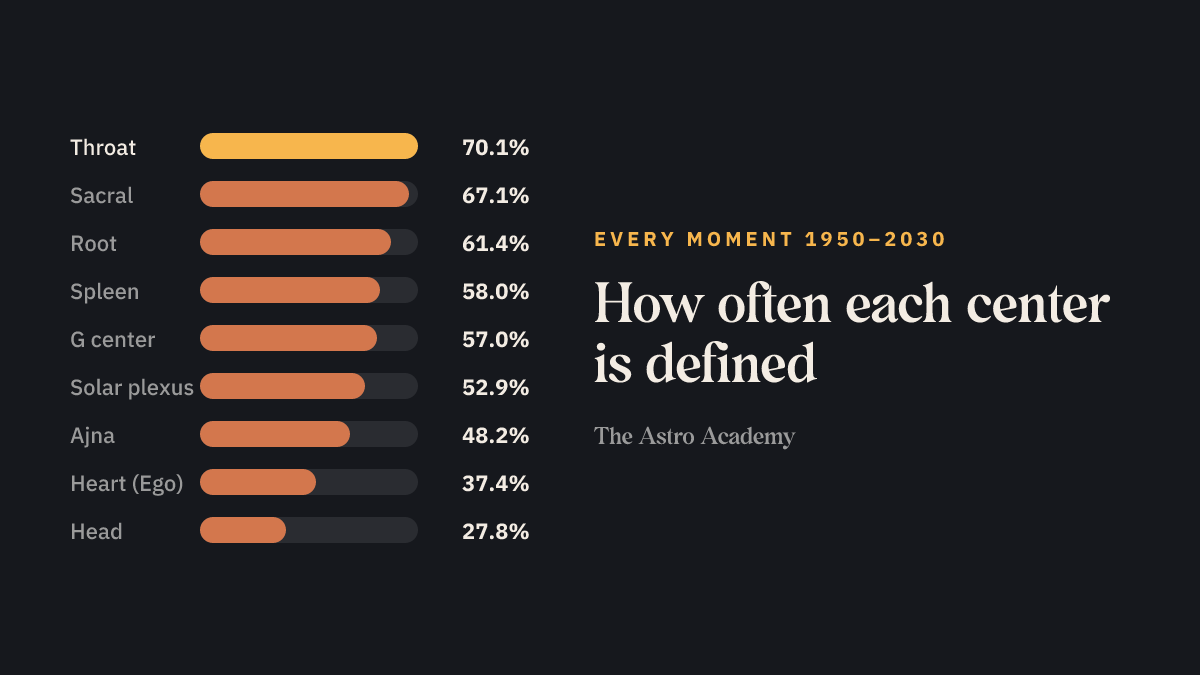
| Center | Defined | Open |
|---|---|---|
| Throat | 70.1% | 29.9% |
| Sacral | 67.1% | 32.9% |
| Root | 61.4% | 38.6% |
| Spleen | 58.0% | 42.0% |
| G center | 57.0% | 43.0% |
| Solar plexus | 52.9% | 47.1% |
| Ajna | 48.2% | 51.8% |
| Heart (Ego) | 37.4% | 62.6% |
| Head | 27.8% | 72.2% |
Every moment from 1950 to 2030 counts equally (98,389 charts, 7 hours 13 minutes apart), no birth registers. Swiss Ephemeris, the same rules as the calculator: true lunar node, Design at 88 degrees of solar arc.
More about Human Design
Building blocks
- Human Design 2027
- Authority
- The nine centers
- Incarnation cross
- Compatibility chart
Questions about the centers
- What are open centers in Human Design?
- You can spot open centers by the white areas in your Human Design chart. You don't have a consistent way of handling those themes yourself there, but you strongly pick up on others' energies and often feel them much more intensely. On average, 4.2 of the nine centers are open.
- What does a defined center mean?
- You recognize a defined center in your Human Design chart by its color, because it's firmly connected to another center by at least one complete channel. In this area of your life, you usually show a very distinct, consistent way of dealing with things. Others experience you in this way again and again, so you're known for exactly that.
- How many centers are there in Human Design?
- There are nine of these energy centers: Head, Ajna, Throat, G center, Heart, Sacral, Spleen, Solar Plexus, and Root. Four of them are motors that provide drive. Three are awareness centers. Two are considered pressure centers, with the Solar Plexus and Root each having two functions at once.
- Is it bad to have a lot of open centers?
- No, open centers in your Human Design chart aren't a weakness. Think of them more like open windows inside you, making you really sensitive to the energies and moods all around you. Many who have these centers often develop a keen intuition for people and places. It's smart, then, not to make decisions when you feel pressure from these open areas.
- What is the difference between open and undefined centers?
- Human Design texts sometimes differentiate between an undefined center, which is white and shows individual active gates, and a completely open center, which has no defined gates at all. In daily conversation, though, these two terms are often used interchangeably. For many people, they describe the same thing: a center that doesn't have a full channel.
Your centers from your birth data
Enter your birth data to see which of your nine centers are defined and which are open. The calculator is free, and there's no sign-up.
Show my centersFree, no sign-up.