
Free · no sign-up · in seconds
Human Design: meaning, types and basics
Get your type, authority and profile from your birth data.
Human Design is a system that creates a personal chart from your birth date, exact time, and place. This chart is like a very individual map for you, with nine centers, 36 channels, and 64 gates. It connects astrology with the ancient Chinese I Ching, as well as ideas from the chakra system and the Kabbalah. Here you'll find everything important to get started: where it comes from, how your chart is created, what type, authority, and profile mean for you, and what questions critics ask.
Contents

Video · 38 seconds
Your inner manual
Human Design is a system that shows you your personal style for making decisions. It's based on your Type, your Authority, and your Profile. Calculate it for free: theastroacademy.com
Read along
There is a personal user manual just for you. It's calculated from your birth data. Human Design doesn't show your future. It shows your personal style for making decisions. Your Type describes how you best interact with the world around you. Do you initiate or respond? Your Authority is your most reliable guide. Do you have a gut feeling or need to talk it through? This is an invitation to observe yourself. What part of this feels familiar to you? Find out your Type and Authority for free at theastroacademy.com.
What a Human Design chart is made of
The five types
Generator, Manifesting Generator, Projector, Manifestor and Reflector, with their strategy and signal.
See the typesAuthority
What you can listen to when you decide, from emotional to lunar.
See authorityThe twelve profiles
Two numbers from the lines of your two Suns, each one a role.
See the profilesThe nine centers
What defined and open mean, from the Head to the Root.
See the centersIncarnation cross
Four gates from your two Suns and Earths as a life theme.
See the crossCompatibility chart
Two charts on top of each other: which channels you form only together.
See the compatibility chartWhat is Human Design?
Human Design, also known as the Human Design System, is like a personal roadmap. It uses your birth information to create a visual map with nine energy centers. This map clearly shows you how you can make good decisions and use your energy in a way that feels right for you. It's a suggestion for you to explore curiously in your own life.
- Astrology: It's based on planet positions, just like with a birth chart. But zodiac signs and houses don't play a role in it.
- I Ching: The old Chinese Book of Changes has 64 symbols, called hexagrams. Each one has six lines, and these appear in the Human Design chart: as 64 gates, each with six lines.
- Centers: The nine centers in your Human Design chart might remind you of the chakras from Indian tradition. There are seven energy points there; in Human Design, nine areas in the body are distinguished.
- Kabbalah: The network of channels connecting the centers looks a lot like the Tree of Life, a well-known diagram from Jewish mysticism.
In the end, you get a picture called a “Human Design chart”: colored and white centers connected by many lines. Many people feel unsure where to start when they first see it. That's why this text takes you from the big picture to the details.
Where Human Design comes from
Human Design is still a very young system. It began in 1987 on the island of Ibiza. The Canadian who started it had worked in advertising and as a magazine publisher before then.
| Feature | Detail |
|---|---|
| Founded | 1987, on Ibiza |
| Founder | Alan Robert Krakower (Ra Uru Hu), 1948 to 2011 |
| Sources | astrology, I Ching, chakra system, Kabbalah |
| Chart building blocks | 9 centers, 36 channels, 64 gates with 6 lines each |
| Types | 5 |
| Profiles | 12 |
Before dedicating himself to Human Design, Krakower, born in 1948, was a person of many talents. He said the entire system came from an experience he had in 1987, which lasted eight days and felt like a revelation to him. He shared this knowledge until his death in 2011. Today, many different schools and teachers carry it forward, sometimes using their own terms.
How your chart is calculated
Your Human Design chart, your personal Human Design chart, comes from two special moments. There’s your birth, naturally. But there’s a second one, about three months earlier: the exact moment the Sun was 88 degrees earlier in the zodiac. That can be 87 or even 92 days, depending on the time of year, because the Sun moves a little bit faster around January.
- For the moment of your birth, the system works out 13 points: the Sun, the Earth, the Moon, the Moon’s north and south nodes, and the eight bodies from Mercury to Pluto. This side is called the Personality.
- Then it goes back to the moment the Sun was exactly 88 degrees behind and adds 13 more points. That set is the Design side.
- Each of the 26 points lands in a gate. The wheel of 64 gates cuts the zodiac like a pie into equal slices of 5.625 degrees.
- Every gate holds six lines, each just under one degree wide. The line of your Sun on each side later becomes your profile.
- If both gates of a channel are active, the channel counts as defined, and so do the two centers it connects. Those centers decide your type and authority.
The exact birth time is really important here. That’s because the Moon moves on very quickly, and the Personality Sun changes its line every day. So your individual profile always depends on the exact time of your birth. Your Human Design type, however, is set all day on 62.4% for every birthday. With the Human Design calculator, you can easily find out which parts of your chart are fixed and which depend on your precise birth time.
The building blocks of your chart
Your chart is made up of eight building blocks that build on each other step by step. For your everyday life, the first three are all you need; everything else is just fine-tuning.
- Type: This is how your energy comes across to others. There are five Types, and each one works in its own distinct way.
- Strategy: Your personal rule of thumb that shows you the best way to take new steps. For the Generator, for example, that's “wait to respond.”
- Authority: This is your very personal way of feeling what's right for you. Whether you rely on your gut feeling or prefer to sleep on it for a night, your Authority in Human Design shows it to you.
- Profile: Two numbers from 1 to 6 from your Sun's lines together describe your very personal role. All 12 Profiles are waiting for you to discover them.
- Centers: Nine areas that can be either defined (colored) or open (white). You can read what that means for you in the section on the nine Centers.
- Channels: These are the 36 connections that link two centers together. A channel is defined when the gates at both its ends are active.
- Definition: This shows how your defined centers are connected. The most common is the split definition with 47.3%, meaning two groups that aren't directly linked.
- Incarnation cross: The four gates of Sun and Earth on both sides of your chart. They're read as your life theme. You can find out more about your Incarnation cross there.
A Human Design chart has on average 3.5 defined channels and 4.2 open centers. Many people wonder about all the white in their chart, but that's actually the normal case.
The five types at a glance
Knowing your Human Design type is a first step to discovering this system for yourself. It depends on two very simple questions: Is your Sacral center defined, and is one of your motor centers connected to the Throat center? And if you notice that none of your centers are defined, then you're a Reflector.
| Type | Strategy | Signal when it fits | Signal when it doesn’t | Share |
|---|---|---|---|---|
| Generator | Wait to respond | Satisfaction | Frustration | 35% |
| Manifesting Generator | Respond, then inform | Satisfaction and peace | Frustration and anger | 32.1% |
| Projector | Wait for the invitation | Success | Bitterness | 21.7% |
| Manifestor | Inform before you act | Peace | Anger | 10.3% |
| Reflector | Wait a lunar cycle | Surprise | Disappointment | 0.9% |
This signal acts like a little alarm inside you, drawing your attention to something. If you feel frustration or bitterness building up in you over a week, for example, that's a valuable clue in Human Design. It can help you try out your type's strategy more consciously. The shares mentioned here come from our count of many birth moments with the Swiss Ephemeris.
Nine centers: defined or open
In Human Design, a defined center is like a reliable source that's always there. An open center, on the other hand, takes in what comes from outside. Neither is better nor worse; they're just different.
| Center | Theme | Share defined |
|---|---|---|
| Head | Questions and inspiration | 27.8% |
| Ajna | Thinking and making sense | 48.2% |
| Throat | Speaking and doing | 70.1% |
| G center | Direction and sense of self | 57% |
| Heart (Ego) | Willpower and self-worth | 37.4% |
| Sacral | Life force and work energy | 67.1% |
| Spleen | Gut instinct and wellbeing | 58% |
| Solar plexus | Feelings and moods | 52.9% |
| Root | Pressure and drive | 61.4% |
If you have an open Solar Plexus center, for example, you often feel the mood in a room much more clearly than your own. For your open centers, check if such feelings seem familiar to you. You can read more about this on the page about the centers in Human Design.
Human Design for beginners: where to start
Start gently with your Human Design Type and watch yourself for two weeks. That’s the best foundation for everything that comes next.
- Calculate your chart with the most exact birth time you can get. It’s often on your birth certificate.
- Read just your type and strategy at first. Then try the strategy for two weeks on small stuff, like plans or shopping.
- Keep an eye on your type’s signal. Which days felt satisfying, and which ones left you frustrated?
- When a real decision comes up, bring in your authority and compare it with how you usually decide.
- Next, look at your open centers. Where might you be picking up pressure or moods from others?
- Leave profile, channels and cross for last. Jot down what fits and what doesn’t, so you can compare honestly later on.
Many read their entire Human Design chart on the first evening and often feel pretty confused afterward. Taking it slower usually makes it easier.
Human Design vs. the birth chart
Both Human Design and astrology look at the same planet placements when you were born. But they speak different languages to make sense of them. While your birth chart interprets signs, houses, and planet angles, Human Design takes those same sky pictures and turns them into gates and centers.
| Feature | Birth chart | Human Design |
|---|---|---|
| Moments | one: your birth | two: birth and the Design moment |
| Division | 12 signs and 12 houses | 64 gates with 6 lines each |
| Points | planets, Ascendant, house cusps | 13 per moment, Earth included |
| Result | planets in signs and houses, aspects | type, authority, profile, centers, channels |
| Birth time | needed for the Ascendant and houses | needed for the Moon and points near a gate edge |
If you place both systems side by side, you often discover surprisingly similar themes. Your birth chart offers you the classic interpretation, and with the calculator for Sun, Moon, and Ascendant, you quickly see your three most important cornerstones.
Is Human Design real or scientific?
Many people wonder if Human Design is scientific. No, there's no scientific proof that your type, authority, or centers can describe you or predict your future. It's an interpretive system you can explore for yourself or simply disregard.
- Origin: Because this system is based on just one person's experience, and you can't repeat the observations.
- Terms: The teaching talks about tiny Neutrinos that are said to shape you as they pass through your body. But there's no physical proof for that.
- Recognition: General descriptions fit so many people. Psychology calls this the Barnum Effect, and it works the same way for horoscopes and personality tests.
- A fair view: Still, many people find their Human Design chart acts as a helpful list of questions. This experience proves nothing, but for them, it's absolutely real, a feeling that's simply there.
Perhaps the most honest way to see your chart is as a hypothesis. You read a description. Then, over a few weeks, you just observe yourself in your daily life and decide for yourself what really works for you.
What Human Design is not
Human Design isn't an oracle that tells you what will happen. Instead, it holds up a mirror for you, where you can find questions for yourself.
- Not a diagnosis: If your Splenic center is open, that doesn't tell you anything about your health. If you have physical complaints, it's always important to seek medical or therapeutic help first.
- Not a prediction: Your chart shows you your predispositions. It doesn't tell you exactly what life will bring.
- Not a box: Your Human Design Type is never a reason to reject someone, whether it's in your job or in personal relationships.
- Not a rulebook: Your Human Design Strategy and Authority are like a helpful guide you can try out. If something doesn't quite feel right for you, you don't have to stick with it.
Where to go next
Once you get a better feel for your own Human Design chart, two questions often come up: the big cycle shift in 2027 according to Human Design, and how two charts connect with each other.
- 2027: According to Human Design teachings, a long global cycle that's been running since 1615 ends in 2027. You can find out what the system says about this, and which of the four new gates are active in your chart, on the Human Design 2027 page.
- Relationships: When you layer two charts over each other, often entirely new channels show up. Neither of you has these channels alone. The Human Design Partner Chart shows you how this works.
- Types in detail: Each type has its very own page. On that page, you can learn all about your type's strategy and signature, like for the Projector.
How often is a chart split?
In 47.3% of all charts, you can see the defined centers divide into two separate groups; that’s called split definition in Human Design. Only 38.8% of all charts show a single, firmly connected group of centers. On average, you find 3.5 defined channels in a Human Design chart.
A triple split appears in 12.2% of all charts, and a quadruple split in 0.7%. No definition, meaning you're a Reflector, appears in 0.9% of all charts. Many with a split definition know the feeling very well that another person can build exactly the bridge they're still missing on their own.
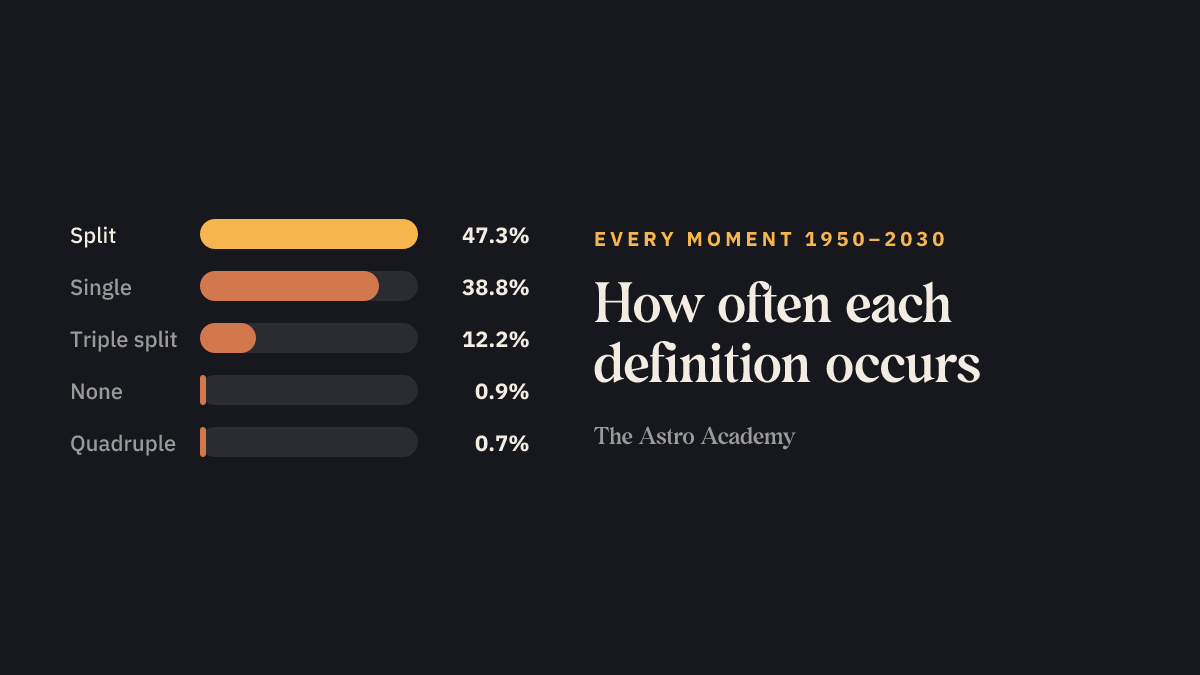
| Definition | Groups | Share |
|---|---|---|
| Split | 2 | 47.3% |
| Single | 1 | 38.8% |
| Triple split | 3 | 12.2% |
| None | 0 | 0.9% |
| Quadruple | 4 | 0.7% |
Every moment from 1950 to 2030 counts equally (98,389 charts, 7 hours 13 minutes apart), no birth registers. Swiss Ephemeris, the same rules as the calculator: true lunar node, Design at 88 degrees of solar arc.
Start with your own chart
Enter your birth data and start with just your type and strategy. You can add the rest whenever you like.
Calculate your chartFrequently asked questions
- What is Human Design in simple terms?
- Human Design is an interpretation system that uses your birth data to create a kind of map, your chart with nine centers. It combines astrology with the Chinese I Ching and gives you hints about how you might make better decisions and how to handle your own energy well. You can then quietly check these ideas for yourself in your everyday life.
- Is Human Design real?
- No, there isn't a single study proving that your Type, Authority, or centers mean something specific about you. This system goes back to one man's experience in 1987. But many people use it as a nice nudge to observe themselves.
- Who created Human Design?
- A former Canadian advertising professional started this system. He reported a special experience on Ibiza in 1987, from which Human Design emerged. He shared his insights with the world until his passing in 2011.
- Is Human Design the same as astrology?
- Both systems look at the planets' positions at your birth. But Human Design adds a second point in time, about three months before you were born. The planets aren't interpreted through zodiac signs and houses, but rather read through the 64 gates of your Human Design chart.
- What is the rarest Human Design type?
- The Generator makes up the largest part of all charts, at 35%. The Manifesting Generator follows with 32.1%. The Reflector is the rarest at 0.9%, because they don't have a single defined energy center in their chart.
- Can I get my Human Design chart without a birth time?
- Yes, you can, but with some limits. Without an exact birth time, the calculator goes through all hours of the day and shows you what information is reliably fixed. Your type is the same all day for 62.4% of all birthdays, but your profile and inner authority might change.
More about Human Design
Start
- Human Design: the basics
- Human Design chart calculator