
Free · no sign-up · in seconds
Human Design compatibility: your composite chart
Your birth data, then the other person’s.
If you're curious about a Human Design partnership, it's easy to layer two charts: yours and the other person's. That creates something brand new. It's a third chart, revealing the special traits of your bond. You'll see channels in it that neither of you has on your own. Centers that only find their clear definition when you look at both charts together will also appear. Just enter both of your birth dates. Then you'll see where you naturally attract each other and where one person might influence the other. Your partnership chart offers nice points to discuss, but no fixed judgments about your relationship.
Contents
Your shared chart in three steps
Enter two sets of birth data
Yours and your match’s, with time and place if you have them.
Two charts
Birth and Design for each person with the Swiss Ephemeris.
Lay them together
Which channels form only as a pair, which centers do you define together?


Video · 34 seconds
Your third chart
In Human Design, you can layer two charts to understand your relationship dynamic. The result isn't a verdict, but a map for good conversations. Calculate it for free: theastroacademy.com
Read along
Your relationship has its own Human Design chart. It only appears when you are together. Imagine two transparencies. Each one holds part of a drawing. Only when you lay them on top of each other can you see the full picture. It works the same way with your two charts. Together they create a third, shared one. This shared chart shows you topics for good conversations. It is not a verdict, but an invitation to talk. See what connects you. Work it out for free at theastroacademy.com.
How a composite chart works
A Human Design partner chart, often called a Composite, takes two people's active gates and puts them together in one chart. That's how you see which channels and centers really come alive only through your connection.
- First, each person gets their own chart: birth and Design moment.
- Then the active gates from both charts go into one diagram.
- If both gates of a channel are now active, it counts as defined in the composite, even when each gate comes from a different person.
- Last, each of these channels gets sorted into one of the four kinds of connection.
The four kinds of connection
In Human Design, there are four ways two people can experience a channel together. Each of these connections brings its very own dynamic to your relationship.
| Kind | Who has what | What the teaching sees in it |
|---|---|---|
| Electromagnetic | Each person has one gate of the same channel | attraction and friction: together you form what neither has alone |
| Companionship | Both have the same full channel | shared ground where you understand each other without many words |
| Dominance | One has the full channel, the other neither of its gates | one person shows the other this theme, and the other takes it in |
| Compromise | One has the full channel, the other one of its gates | the full channel usually wins, and the person with the single gate tends to give way |
Especially in partnerships, you often experience how the energy of sparks and friction works together in electromagnetic channels, bringing up common themes.
Centers defined only together
When your connection creates a new channel, the two centers at its ends also become defined in your partner chart. This means even a center that was open for both of you can suddenly get a shared color.
- Example: If one person has Gate 34 and the other has Gate 20, the Channel of Charisma forms between the Sacral and Throat centers. Both centers are then defined together, a shared power source.
- Defined together: In these areas, many couples feel a surprising stability and strength they might not have known alone, like more drive or a new clarity in conversation.
- Open in both: If a center stays white in the partner chart, you both tend to take on the themes of that area from your surroundings. An open door, you could say.
- Defined in one person: Here, one side clearly shapes the other. Whoever has the center open often feels their partner's energy there much more strongly than the partner themselves perceives it, an interesting dynamic.
You can find out exactly what each of these areas means in detail on the page about the centers in Human Design.
Both strategies side by side
Every Human Design Type has a particular strategy that carries them through life. When you interact with others, these strategies often come together. And when you know how others operate, it just makes some friction easier to understand.
| Type | Strategy | What often helps the other person |
|---|---|---|
| Generator | Wait to respond | asking concrete questions that allow a yes or no |
| Manifesting Generator | Respond, then inform | living with changes of pace and asking for quick heads-ups |
| Projector | Wait for the invitation | asking outright for their advice and their view |
| Manifestor | Inform before you act | giving them room and getting a heads-up in return |
| Reflector | Wait a lunar cycle | allowing about a month for big decisions |
Take a couple, for instance, with a Projector and a Generator. The Generator waits to respond to something. The Projector, though, waits to be invited. Many people find things get smoother when the Generator simply asks, “How do you see this?” Then the Projector can answer, and both feel heard.
What a composite can tell you
Your partner chart shows you what topics connect the two of you or what you can talk about easily. But it alone won't tell you if you actually fit together.
- What it can do: Here, you can see exactly where things might spark between you two, or where they might rub each other the wrong way. It's a great starting point for an honest conversation.
- What it can’t do: It won't predict if a relationship will last, who is right, or whether you'll go your separate ways.
- Not a substitute: When things get really tough, an open conversation or professional couples counseling helps way more than any Human Design chart.
- Not a score: Having many shared channels doesn't automatically make a relationship better, and fewer channels don't mean less connection.
How to use your composite
When you explore your composite chart with someone, that's when it shows its greatest value. And following this specific order can really help you with that.
- Enter both sets of birth data, ideally with times. If a time is missing, some gates stay open.
- Start with your types and strategies, then talk about what each of you needs day to day.
- Look for the electromagnetic channels. Where do spark and friction show up in the same spot for you two?
- Check dominance and compromise. Where does one of you tend to set the tone?
- Read the centers you define together, and notice what comes easier to you as a pair.
- For the classic view as well, put a synastry chart next to it.
Your very own chart, this wonderful map of what you're made of, is waiting for you in the Human Design chart calculator. You can find the most important first steps for this on the What is Human Design page.
How often does a connection form?
In our count, at least one electromagnetic channel forms in 95.6% of all pairs of calculated birth moments, and on average even 3.2 per pair. Do you notice how you naturally complete each other in conversation, almost by itself? This completion is more the rule than the exception.
A whole, jointly shared channel is rarer, like two best friends on the same wavelength: That happens in just 30.2% of pairs. And in 60.3%, an entirely new center even forms that neither of you had alone.
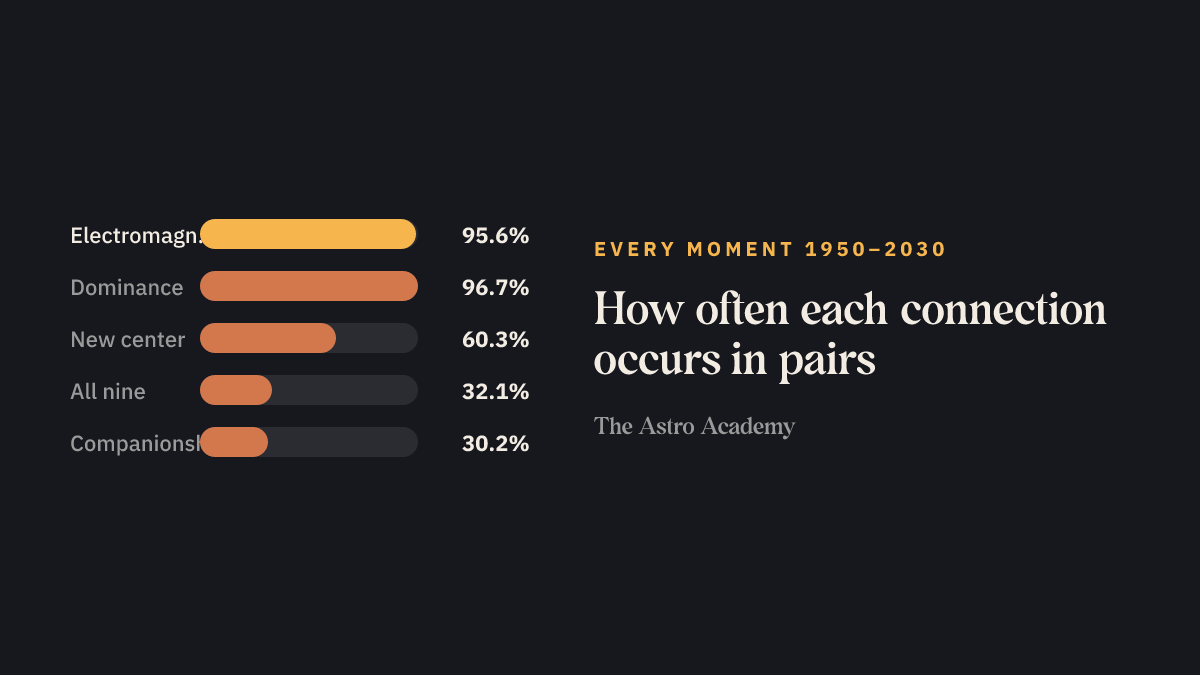
| Connection | Meaning | Share of pairs |
|---|---|---|
| Electromagnetic | At least one channel, where each side has a gate | 95.6% |
| Dominance | One person has a whole channel, the other has neither of the two gates | 96.7% |
| New center | A center is defined only together | 60.3% |
| All nine | Together all nine centers are defined | 32.1% |
| Companionship | Both have the same whole channel | 30.2% |
Every moment from 1950 to 2030 counts equally (98,389 charts, 7 hours 13 minutes apart), no birth registers. Swiss Ephemeris, the same rules as the calculator: true lunar node, Design at 88 degrees of solar arc. For pairs: 20,000 random pairs of these charts.
More about Human Design
Building blocks
- Human Design 2027
- Authority
- The nine centers
- Incarnation cross
- Compatibility chart
Questions about the compatibility chart
- Which Human Design types are compatible?
- In Human Design, no relationship is off-limits; each one has its own beauty. It helps you to know the other person’s strategy. For example, a Projector needs to wait for the invitation. Many Generators know best what feels right when you ask them a clear yes or no question. That makes your interactions much smoother.
- What is an electromagnetic connection in Human Design?
- This is a special kind of channel: each person brings one of the two gates, and only together is it complete. Human Design often describes this as a strong attraction, but it can sometimes lead to friction.
- Can Human Design tell if a relationship will last?
- Your partner chart simply describes the themes and dynamics that come up between you, not a fixed future. Whether your connection lasts is entirely up to you and your shared experiences together.
- How is a Human Design composite different from synastry?
- A partnership horoscope, often called synastry, compares the planetary positions of two charts through aspects. In the Human Design composite chart, you see how your gates overlap and which channels and centers connect anew because of that. For both views, your birth data are key.
- Do I need my partner’s birth time?
- For an accurate result, you'll need the birth time, especially for the Moon. Without it, you'll see most of the gates, but individual channels will remain open, and your full picture won't be complete.
Your shared chart
Enter both sets of birth data and see which channels connect you. Then read the result together and talk it over.
Show our chartFree, no sign-up.