
Oracle spread · 3 positions
Decision oracle: a clear look at your choice
Decision oracle
Focus on your question and draw all three cards.
3 cards to go.

Video · 34 seconds
Make your next choice
When you're facing a tough choice, an outside perspective can help. This oracle acts as a mirror for your own feelings about two specific paths. Calculate it for free: theastroacademy.com
Read along
Facing a choice and wishing for a clear sign? The cards are only a mirror. They show you what you already think about your options. That is why the most important step happens before you draw. You have to clearly name Path A and Path B. Then you draw three cards. One for each path, and one for the advice in the middle. The middle card is not a tie-breaker. It points to an attitude that helps you most right now. Try the oracle for free at theastroacademy.com.
Contents
This free decision oracle helps you weigh two options. You'll get one card for each path and a third card for advice, which gives you a fresh look at your situation. The reading acts like a mirror, showing you your own thoughts and feelings about the choice you're facing.
Three cards for your decision
It all starts with your question.
- Name paths: Before you draw, you need to clearly name the two different paths you're thinking about, calling one Path A and the other Path B. When you're ready, the tool will show three cards: the first is about your feelings for Path A, the second for Path B, and the third in the middle gives general advice. Getting your options clear is the most important step.
- Path examples: For example, instead of a general idea like “career change,” your Path A could be “staying at my current job for another year,” and Path B could be “starting my own small business.” This clarity makes the cards' reflection much more useful and specific to you.
| Card | Position | Meaning |
|---|---|---|
| First | Path A | feelings for Path A |
| Second | Path B | feelings for Path B |
| Third | Middle | general advice |
The cards come from our 40-card angel oracle deck. Each card has a theme that helps you think. We use angels as a symbol of care and support, no matter what you believe.
How to understand the center card
The middle card gives you a theme to think about for the whole situation. It's not there to break a tie or tell you what to do. Instead, it points to a quality, attitude, or situation that could be good to remember as you make your choice.
- Rest card: For instance, imagine you're picking between two vacation spots, and the advice card you draw is Rest. This suggests that truly needing some downtime might be a big factor.
- Ask yourself: You can then ask yourself which option would honestly give you more peace and recovery, beyond just what looks fun on the surface.
- Trust card: If the advice card was Trust, it might make you look at any worries you have about either path. It could be an encouragement to trust your own preparation or to have faith that things will work out, no matter which way you go.
The advice always relates to how you approach the decision inside yourself.
When both options seem positive
Sometimes this oracle for decisions shows two appealing cards, one for each path. This often means both options have good sides or could lead to good things for you.
The reading isn't meant to find one right answer, but to help you explore your own feelings. When this happens, look closely at the different themes.
- Friendship card: Let's say Path A shows the Friendship card and Path B shows the Growth card. Neither is automatically better. The question then becomes personal: what do you feel you need more of in your life right now?
- Growth card: Is it connection and community, or is it personal development and new challenges? This kind of result shows how the cards reflect your inner world. They don't make the choice for you. They just clarify what each option might mean to you on a deeper level, helping you connect with your own priorities.
The oracle shows, it doesn't decide
An oracle reading works best as a tool for self-reflection. The cards you draw act like a mirror, showing you different parts of your own thoughts, hopes, and fears about the decision you face. The final choice is always yours.
- Pay attention: Pay attention to your first, gut reaction when you see the cards.
- Ask yourself: Did one of the cards feel more right, more comforting, or more energizing than the other? These gut feelings are a valuable part of the process and contain information about what you truly want.
- Use the reading: Use the reading as a starting point for deeper thought, not as a final answer.
- Write down: You can always write down the cards and your thoughts in a notebook.
- Look back: Looking back on these notes later can often show you patterns in how you approach choices in your life.
The positions at a glance
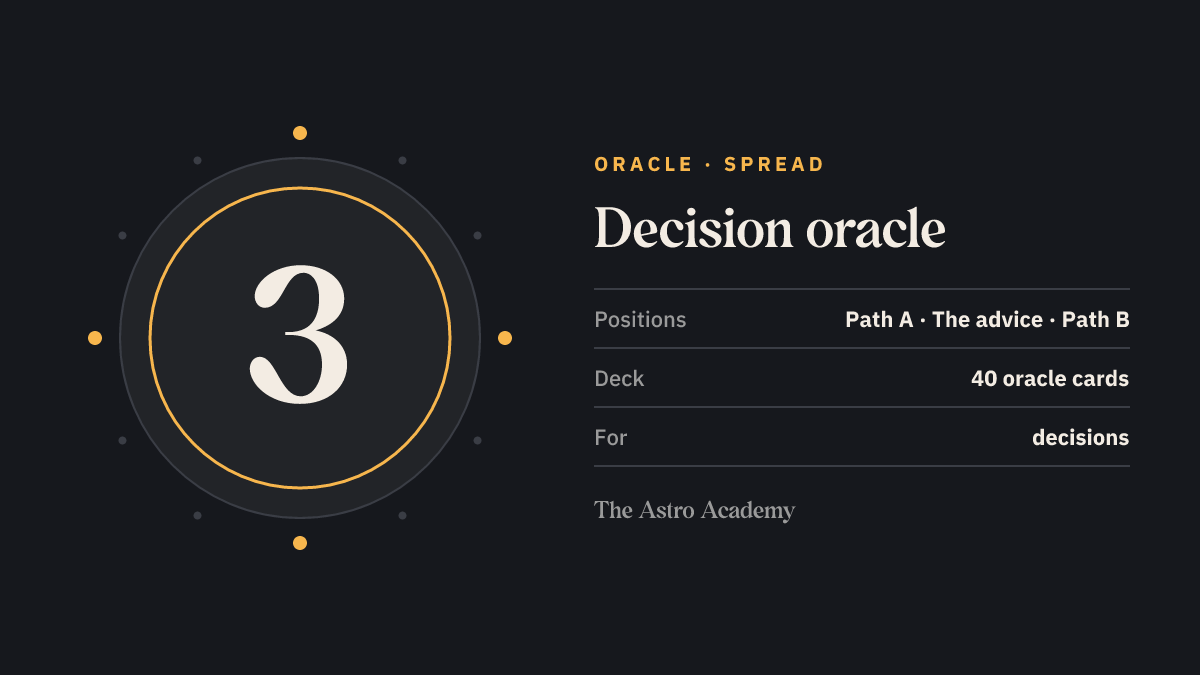
“Decision oracle” has 3 positions. Each one asks the card lying there its own question.
| No. | Position | Guiding question |
|---|---|---|
| 1 | Path A | What does path A bring you? |
| 2 | The advice | What should you watch for? |
| 3 | Path B | What does path B bring you? |
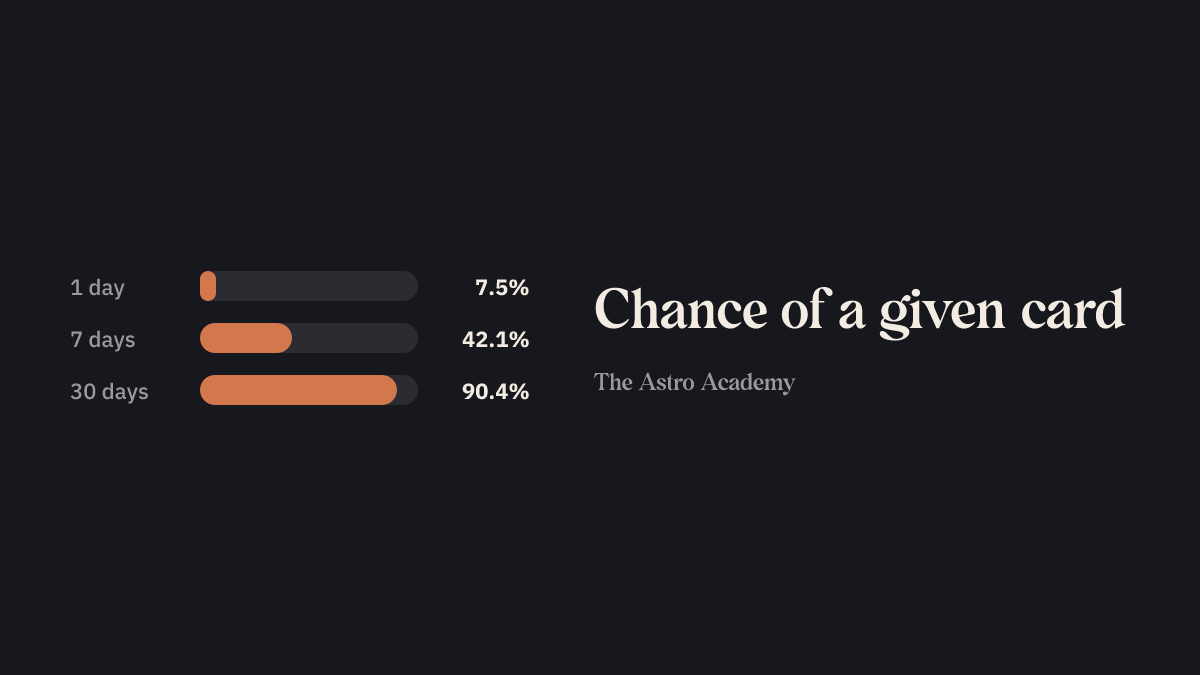
How often does a given card turn up in “Decision oracle”?
With 3 cards out of 40 Oracle cards, every single card is in your spread with 7.5 %. Lay it every day for a week and a given card shows up at least once with 42.1 %, within a month with 90.4 %.
Until you have seen each of the 40 cards at least once takes 55.9 days on average. The last missing cards take the longest, because fewer new ones are left each day.
| Case | Value |
|---|---|
| Cards in the deck | 40 |
| Cards in the spread | 3 |
| Chance per card and spread | 7.5 % |
| At least once in 7 days | 42.1 % |
| At least once in 30 days | 90.4 % |
| Two given cards on consecutive places | 0.26 % |
| Days until every card was laid once (mean) | 55.9 |
Pure probability: every card equally likely, every spread freshly shuffled, no card twice in one spread. The mean until every card was laid is computed exactly over all intermediate states.
Frequently asked questions
- What kind of questions work best for a decision oracle?
- The best questions involve a clear choice between two defined paths. For example, “Should I focus on project A or project B this month?” works better than a vague question like “What should I do with my life?” Being specific helps you get a clearer reflection from the cards.
- Can I use this oracle for decisions about other people?
- This reading is designed to reflect your own feelings and options. It can't tell you what someone else thinks or will do. You could, for example, ask about your path in a relationship, such as choosing between “speaking up” versus “waiting,” but not “Will they call me back?”
- What if I don't like the cards I drew?
- An uncomfortable card can be a prompt to look at a fear or a challenge connected to that path. It doesn't mean the option is bad or doomed. Consider what part of that card's theme might be something you're worried about or have been trying to ignore.
- How often can I ask the same question?
- It's usually best to sit with a reading for a while before asking the same question again. Constantly repeating it on the same day can create more confusion. Give yourself time to think about the themes the cards brought up and see how they feel after a day or two.
- Is this the same as a yes or no oracle?
- No, this is an oracle for decisions between two distinct paths, giving you more detail than a simple yes or no. A yes or no oracle gives a direct binary answer based on chance. This spread provides themes for reflection to help you weigh your options more thoughtfully.