
Kipper card · #33 / 36
Gloomy thoughts: Kipper card meaning
- Worry
- Brooding
- Sadness
- Doubt
- Pessimism

Video · 31 seconds
Your thoughts on repeat
The “Gloomy Thoughts” Kipper card isn't a bad omen. It's a mirror for worry, doubt, and feeling stuck. This video explains the card's simple advice for clarity. Calculate it for free: theastroacademy.com
Read along
Do you keep replaying a tough conversation in your head? A Kipper card called “Gloomy Thoughts” captures this exact feeling. It's like looking out of the window on a rainy day, deep in thought. This card says nothing about what will happen. It simply mirrors how you feel right now. This is an invitation to step out of your head. Try opening a window just to feel the air on your face. Find the card's full meaning at theastroacademy.com.
Contents
Gloomy thoughts in one sentence
Gloomy thoughts reflects a state of mind marked by worry, doubt, or a pessimistic outlook. It points to a period of being caught in a loop of negative thinking that colors your view of the world.
| Feature | Gloomy thoughts |
|---|---|
| Number | 33 of 36 |
| Keywords | Worry, Brooding, Sadness, Doubt, Pessimism |
| Yes or no | leaning no |
| Timing | This card does not indicate a specific timeline, as it represents a state of mind that can last as long as one chooses to dwell in it. |
| In love | For relationships, this card might show insecurity, jealousy, or doubts about where things are headed. |
| Work & money | When it comes to your career, Gloomy thoughts can mean you're unhappy with your job, anxious about how you're doing, or feel stuck with no way out. |
| Question for you | If you could set one worry aside for just one day, which one would it be? |
What the card shows
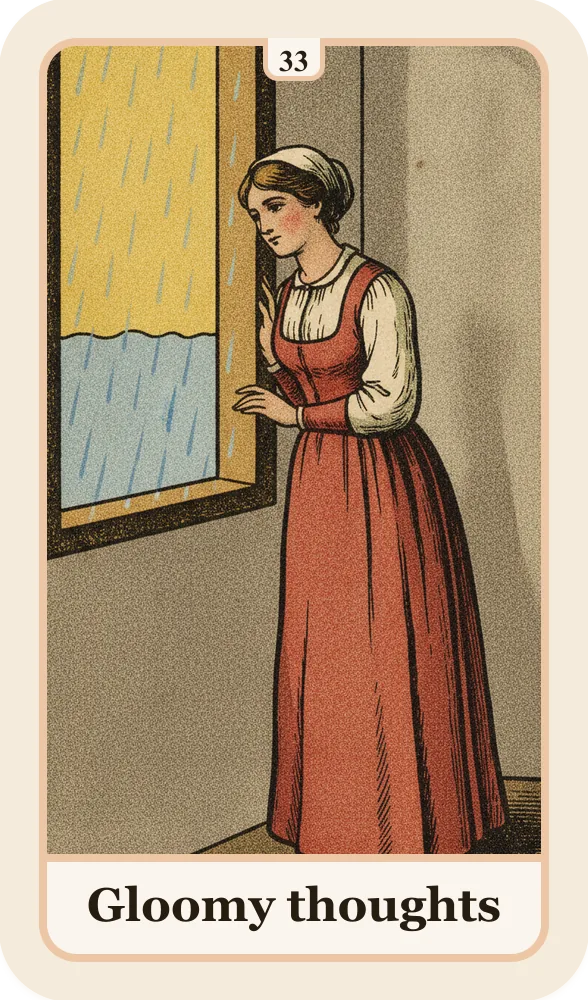
The card shows someone looking out a rainy window, deep in thought. This picture really gets at what Gloomy thoughts is about: brooding, feeling down, and tending to see the glass as half empty. It's more about how you feel inside, not something happening outside. It's about those heavy worries that hide the good things.
Maybe you keep replaying a tough talk in your head for days, always thinking it'll end worse. Or maybe you just feel down and can't get going. What thoughts are dimming your view right now?
Other cards nearby change what it means. If Great fortune is close, it might mean your worries aren't real and are stopping you from seeing your good luck. Next to High honor, it could mean you have “impostor syndrome,” where you doubt yourself even with all your successes.
Love, work and money
In love
For relationships, this card might show insecurity, jealousy, or doubts about where things are headed. If you're single, it could mean you feel negative about dating or finding love. What fear is coloring your love life outlook?
Tip: Gloomy thoughts love to circle. If you start brooding about love today, write the thoughts down and ask each one: do I know this for sure? The picture often turns friendlier then.
Work & money
When it comes to your career, Gloomy thoughts can mean you're unhappy with your job, anxious about how you're doing, or feel stuck with no way out. It points to an inner struggle with your work life, whether or not your actual situation shows it.
Tip: Gloomy thoughts love the merry-go-round. Give your work worries a fixed quarter of an hour today, write them down and then do something with your hands on purpose. Even brooding needs a closing time.
Does Gloomy thoughts say yes or no?
Leaning no. The card's heavy, unsure mood suggests now isn't the right time to move forward. You need more clarity and a better outlook before you can expect a “yes.”
What the card advises
Open a window or step outside for five minutes to feel the air on your face. Even a small change of scenery can help break a cycle of brooding.
Timing: This card does not indicate a specific timeline, as it represents a state of mind that can last as long as one chooses to dwell in it.
If you could set one worry aside for just one day, which one would it be?
How often does a given card turn up in “daily spread”?
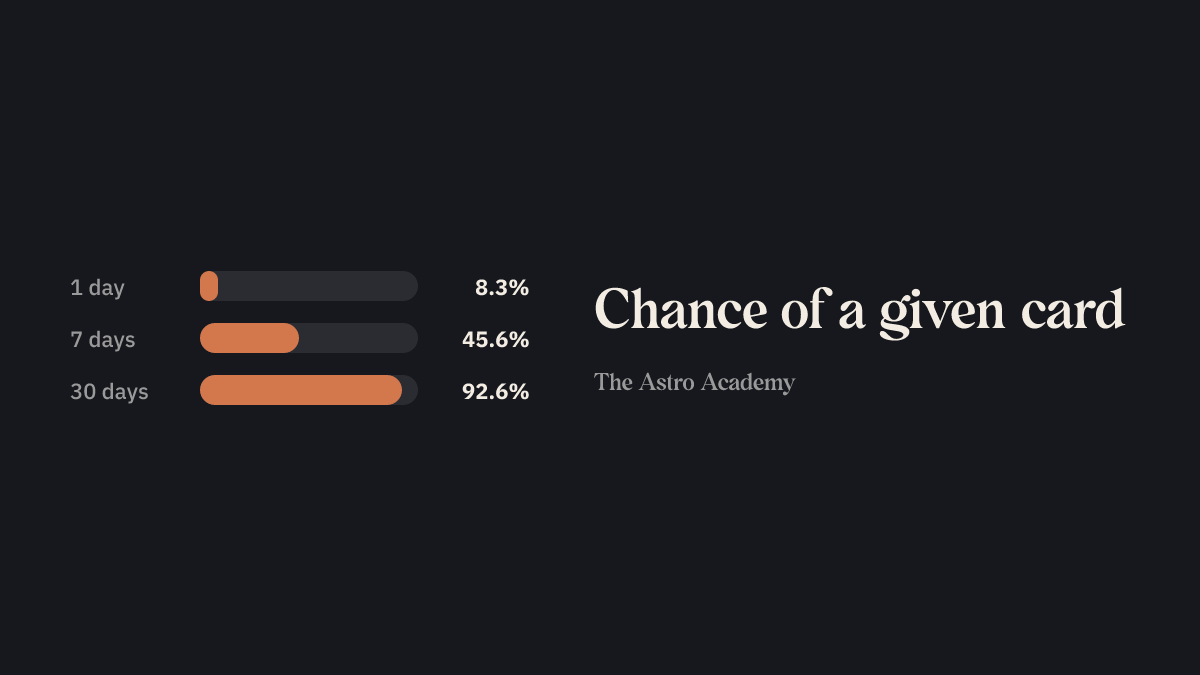
With 3 cards out of 36 Kipper cards cards, every single card is in your spread with 8.3 %. Lay it every day for a week and a given card shows up at least once with 45.6 %, within a month with 92.6 %.
Until you have seen each of the 36 cards at least once takes 49 days on average. The last missing cards take the longest, because fewer new ones are left each day.
| Case | Value |
|---|---|
| Cards in the deck | 36 |
| Cards in the spread | 3 |
| Chance per card and spread | 8.3 % |
| At least once in 7 days | 45.6 % |
| At least once in 30 days | 92.6 % |
| Two given cards on consecutive places | 0.32 % |
| Days until every card was laid once (mean) | 49 |
Pure probability: every card equally likely, every spread freshly shuffled, no card twice in one spread. The mean until every card was laid is computed exactly over all intermediate states.
In the big spread with all 36 cards, Gloomy thoughts is always there. The chance it lies in the top row is 25.0 %, that it lands exactly on its own house 33 2.78 %.
Read by me
Is Gloomy thoughts in your spread? I read it for you.
To Theresa’s readingFrequently asked questions
- Can Gloomy thoughts mean depression?
- This card points to a low mood, sadness, or a pattern of negative thinking. If these feelings are strong, last a long time, and affect your daily life, it's always a good idea to talk to a trusted friend or a mental health professional.
- What if Gloomy thoughts is surrounded by positive cards?
- This is often a sign that things are much better than your thoughts are letting you believe. It suggests your own negative mindset might be the main problem, and changing how you see things could show you the chances all around you.
- How does Gloomy thoughts affect a project?
- It suggests you might lack confidence or motivation for the project. You may be focusing too much on what could go wrong instead of what could go right. This way of thinking can lead to putting things off or even self-sabotage.